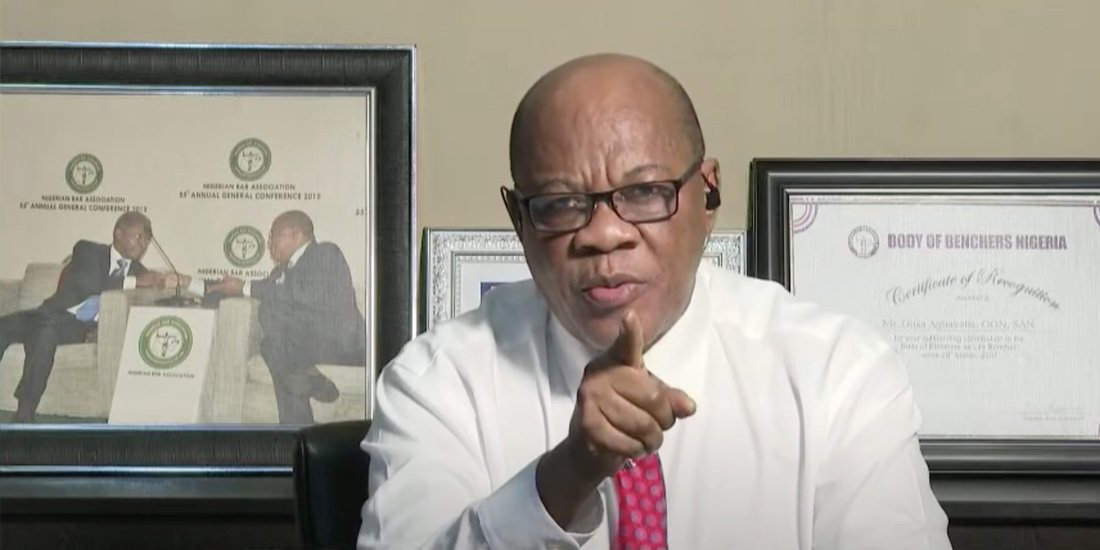
A former President of the Nigerian Bar Association (NBA), Olisa Agbakoba, has cautioned that the proposed establishment of state police could become a tool for political oppression if strong constitutional safeguards are not put in place to guarantee its independence.
Agbakoba made the submission in a letter dated June 26, 2026, addressed to the Secretary to the Government of the Federation, George Akume, in which he urged the Federal Government to use the ongoing constitutional amendment process to strengthen the autonomy of key democratic institutions.
The senior lawyer commended President Bola Ahmed Tinubu for forwarding to the National Assembly an Executive Bill seeking to amend Section 214 of the 1999 Constitution to pave the way for the creation of state police.
While describing the proposal as a significant step toward improving internal security and promoting community policing, Agbakoba warned that devolving policing powers to the states without adequate constitutional protections could expose the system to political abuse by state governments.
He argued that the experiences of State Independent Electoral Commissions (SIECs) and local government councils, which he said have largely fallen under the control of state executives, demonstrate that decentralisation alone does not guarantee institutional effectiveness.
“Devolution without institutional protection is reform in name only,” Agbakoba stated, adding that institutions lacking constitutional guarantees often become instruments of executive authority rather than independent bodies serving the Constitution and the public.
The former NBA president called for constitutional provisions that would ensure the operational independence of state police and other strategic public institutions through secure tenure for officials, guaranteed funding, and accountability mechanisms insulated from executive influence.
Drawing comparisons with South Africa, Agbakoba urged Nigeria to adopt a constitutional framework similar to Chapter 9 of the South African Constitution, which protects institutions supporting constitutional democracy from political interference.
He noted that South Africa’s constitutional model guarantees the independence of bodies such as the Public Protector, Human Rights Commission, Electoral Commission and Auditor-General through constitutional safeguards and parliamentary oversight.
Agbakoba recommended that Nigeria extend similar constitutional protection to key institutions, including the Nigeria Police Force, Independent National Electoral Commission (INEC), Economic and Financial Crimes Commission (EFCC), Independent Corrupt Practices and Other Related Offences Commission (ICPC), and the Central Bank of Nigeria.
He also advocated constitutional guarantees for the independence of the National Judicial Council, the Attorney-General of the Federation, the Accountant-General of the Federation, the National Human Rights Commission, the Code of Conduct Bureau, and the Office of the Public Defender.
According to Agbakoba, strengthening the independence of these institutions alongside the establishment of state police would help deepen Nigeria’s democracy, promote accountability and prevent the abuse of power by elected officials.