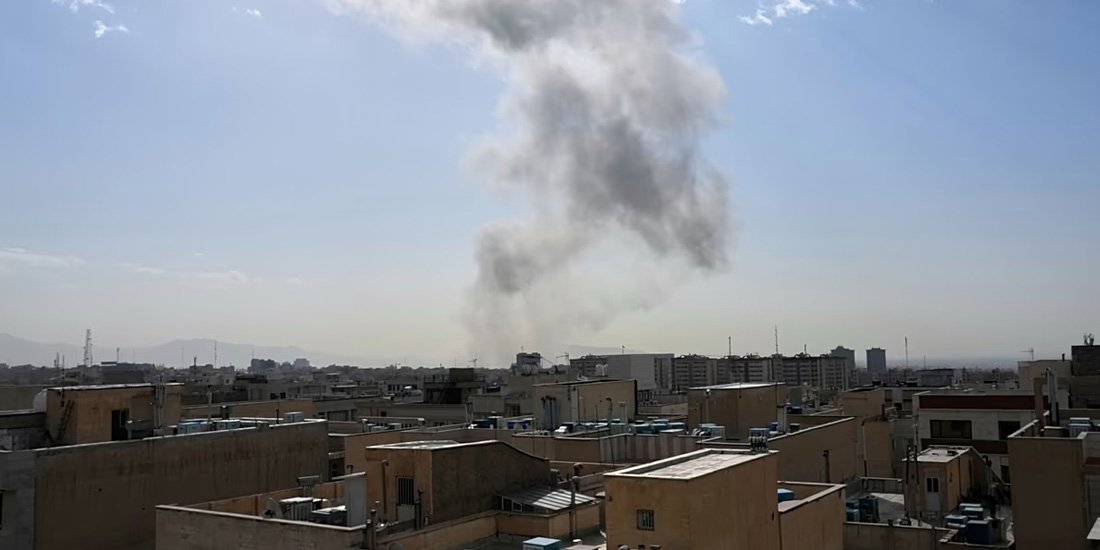
The Middle East conflict escalated sharply on Sunday after the United States launched a fresh wave of airstrikes against Iran in response to an Iranian attack on a commercial container ship in the Strait of Hormuz, prompting Tehran to retaliate with missile and drone attacks targeting several Gulf states hosting U.S. military installations.
The latest exchange of hostilities has intensified fears over regional stability and raised fresh doubts about the future of ongoing diplomatic efforts aimed at ending the conflict.
U.S. Targets Iranian Military Sites
According to the U.S. Central Command (CENTCOM), American forces struck about 140 targets across Iran, including missile and drone launch sites, ammunition depots, communications facilities and other military installations.
The military said the operation was intended to weaken Iran’s capability to threaten international shipping through the Strait of Hormuz, one of the world’s most strategic maritime routes for global oil and gas supplies.
President Donald Trump defended the strikes during an interview with NBC’s Meet the Press, saying, “We bombed the hell out of them last night.”
Iranian state-affiliated media reported that a naval officer was killed during the attacks.
Iran Launches Retaliatory Attacks
Iran responded by launching missile and drone attacks targeting countries hosting U.S. military assets, including Bahrain, Kuwait, Qatar, Jordan and Oman.
Tehran maintained that it alone has the authority to control navigation through the Strait of Hormuz and suggested that commercial vessels could be required to pay transit fees.
“The era of one-sided deals is over,” Iranian Parliament Speaker Mohammad Bagher Qalibaf said, accusing Washington of violating previous commitments.
Iran also warned that additional U.S. military action could trigger further attacks on American interests across the region.
Strait of Hormuz Remains Flashpoint
The Strait of Hormuz remains the central issue in negotiations between Washington and Tehran.
While the United States insists the strategic waterway remains open to international shipping, Iran maintains that navigation has been restricted until regional tensions ease.
The U.S. Navy said more than 140 ships had successfully transited the strait over the past week, although maritime authorities noted that vessel traffic had fallen significantly compared to pre-conflict levels.
Before the conflict, nearly one-fifth of the world’s traded crude oil and natural gas passed through the narrow waterway daily.
Gulf States Intercept Missiles
Several Gulf countries activated their air defence systems following Iran’s retaliatory attacks.
Qatar confirmed that its military intercepted incoming missiles, although three people, including a child, sustained injuries from falling debris, according to the country’s Interior Ministry.
Missile alerts were also activated in Bahrain, home to the U.S. Navy’s Fifth Fleet, while Kuwait reported intercepting incoming projectiles.
Oman confirmed that drones struck areas near the Strait of Hormuz and subsequently summoned Iran’s ambassador to protest what it described as “irresponsible” actions.
Jordan also reported that three Iranian missiles landed within its territory, causing minor property damage but no casualties.
The United Arab Emirates said warning sirens were activated, although no missiles entered its airspace.
Commercial Vessel Damaged
The escalation followed an Iranian strike on a Cyprus-flagged container vessel operating near the Strait of Hormuz.
U.S. officials said the attack caused significant damage to the ship’s engine room.
Omani maritime authorities rescued 23 crew members from the vessel, while one Indian crew member remains missing.
India’s Ministry of External Affairs confirmed efforts were ongoing with Omani authorities to locate the missing sailor.
Iran’s Revolutionary Guard claimed the vessel ignored instructions to follow what it described as an approved maritime route before being targeted.
Diplomatic Efforts Under Pressure
The renewed fighting has placed growing pressure on diplomatic efforts to salvage the temporary 60-day agreement reached between the United States and Iran in June.
The interim arrangement was intended to pave the way for a permanent settlement but now faces increasing uncertainty as military confrontations continue.
Despite the latest violence, mediators from Pakistan, Qatar and Egypt are continuing behind-the-scenes efforts to preserve the ceasefire framework.
Oman also confirmed that discussions with Iran over navigation in the Strait of Hormuz would continue at both political and technical levels.
Iran Vows Continued Resistance
Meanwhile, Iran’s new Supreme Leader, Ayatollah Mojtaba Khamenei, pledged that the country would continue to seek revenge for the killing of his father, former Supreme Leader Ayatollah Ali Khamenei, during the opening phase of the conflict.
In a statement broadcast on state television, Khamenei declared that avenging his father’s death “is the will of our nation and must certainly be carried out.”
The latest escalation has heightened concerns over global energy security and the potential for a broader regional conflict, as diplomatic efforts struggle to keep pace with the rapidly deteriorating security situation.