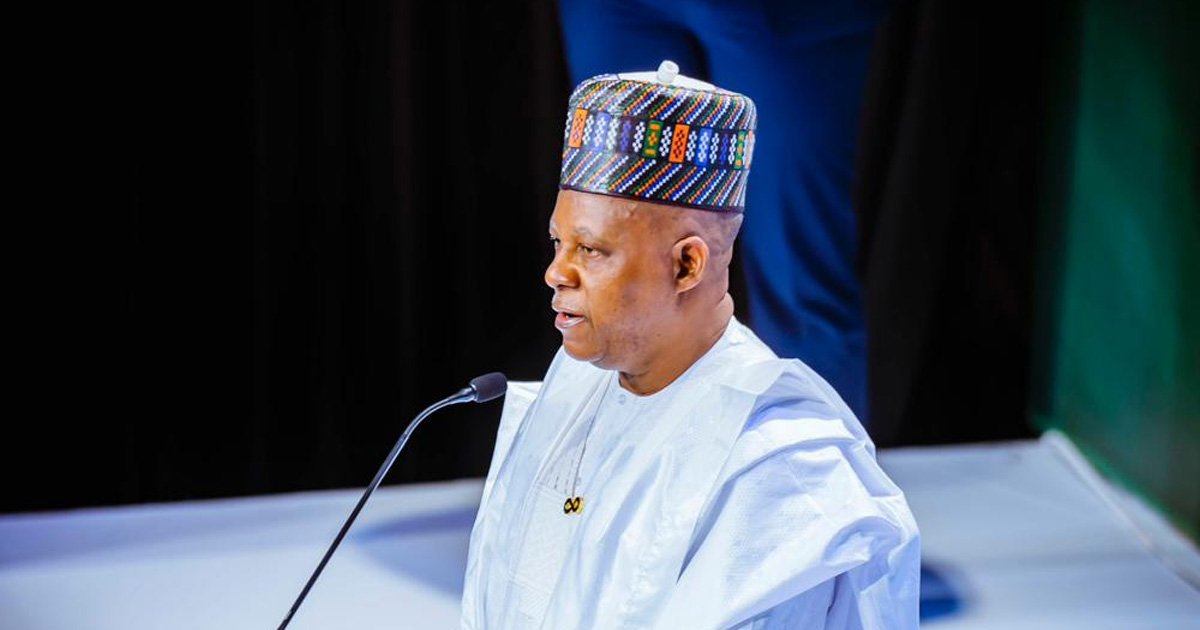
Vice President Kashim Shettima has declared that Nigeria’s debt service-to-revenue ratio declined sharply from 120 percent in December 2022 to 68 percent in 2025 as a direct result of ongoing tax reforms introduced by the Tinubu administration, describing the improvement as evidence that the reforms were already delivering measurable fiscal gains.
Represented by Special Adviser on Economic Affairs Dr. Tope Fasua at the 2026 Tax Conference in Abuja organized by the Chartered Institute of Taxation of Nigeria, the Vice President described the reforms as Nigeria’s first comprehensive tax overhaul in more than 35 years and said they were designed to reposition the economy for long-term growth by broadening the tax base, streamlining administration, and reducing the debt burden that had constrained government’s ability to fund public services.
He said the reforms, which took effect from January 1, 2026, were aimed at transitioning Nigeria from a nation that borrowed to survive into one that invested to thrive, and emphasized that provisions protecting low-income earners were among the most significant but least understood elements of the package. He noted that individuals earning N1 million or less annually and small businesses turning over N100 million or less were fully tax-exempt under the new framework.
Finance Minister Taiwo Oyedele said the reforms were not about additional taxation but about building a stronger fiscal foundation for long-term national development. He said the previous tax system had been weakened by fragmented administration, multiple taxation, weak compliance, and unstable revenues, and that businesses had faced rising compliance costs and citizens had perceived the system as unfair because the burden was unevenly distributed.
Oyedele described the reform as designed to simplify taxation, reduce compliance burdens, encourage investment, promote voluntary compliance, and align taxation with productivity, and urged states that had not yet adopted tax modernization laws to do so without further delay.
Chartered Institute of Taxation President Innocent Ohagwa commended the Tinubu administration, the National Assembly, and other stakeholders for delivering the new tax laws, and called on all tax professionals to support implementation by promoting transparency, accountability, and compliance across the system.