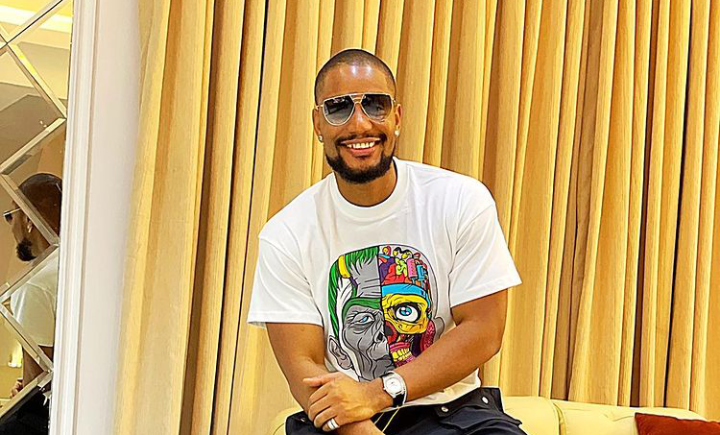
Nigeria woke up on Tuesday to one of the most devastating pieces of news to have emerged from the entertainment industry in recent memory. Alex Ekubo, an actor who for nearly two decades embodied the charm, elegance and versatility that made Nollywood a cultural force on the African continent, has died at the age of 40. He had been fighting cancer in secret, shielding the world from the full extent of his suffering until there was nothing left to shield.
His death was confirmed on Tuesday by talent manager and filmmaker Sam Olatunji, whose announcement on Facebook triggered an immediate outpouring of grief across social media platforms. By Tuesday evening, the name Alex Ekubo was trending across Nigeria and beyond, as fans, colleagues and public figures scrambled to find words adequate enough to honor a life that had clearly touched far more people than even those closest to him had realized.
Details that emerged in the hours following the announcement painted a picture of a man who had endured an extraordinarily difficult final chapter in private. Sources familiar with the circumstances of his illness revealed that the actor had been battling stage 4 liver cancer since 2024, undergoing a liver transplant in an attempt to fight back against the disease. When complications arose and his condition deteriorated beyond recovery, he was rushed to Evercare Hospital in Lekki, Lagos, where he passed away after spending several hours on life support. He was 40 years old.
What made the grief that swept through Nollywood on Tuesday particularly raw was the realization, shared openly by colleague after colleague, that almost none of them had known how serious his condition truly was. He had gone quiet on social media since December 2024, and while fans had noticed his prolonged absence and grown increasingly concerned, those who reached out to people close to him were told he was fine, taking time away from the spotlight to rest and focus on personal matters. That story, it now became heartbreakingly clear, had been a carefully maintained cover for a man determined not to let his illness become public spectacle.
The life that ended on Tuesday had begun on April 10, 1986, in Arochukwu, Abia State. Ekubo attended Federal Government College Daura for his secondary education and later studied Law at the University of Calabar, a background that gave him a sharpness and discipline that would serve him well in an industry that demands both. His route into entertainment came not through a traditional audition but through the 2010 Mr Nigeria pageant, where he emerged as first runner-up and announced himself to the country as a young man of striking presence and considerable promise.
His acting career had actually begun earlier, with a minor role in a 2003 production, but it was his appearance in the Nollywood hit Weekend Getaway that truly announced him to mainstream audiences. From there, the trajectory was steep and consistent. He featured in a string of celebrated productions including The Bling Lagosians, Omo Ghetto: The Saga and A Sunday Affair, building a reputation as one of the most bankable and dependable performers in the industry. His role in the 2012 film In the Cupboard earned him the Best Actor in a Supporting Role award at the Best of Nollywood Awards, and by 2020 the United Nations had recognised him among the Most Influential People of African Descent Under 40, a distinction that reflected the breadth of his impact beyond the cinema screen.
The tributes that poured in on Tuesday were remarkable not only for their volume but for their emotional honesty. Veteran filmmaker Lancelot Imasuen, the man who gave Ekubo his very first movie role, recalled a young boy who would turn up at film locations every Saturday while still a student, driven by a passion for storytelling that had clearly never dimmed. Imasuen described the loss as devastating, the kind of blow that takes time to fully absorb.
Funke Akindele, one of the most prominent figures in contemporary Nollywood, offered a tribute that left many readers in tears. She revealed on Instagram that she had spent weeks attempting to reach her friend, sending voice notes, messages and check-ins, each of which he had deflected with assurances that he was well. He had told her they would see each other soon, a promise that his illness ultimately made impossible to keep. Her tribute spoke not only to her grief but to the particular cruelty of losing someone who was actively protecting you from the knowledge of how close to the end they were. It was, she said, a kindness she would spend a long time learning to accept.
Kate Henshaw expressed a similar anguish, describing how she had sent him several messages without receiving a response and had eventually decided to give him space, assuming he simply needed time away from the noise of public life. That assumption, she wrote, now sat with her in a way she had not yet found the language to fully express. Actor Bolanle Ninalowo, writing from the United States, asked for God’s healing over the family and everyone who had loved him. Godwin Nnadiekwe, a close colleague, wrote with the kind of openness that grief sometimes unlocks, revealing that the news had broken him, that he could not reconcile himself to a reality in which this was how the story ended, and that the knowledge that Ekubo had prepared his will while the rest of them were still hoping for his recovery was a detail almost too painful to sit with.
BBNaija star Pere shared his own parting moment with the actor publicly, posting a screenshot of a message exchange in which he had checked in on Ekubo, and noting that the warmth of the response he received had taken on an entirely new meaning now that he understood the circumstances under which it had been written. Richard Mofe-Damijo, a veteran of the industry whose opinion carries considerable weight within Nollywood, offered measured words of tribute, reflecting on a life he described as well lived and a legacy he was certain would endure. Singer Peter Okoye offered two words that carried the full weight of shock: simply, Rest in Peace.
Political voices added their own tributes to the chorus. Human rights activist Omoyele Sowore wrote about encountering Ekubo’s work during a long haul flight and being struck by the effortless authority with which the actor commanded the screen, a memory that had stayed with him long before he ever expected it would become the basis of a farewell. Human rights lawyer Inibehe Effiong paid tribute to the strides Ekubo had made within the industry, expressing confidence that his memory would continue to guide and inspire the generation of actors coming up behind him.
What emerges from all of these testimonies, taken together, is the portrait of a man who was loved with an intensity that surprised even those doing the loving when they finally had to reckon with his absence. He entered Nollywood as a pageant finalist with a law degree and a face the cameras could not resist, and he spent nearly twenty years justifying every expectation that followed. He chose, in the end, to carry the weight of his illness alone, to protect the people who cared about him from the slow grief of watching him decline. It was a final, quiet act of generosity from a man who appears to have spent much of his life putting others at ease.
The family is yet to release a formal statement. The tributes continue to pour in. And the space that Alexx Ekubo occupied in Nigerian entertainment, in popular culture, and in the lives of the people who knew and loved him, has become very suddenly and very painfully visible.
Rest in peace, Alexx Ekubo. April 10, 1986 — May 12, 2026.