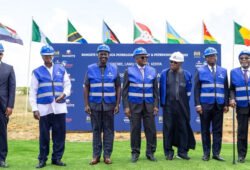
The Nigeria Liquefied Natural Gas Limited (NLNG) has said its $10 billion Train 7 project is expected to commence operations by the end of 2027.
NLNG Managing Director, Adeleye Falade, disclosed this on the sidelines of the Gastech conference in Bangkok, saying the company was working to increase production and address persistent gas supply challenges.
The Train 7 project, located on Bonny Island, Rivers State, is expected to increase NLNG’s production capacity from the current 22 million metric tonnes per annum (mtpa) to 30 million mtpa.
The project has faced several delays, including disruptions linked to the COVID-19 pandemic and the Russia-Ukraine war.
Falade also disclosed that NLNG remained under a force majeure declared in 2022 following widespread flooding that disrupted gas supplies to the company.
He said the force majeure would be lifted once the plant reached a 90 per cent utilisation rate.
The facility is currently operating at between 82 and 83 per cent capacity.
“We still have a delta of about 15 per cent that we need to close. Operationally, we are able to do that, but our biggest constraint is gas supply,” Falade said.
He added that the company was working with the government and other stakeholders to increase gas supplies to the plant.
NLNG Prioritises Existing Contracts
Falade said NLNG remained focused on fulfilling its existing contractual obligations to buyers while seeking opportunities to maximise production.
He also disclosed that demand for additional LNG volumes and spot cargoes had increased following disruptions to exports through the Strait of Hormuz.
According to him, buyers were increasingly looking for diversified and reliable sources of LNG supply.
“Our priority currently is to continue to make sure that we fulfil our obligations to our existing customers and maximise as much production opportunity as possible that we have,” he said.
NLNG is majority-owned by the Nigerian National Petroleum Company Limited (NNPC), with Shell, TotalEnergies and Eni as its international partners.
Oil Prices Surge Above $109
Meanwhile, international oil prices surged amid growing concerns over disruptions to crude supplies from Saudi Arabia and Libya.
Brent crude futures rose by $3.49, or 3.3 per cent, to $109.20 a barrel, while US West Texas Intermediate (WTI) futures gained $5.08, or 5.01 per cent, to $106.46 a barrel.
The rise followed the suspension of oil loadings at Saudi Arabia’s Red Sea port of Yanbu and the shutdown of operations at three oil fields in Libya.
The latest supply concerns followed attacks on Saudi Arabia, including an earlier strike on the kingdom’s East-West Pipeline, a major route for transporting Saudi crude.
Saudi Arabia subsequently informed some European customers that late-September crude cargoes would be cancelled, while oil loadings at Yanbu were also suspended.
In Libya, the National Oil Corporation said operations at three oil fields had been suspended following a disruption to the Hamada-Zawiya crude export pipeline.
The corporation warned that it could declare force majeure if the disruption persisted or spread to other fields.
The supply disruptions have also coincided with a sharp decline in vessel traffic through the Strait of Hormuz, a major global oil shipping route.
Preliminary data showed that only four commodity vessels passed through the waterway on Monday, compared with 10 the previous day.
Analysts and traders are closely monitoring the disruptions amid concerns that prolonged supply constraints could trigger further increases in international crude prices.