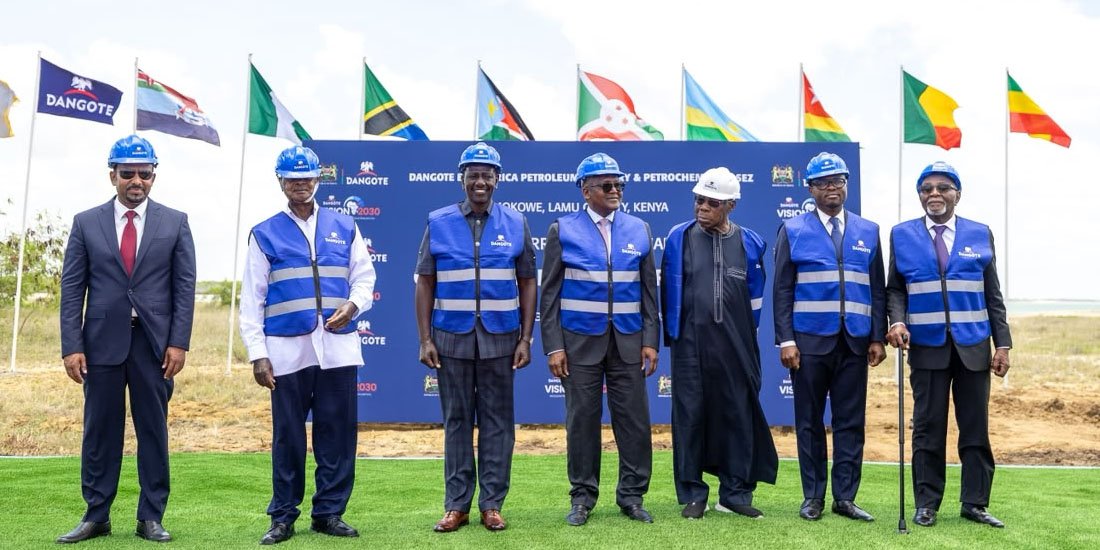
Africa’s drive towards greater control of its energy resources received a major boost in Kenya as Aliko Dangote formally commenced the development of a $16 billion refinery in Lamu County, with several African leaders attending the groundbreaking ceremony.
Kenyan President William Ruto joined Dangote at the ceremony for the proposed 700,000 barrel per day facility, which is expected to become the largest refinery in East Africa when completed.
The project is being developed as more than a conventional refinery. Plans include a 1,000 megawatt power plant as well as facilities for plastics, fertilizer and chemical production, creating what is intended to become a major industrial complex on the East African coast.
Ugandan President Yoweri Museveni, Ethiopian Prime Minister Abiy Ahmed, Togolese President Jean Lucien Savi de Tové, Beninese President Romuald Wadagni and former Nigerian President Olusegun Obasanjo were among the dignitaries at the ceremony.
Ondo State Governor Lucky Aiyedatiwa and the Ooni of Ife, Oba Adeyeye Ogunwusi, were also present, while Rwanda, Burundi, South Sudan and Tanzania were represented at the event.
Dangote told the gathering that the refinery represented a broader African industrial ambition, with the continent seeking to retain more of the economic value generated from its natural resources.
He said Africa had for decades exported raw materials only to import finished products at considerably higher costs, effectively transferring employment and industrial opportunities outside the continent.
Drawing a comparison with his refinery at Lekki in Lagos, Dangote said the success of the Nigerian project had demonstrated that an African company could undertake an industrial development of such magnitude.
He said the Lamu refinery would now test whether that achievement could be replicated elsewhere on the continent.
Dangote placed the construction period at 40 months and disclosed that about 110 pieces of equipment had already arrived for the project. Another vessel carrying about 400 pieces of construction equipment is expected at Lamu Port within 60 days.
The company also plans to establish an engineering training school in Lamu to develop Kenyan technical capacity for the project.
Dangote said the intention was to employ qualified local professionals and reduce dependence on technical personnel brought in from countries such as China and India.
Lamu’s deep water port was a major factor in the decision to locate the project in Kenya. Its capacity to receive large vessels carrying crude oil is considered critical to the refinery’s operations.
The project had previously been proposed for Tanga in Tanzania before Dangote settled on Lamu, citing deeper waters, stronger ground conditions for heavy industrial equipment and better access for large ocean going vessels.
Dangote Group has also offered governments in East Africa a combined 30 per cent equity interest in the refinery, potentially giving participating countries a direct stake in the project.
President Ruto described the investment as capable of reshaping Kenya’s industrial and energy landscape.
He challenged Dangote to deliver the refinery within the promised 40 months.
According to Ruto, the project could increase Kenya’s economy by 12 per cent, create about 60,000 direct jobs and generate approximately $4 billion annually in foreign direct investment during the construction period.
The refinery is also expected to support development along the Lamu Port South Sudan Ethiopia Transport Corridor.
Museveni welcomed the investment but made it clear that Uganda would continue with plans for its own refinery.
He argued that East Africa’s petroleum demand was sufficiently large to accommodate multiple refineries and said Uganda would also maintain its energy cooperation with Tanzania through the Tanga corridor.
The Ugandan leader said Africa’s long term economic security depended on industrialization, regional integration and processing natural resources within the continent rather than exporting them in raw form.
Obasanjo used the occasion to recall Dangote’s earlier entry into cement manufacturing and the obstacles the businessman encountered.
The former Nigerian president accused Lafarge of attempting to frustrate Dangote’s expansion in Africa, including difficulties experienced in Senegal. He argued that African entrepreneurs capable of building large industrial businesses should be encouraged rather than obstructed.
Meanwhile, Honeywell Technologies has been selected to provide engineering services, technology licenses and equipment for the refinery.
Honeywell Technologies President Rajesh Gattupalli said the company’s previous relationship with Dangote had produced engineering designs that could be adapted for the Kenya project.
According to Honeywell, using existing large scale engineering designs could shorten the development period by almost two years compared with the timetable normally required for a completely new refinery.
The refinery is expected to produce petrol, diesel, aviation fuel and polypropylene and will be capable of processing different grades of crude oil from several regions.
Honeywell estimates the value of its involvement in the project at approximately $300 million.
If completed according to schedule, the Lamu refinery would represent one of the biggest private industrial investments in Africa and another major attempt to shift the continent from exporting raw resources towards processing, manufacturing and value creation.