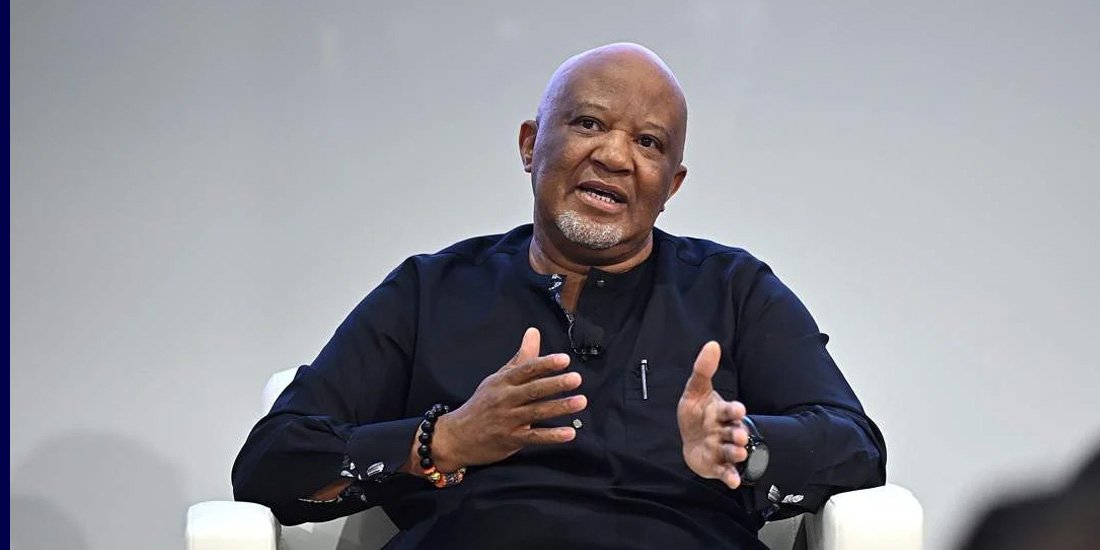
The Chairman of MTN Group and former South African Deputy Finance Minister, Mcebisi Jonas, has strongly condemned the growing wave of xenophobia in South Africa, describing it as a consequence of government failure rather than the presence of foreign nationals.
Jonas made the remarks while delivering a tribute at the funeral of Zimbabwean-born activist and public servant, Thokozani Damasane, where he criticised anti-foreigner sentiment and urged South Africans to embrace solidarity across the continent.
In a speech that has since gained widespread attention across South African civil society, Jonas argued that the country’s social and economic challenges would not be resolved by driving out foreign nationals.
“Foreigners can leave tomorrow—inequality will be with us. Foreigners will leave tomorrow—unemployment will be with us. Foreigners will leave tomorrow—our police will remain corrupt. Foreigners will leave tomorrow—our politicians will still be concerned with one thing: being elected and re-elected,” he said.
Jonas blamed the crisis squarely on the failure of the state, accusing government institutions of failing to effectively manage immigration, secure the country’s borders, enforce the law, and provide quality public services.
“The problem is the failure of the state. The state doesn’t manage immigration. It doesn’t manage its borders. It doesn’t enforce law enforcement. It doesn’t manage education. What are you expecting?” he asked.
According to him, these governance failures have created an environment in which politicians exploit public frustration by blaming foreigners for the country’s economic and social problems instead of addressing the root causes.
“When people feel the burn, they become vulnerable to politicians whose sole purpose is to be elected and re-elected. Some of them have no credibility whatsoever. But they lead marches and tell our people that the problem is not us—it is foreigners,” he said.
Reflecting on the life of Damasane, Jonas noted that the late activist was born and educated in Zimbabwe before relocating to South Africa during the country’s post-apartheid transition in search of a new home.
He described a home as a place where humanity is valued and questioned the hostility directed at migrants who have contributed to South Africa’s development.
Jonas also linked xenophobia to colonial legacies, arguing that tribal divisions were reinforced by colonial administrations through policies of indirect rule designed to divide African communities.
“The tribe is a product of colonial powers. It became dominant where colonial rulers psychologically enhanced the idea that one group was different from another. That is how the notion of tribe was strengthened,” he said.
He warned that the same divisive logic now fuels xenophobic violence and called for a renewed sense of national and continental identity based on African unity rather than ethnic exclusion.
“We are a nation embedded in Africa, and our growth and fortune are intertwined with the growth of Africa. South Africa is nothing without Africa, and Africa is nothing without South Africa,” Jonas said.
His comments come amid renewed concerns over attacks on foreign nationals in parts of South Africa, with rights groups and regional leaders repeatedly calling for stronger action to combat xenophobia and promote peaceful coexistence.