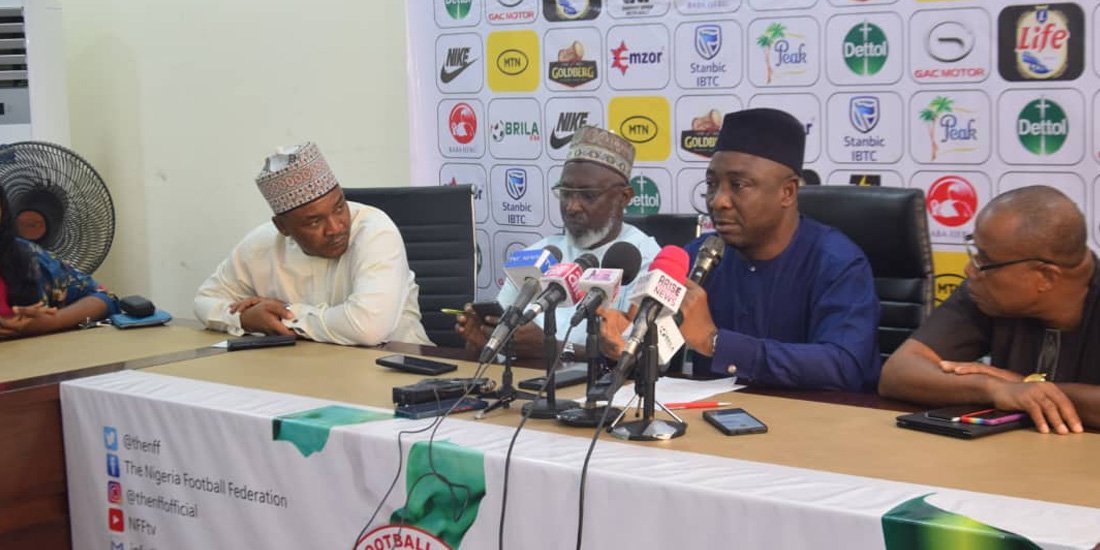
President of the Nigeria Football Federation (NFF), Ibrahim Musa Gusau, and the federation’s General Secretary, Mohammed Sanusi, have resigned from their positions amid growing concerns over the recent poor performances of Nigeria’s national teams.
The development, announced on Thursday, also reportedly saw all members of the NFF Executive Committee tender their resignations, throwing the country’s football administration into a major leadership crisis.
Gusau resigned just 34 days before the expiration of his four-year tenure. He was elected NFF President at the federation’s Annual General Assembly in Benin City, Edo State, on September 30, 2022.
Speaking at a press conference at the NFF Secretariat in Abuja, Gusau said his decision followed consultations with his family, friends and key stakeholders in Nigerian football.
He said he had also informed members of the Executive Committee of his decision, which he described as a carefully considered step taken in the overriding interest of Nigerian football.
“My resignation is intended to give way to a comprehensive and orderly reform process aimed at addressing the longstanding institutional, governance and developmental challenges confronting Nigerian football,” Gusau said.
The Zamfara-born administrator, who also served as President of the West African Football Union (WAFU) Zone B, said he was leaving office with satisfaction over some of the achievements recorded during his tenure.
He highlighted the administration’s increased focus on coaching education, noting that coaching courses had been organised across virtually all licence categories, while the long-awaited CAF A-Licence course is scheduled to begin on September 13.
Gusau also cited improvements in the domestic league calendar and refereeing, as well as infrastructure development, including a 68-room players’ hostel and new training pitches at the MKO Abiola National Stadium in Abuja.
He further pointed to the Super Eagles’ silver and bronze medals at the last two Africa Cup of Nations tournaments and the Super Falcons’ 2025 Women’s Africa Cup of Nations triumph in Morocco.
However, the NFF administration came under increasing pressure following a series of disappointing results involving Nigeria’s national teams.
The latest setback was the Super Falcons’ failure to qualify for the 2027 FIFA Women’s World Cup, ending Nigeria’s unprecedented record of appearing at every edition of the tournament since its inception in 1991.
The development followed the Super Eagles’ failure to qualify for the 2026 FIFA World Cup in the United States, Canada and Mexico, while the country’s U-20 men’s team also missed out on qualification for next year’s Africa U-20 Cup of Nations.
The string of setbacks intensified calls for changes within the NFF, culminating in the mass resignations announced on Thursday.
The departures are expected to pave the way for a leadership transition and potentially broader reforms in the administration and development of Nigerian football.