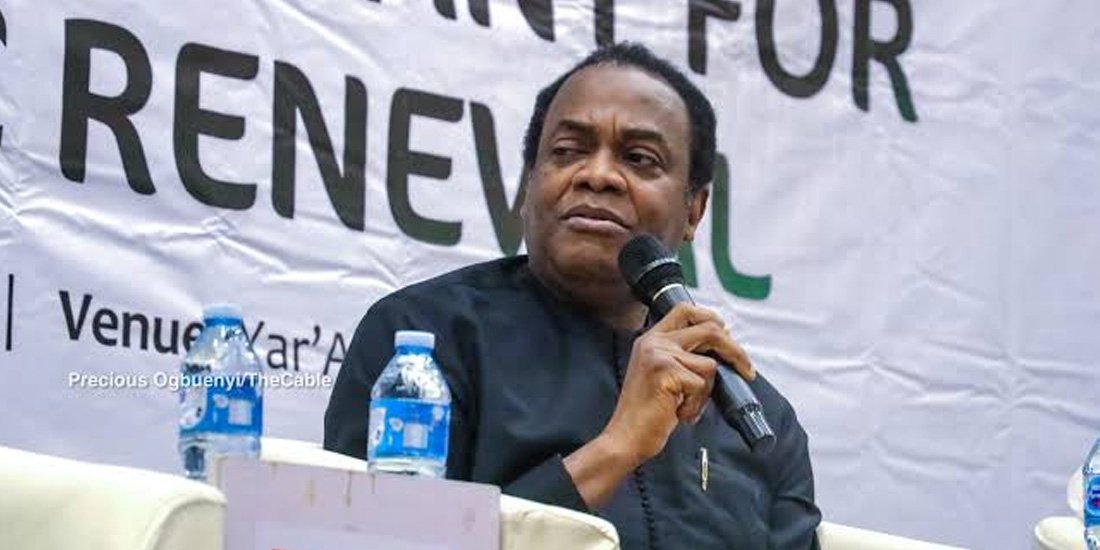
Former Cross River State governor and Peoples Redemption Party presidential candidate Donald Duke has argued that Nigeria’s economy has failed to expand in line with its population since the Second Republic, leaving the country with weaker per-capita economic capacity and deepening social pressures.
Speaking to journalists in Abuja, Duke said the country was still operating around the equivalent of the dollar-denominated budget recorded during the administration of former President Shehu Shagari, despite a much larger population.
According to him, Nigeria’s annual budget during the Shagari era was around $25 billion when the population was about 76 million.
He argued that, after converting current federal spending into dollars, Nigeria remained within a similar broad range despite having an estimated population of about 230 million.
“Today, our population, they say, is about 230 million people. We are still spending the same $25 billion that Shagari spent 46 years ago,” Duke said.
He added that inflation meant $25 billion today had far less economic value than the same amount four decades ago.
Duke argued that the deeper problem was weak productivity and said the failure to expand productive capacity had contributed to poverty, unemployment and insecurity.
He said the basic responsibility of government was to create conditions in which citizens could become productive within a secure and orderly environment.
The former governor also questioned the economic justification and timing of the Lagos-Calabar Coastal Highway.
He said public infrastructure should be judged by its opportunity cost and immediate contribution to economic and social priorities.
Duke acknowledged that he could personally benefit from a road linking Lagos and Calabar but said personal convenience should not determine public investment.
He questioned whether existing routes, including the East-West Road, should have received higher priority and suggested that the coastal highway could have been deferred until government finances were stronger.
The former governor also cited out-of-school children and widespread poverty as areas requiring more urgent attention.
He argued that public spending should be aligned with a clearly articulated national vision centered on productivity, education, security and economic inclusion.
Duke further said economic scarcity contributed to the politicization of ethnicity, religion and regional identity.
According to him, citizens were more likely to rely on ethnic and political connections when they believed access to jobs, services or opportunities depended on proximity to power.
He argued that better-functioning institutions and broader economic opportunity would reduce the incentives for such divisions.
Duke’s comments represent his assessment of Nigeria’s economy and spending priorities and form part of the continuing debate over infrastructure, public finance and economic strategy ahead of the 2027 elections.