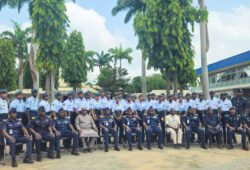
A new chapter of hope has opened for 21 former Almajiri children who have graduated as certified technology technicians and entrepreneurs under the Out-of-School Children/Almajiri-to-Tech Foundation, in what stakeholders described as a practical model for tackling Nigeria’s growing out-of-school children crisis.
The graduates, comprising 14 boys and seven girls, completed a six-month intensive training programme in Abuja, acquiring practical skills in computer and mobile phone repairs, desktop assembly, robotics, drone technology, and the maintenance of laptops, televisions, microwave ovens, power banks, electric fans, torchlights and other electronic devices.
The graduation ceremony showcased the remarkable transformation of children who, only months earlier, survived by begging on the streets under the Almajiri system but are now equipped with employable digital and technical skills capable of transforming their lives.
Founder of the Out-of-School Children/Almajiri-to-Tech Foundation and Managing Director of New Horizons System Solutions Limited, Mr. Tim Akano, described the graduation as far more than an academic achievement.
“This is not just a graduation; it is a resurrection,” Akano declared.
“About six months ago, some of these children could not write their names in English. Today, they can build computers, assemble robots and drones, and repair more than ten different electrical and electronic devices with their own hands.”
He said the programme demonstrates that every child can succeed when given access to quality education, practical digital skills and meaningful opportunities.
Akano unveiled the foundation’s Vision 2031, an ambitious initiative aimed at removing children from the streets through technology-driven education and vocational empowerment.
According to him, Nigeria’s estimated 30 million out-of-school children represent enormous untapped human capital capable of driving economic growth if properly educated and empowered.
“If these children were a country, they would rank among the largest populations in West Africa. Conferences do not empower children—action does. This crisis can be solved within five years if government demonstrates sufficient political will,” he said.
He urged governments at all levels to criminalise child abandonment, enforce free and compulsory basic education, decentralise Islamiyya education into communities, and replace street begging with structured rehabilitation and vocational programmes.
Akano also appealed to the Minister of the Federal Capital Territory (FCT), Nyesom Wike, to provide a permanent facility for the Foundation’s Out-of-School/Almajiri Republic Technicians initiative.
Former Inspector-General of Police, Mohammed Abubakar, described Nigeria’s out-of-school children challenge as a national emergency that demands urgent and coordinated action.
Rejecting the notion that the problem is confined to Northern Nigeria, Abubakar argued that insecurity, unemployment and mass illiteracy among vulnerable children pose a threat to the entire country.
“The problem of out-of-school children is not a Northern problem; it is a Nigerian problem,” he said.
“The Constitution gives every Nigerian the right to live anywhere in the country. When these children migrate to other parts of Nigeria, the problem becomes everyone’s problem. There is a system breakdown, and that system must be repaired.”
He maintained that the widely quoted figure of 30 million out-of-school children could be an underestimate, recalling that a survey conducted in Kano State in 2006 estimated commercial motorcycle operators alone at about three million.
“We are not safe if we fail to take care of out-of-school children and unemployed youths,” the former police chief warned.
Abubakar called on the National Commission for Almajiri and Out-of-School Children Education, alongside northern state governors, to intensify efforts to remove children from the streets and provide them with access to education and vocational opportunities.
Also speaking, President of the Nigerian Institute of Public Relations (NIPR), Dr. Ike Neliaku, commended the initiative as a model of responsible corporate citizenship and humanitarian service.
He praised Akano for investing private resources to equip disadvantaged children with practical skills capable of changing their future.
“We are witnessing the graduation of 21 former Almajiri children who can now repair computers, televisions, fans and many other electronic devices. This is the kind of intervention Nigeria needs to address one of its greatest social challenges,” Neliaku said.
He added that the programme aligns with the NIPR’s commitment to promoting initiatives that deliver measurable social impact and sustainable development.
For the graduates, the ceremony marked more than the completion of a training programme. It symbolised a new beginning—one built on knowledge, technical expertise and renewed hope.
Armed with practical technology skills and entrepreneurial knowledge, the young graduates are expected to pursue careers in technical services, establish businesses and become productive contributors to society, replacing lives once defined by uncertainty with opportunities for self-reliance and economic independence.