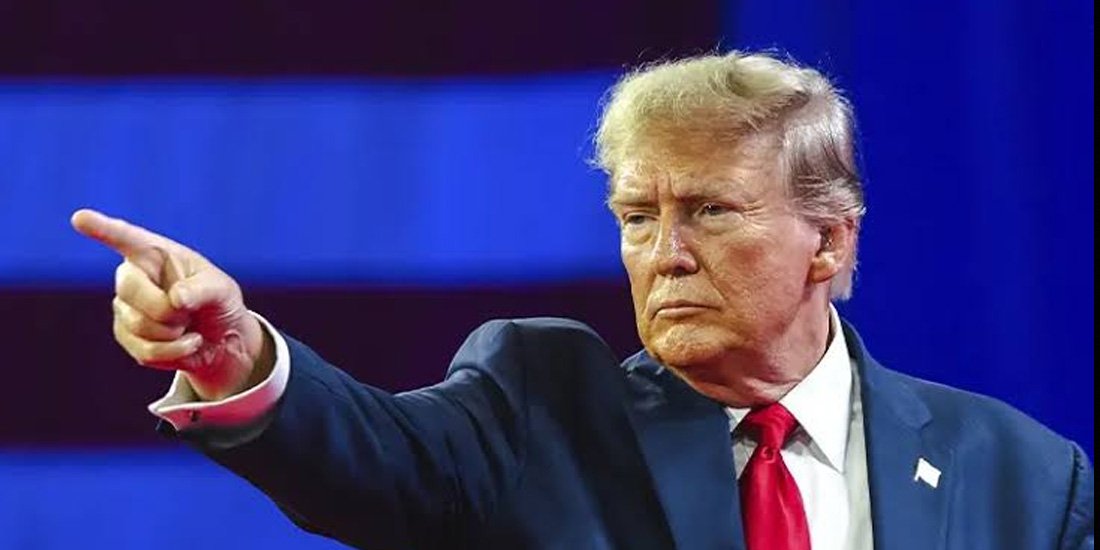
United States President Donald Trump has issued a fresh warning to Iran, threatening overwhelming military retaliation after mourners at the funeral of Supreme Leader Ayatollah Ali Khamenei reportedly chanted slogans calling for his assassination, further escalating tensions between Washington and Tehran.
The latest development comes amid a deepening standoff over the Strait of Hormuz and renewed efforts to revive negotiations over Iran’s nuclear programme.
In a post on his Truth Social platform, Trump warned that the United States had positioned substantial military assets against Iran and would respond decisively to any threat against American interests.
“A thousand missiles are locked and loaded and aimed at the Islamic Republic of Iran, with thousands more ready to immediately follow should the Iranian government act on its threat,” the U.S. president wrote.
Trump said his remarks were prompted by reports that mourners at Khamenei’s funeral carried banners and chanted slogans calling for the deaths of both himself and Israeli Prime Minister Benjamin Netanyahu.
The renewed war of words follows days of heightened military confrontation between the two countries. The United States recently launched airstrikes on Iranian targets after accusing Tehran of attacking commercial vessels transiting the Strait of Hormuz. Iran subsequently retaliated with strikes targeting U.S. military installations in Bahrain, Jordan, Kuwait and Qatar.
Trump also warned that the U.S. military would “completely decimate and destroy” Iran if American interests were threatened.
Meanwhile, senior U.S. officials said Washington had given diplomacy only a limited window to succeed, insisting that Iran must reopen the Strait of Hormuz to unrestricted international shipping, cease attacks on commercial vessels and surrender its stockpile of highly enriched uranium before any new nuclear agreement could be reached.
Tehran has rejected the conditions.
Addressing the United Nations, Iran’s representative maintained that all activities in the Strait of Hormuz, including decisions relating to its operation and any demining efforts, fall under Iran’s authority.
Iran has also proposed imposing transit fees on vessels using the strategic waterway, challenging the long-standing international position that the strait remains an international maritime route.
The dispute has heightened concerns over global energy security, as approximately one-fifth of the world’s traded crude oil and natural gas passes through the Strait of Hormuz. Although oil prices have eased in recent days after earlier surges, analysts continue to warn that prolonged instability could disrupt global energy supplies.
Diplomatic efforts to reduce tensions remain ongoing. Iranian Foreign Minister Abbas Araghchi travelled to Oman on Saturday for talks aimed at easing the crisis, while Turkish Foreign Minister Hakan Fidan expressed optimism that diplomacy could still prevent further escalation.
However, Araghchi accused Washington of violating an interim understanding after the United States revoked waivers that had allowed limited Iranian crude oil sales in U.S. dollars.
“Reality check: There can only be mutual compliance,” the Iranian foreign minister wrote on X.
U.S. officials have reiterated that military options remain on the table should negotiations fail, maintaining that Iran would not be permitted to retain uranium enriched to near weapons-grade levels.
Iran, however, has consistently insisted that its nuclear programme is exclusively for peaceful purposes, despite continued concerns raised by the International Atomic Energy Agency (IAEA) over its uranium enrichment activities.