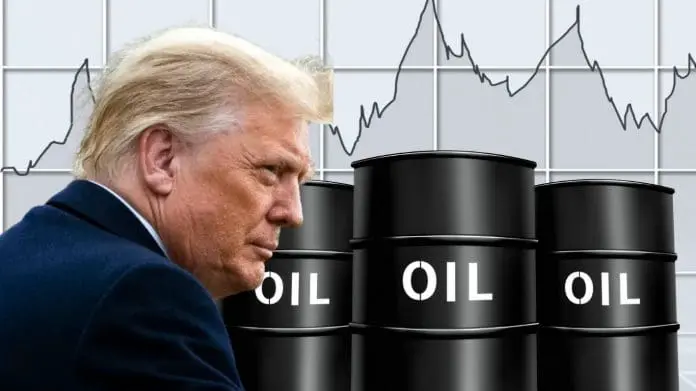
President Donald Trump has repeatedly assured Americans that oil and gasoline prices will plunge once peace is secured in the Middle East and shipping resumes through the Strait of Hormuz. But industry analysts warn that any decline is likely to be gradual rather than dramatic.
With a framework agreement expected to be signed on Friday that could eventually lead Iran to dismantle its nuclear programme, Trump has argued that the economic sacrifices tied to the conflict would be offset by long-term security benefits and lower energy costs.
“Oil prices will drop like a rock,” Trump has said on multiple occasions, predicting a swift return to pre-war energy prices once stability returns to the region.
However, energy markets and shipping experts suggest the reality may be far more complicated.
Market Signals Point to Higher Prices for Longer
Oil prices have already retreated significantly from their recent highs. Brent crude, which surged during the conflict, has fallen by roughly $25 per barrel over the past month and is now trading below $85.
Yet futures markets indicate that traders do not expect prices to return to pre-war levels anytime soon. While short-term contracts have dropped sharply, longer-dated futures continue to suggest oil will remain above $70 per barrel for years.
Analysts say this reflects concerns about the logistical and operational challenges facing the global energy industry as it attempts to restore normal supply flows.
“We’ll figure out what the new normal is,” said Dan Pickering, founder and chief investment officer of Pickering Energy Partners. “But it isn’t going to be $2.85 gasoline.”
Strait of Hormuz Reopening Faces Major Obstacles
Although the Strait of Hormuz is scheduled to reopen on Friday, shipping traffic is unlikely to return to normal immediately.
The strategic waterway, through which a significant share of the world’s oil exports passes, was heavily disrupted during the conflict. Iran is believed to have deployed naval mines in the area, leaving only narrow shipping corridors available for safe passage.
Maritime experts say vessels will need to navigate carefully through constrained routes, creating bottlenecks that could slow the movement of hundreds of millions of barrels of oil currently waiting to reach global markets.
According to Jakob Larsen, Safety and Security Officer at BIMCO, the world’s largest shipowners’ association, clearing mines from the waterway could take several weeks.
Even after shipping lanes are secured, the industry faces another challenge: a shortage of available tankers.
Analysts estimate that dozens of vessels are positioned near the strait, but far fewer than the number typically required to support normal export volumes. Rebuilding tanker capacity could take up to a month after the waterway reopens.
Peace Remains a Key Uncertainty
The pace of recovery also depends heavily on the durability of any peace agreement.
Regional tensions remain high, and Iran has warned that vessels transiting the strait could still face risks. Those threats have pushed maritime insurance costs sharply higher and made some shipping companies reluctant to return immediately.
“Shipowners will not go ahead in significant numbers without a credible and stable ceasefire backed by both sides of the conflict,” Larsen said.
Industry forecasts vary widely. BIMCO estimates it could take around two months for operations to return to normal, while Capital Economics believes a full recovery may require up to six months.
Oil Production Cannot Restart Overnight
Beyond shipping concerns, oil-producing countries face the challenge of restarting wells that were shut down during the conflict.
Industry experts note that oil production is a complex process and cannot simply be switched back on at full capacity. Many storage facilities are already near their limits, leaving little room for additional output.
“You have tanks that are 80% full — there’s not a lot of room to restart production,” said Vikas Dwivedi, Global Oil and Gas Strategist at Macquarie Group.
There is also uncertainty about how efficiently wells will perform after extended shutdowns.
“Will you have the same supply when it reopens? You won’t know until you turn the valve,” Pickering said.
Strategic Reserves Could Support Prices
Even after production and shipping recover, analysts believe another factor could keep prices elevated: the rebuilding of global emergency oil reserves.
Many countries drew heavily on strategic stockpiles during the conflict. Replenishing those reserves could create substantial new demand, potentially exceeding one million barrels per day over an extended period.
That additional demand is expected to provide support for crude prices, limiting the extent of any long-term decline.
While oil markets could experience a temporary oversupply that pushes prices lower in the short term, analysts caution that a surge in demand from governments and refiners may quickly reverse those gains.
“You’re going to get hit with a whole lot of demand on the other side of this,” Dwivedi said. “Talk about unintended consequences.”
Outlook
For consumers hoping for a rapid decline in fuel prices, the path back to cheaper energy may prove longer than political promises suggest.
Although the end of hostilities and the reopening of the Strait of Hormuz would remove major pressures on global supply, logistical bottlenecks, production challenges, infrastructure repairs and the replenishment of strategic reserves are likely to keep oil markets tight for months, if not years.
As a result, analysts say energy prices may fall, but probably more like a feather than a rock.