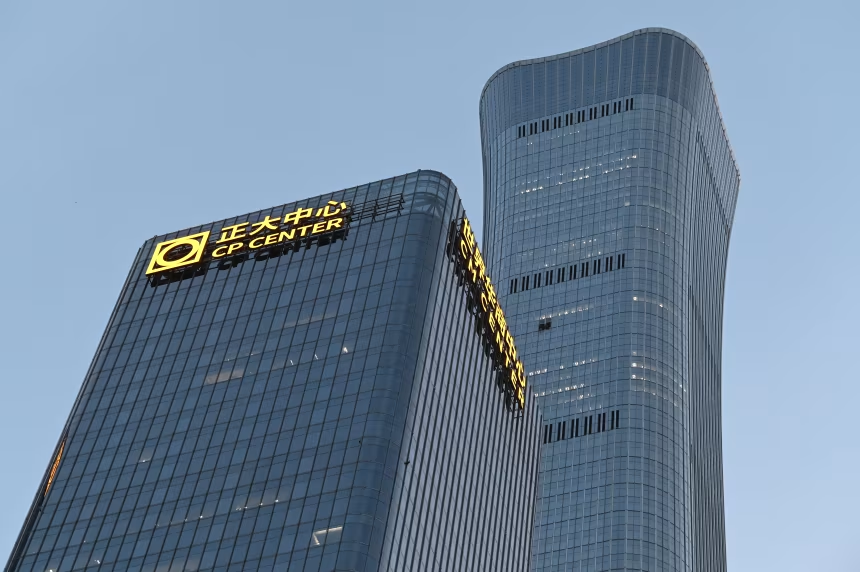
A small aircraft crashed into Beijing’s tallest skyscraper on Friday afternoon, killing the pilot and injuring 13 people in an incident that briefly shocked China’s capital before references to the crash largely disappeared from the country’s tightly controlled online space.
The aircraft struck the upper floors of the 109-story CITIC Tower, also known as China Zun, sending shattered glass and pieces of the plane raining onto nearby streets during the evening rush hour. The skyscraper, which stands 528 metres (1,732 feet) tall, has dominated Beijing’s skyline since its completion in 2018.
Witnesses described scenes of panic as office workers evacuated the building and emergency services rushed to the scene. However, within hours, videos and discussions of the crash had been removed from Chinese social media platforms, while state media remained silent about the incident.
Authorities Confirm Casualties
Nearly a day after the crash, Beijing government-affiliated media confirmed that a single-engine, two-seat light sport aircraft had collided with the high-rise during flight.
Officials said the pilot, who was the only person aboard, died in the crash, while 13 people on the ground sustained injuries. Authorities said an investigation into the cause of the incident is underway.
Officials have not indicated whether the crash was accidental or deliberate.
Security Questions Emerge
The incident has sparked questions about how a light aircraft managed to enter the heavily restricted airspace over Beijing, home to China’s top Communist Party leadership and one of the world’s most tightly controlled capitals.
Flying private aircraft over the city requires authorization from both the Civil Aviation Administration of China and the People’s Liberation Army Air Force. Beijing also recently introduced stricter regulations that effectively prohibit recreational flying and severely restrict civilian drone operations.
Unverified flight-tracking data circulating online appeared to show the aircraft deviating significantly from its intended route after taking off from Beijing’s Shifosi Airport.
Images shared before they were removed from Chinese social media appeared to identify the aircraft as a domestically manufactured Sunward SA60L Aurora owned by a local general aviation company that provides pilot training, sightseeing flights and aerial photography services.
Information Quickly Disappears
The government’s response followed a familiar pattern seen after other high-profile incidents in China.
Videos showing the plane striking the skyscraper briefly circulated online before being deleted. Searches for terms such as “plane crash in Beijing” on Chinese social media platform Weibo later produced no relevant results.
Anna, a Beijing resident who asked to be identified only by her first name, said she travelled to the crash site after seeing online posts before they disappeared.
“I was just two stops away, and I saw the post, but it was deleted soon after. So I came here myself,” she said.
Outside mainland China, footage of the crash spread rapidly across international social media platforms.
Heavy Security Around Crash Site
On Saturday, police maintained a strong presence around the CITIC Tower, restricting access to employees and emergency personnel. Roads surrounding the building were partially closed, while delivery drivers reportedly waited outside security checkpoints for office workers to collect their orders.
The CITIC Tower sits in Beijing’s central business district, housing state-owned conglomerate CITIC Group and offices of technology giant Alibaba. The area is also home to numerous foreign embassies, including those of the United Kingdom and Vietnam, as well as international financial institutions such as the World Bank and the International Finance Corporation.
Calls for Greater Transparency
The delayed official acknowledgment has renewed scrutiny of China’s handling of major public incidents, where information is often tightly controlled during the early stages of investigations.
The crash also revives concerns over transparency in aviation accidents. Chinese authorities have yet to publicly provide a comprehensive explanation for the 2022 China Eastern Airlines Boeing 737-800 disaster in Guangxi, which claimed 132 lives in the country’s deadliest air crash in decades.
As investigators continue examining Friday’s incident, questions remain over how the aircraft breached Beijing’s tightly protected airspace and what caused it to collide with one of the city’s most recognizable landmarks