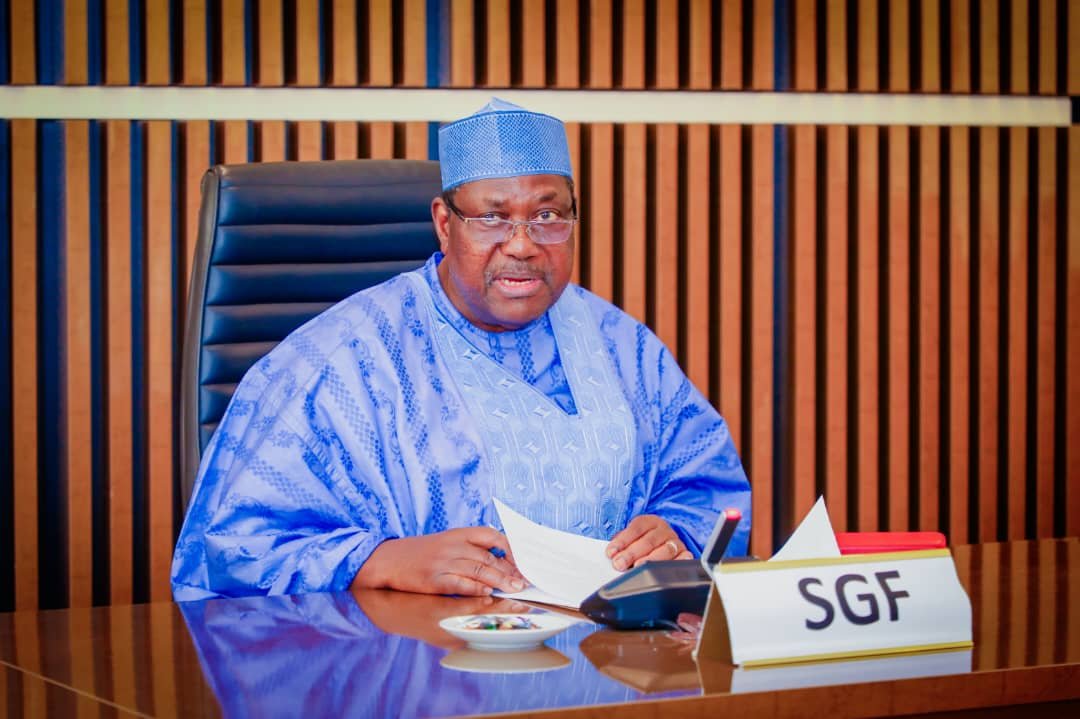
Secretary to the Government of the Federation Senator George Akume has confirmed that former Vice President Atiku Abubakar, now seeking the presidency on the African Democratic Congress platform, was personally present at the gathering of founding PDP leaders that agreed to institutionalize rotational presidential power between Nigeria’s North and South following the political crisis unleashed by the annulment of the June 12, 1993 election.
Akume made the disclosure at a press conference in Abuja convened as part of Nigeria’s 27th Democracy Day anniversary commemorations, providing a firsthand account of the meeting at which one of the defining principles of the PDP’s early years and a lasting feature of Nigeria’s post-1999 political culture was negotiated and settled.
The meeting, he said, was convened in Kaduna by the late Chief Solomon Lar and brought together senior founding figures including Alhaji Adamu Ciroma, with the agenda centered on how to respond constructively to the political vacuum and national trauma created by the annulment of the election that Chief Moshood Abiola had won in a result widely regarded as the most credible popular mandate in the country’s electoral history.
Akume described the deliberations as genuinely contentious, with significant disagreement among the participants before a consensus emerged that alternating the presidency between North and South was both politically necessary given the bitterness of the June 12 wound and institutionally wise as a mechanism for managing the country’s regional diversity over successive election cycles. Atiku, he said, was part of that agreement and understood the principle it represented when he put his name to it.
The disclosure carried obvious contemporary resonance at a moment when Atiku, a northerner, was actively pursuing a third presidential candidacy despite the principle having already produced two northern presidencies in the post-1999 period and a broader consensus that the presidency should remain in the South through the 2027 cycle.
Akume used the broader Democracy Day address to reflect on how far Nigeria’s democratic institutions had travelled since 1993, expressing confidence that the electoral system had developed sufficient resilience and institutional memory to prevent a recurrence of the kind of authoritarian intervention that had derailed democratic progress in that year. He said the most fundamental lesson the June 12 experience had embedded in Nigeria’s political consciousness was the principle that the expressed will of the electorate was supreme and that no institution or interest had the authority to override it.