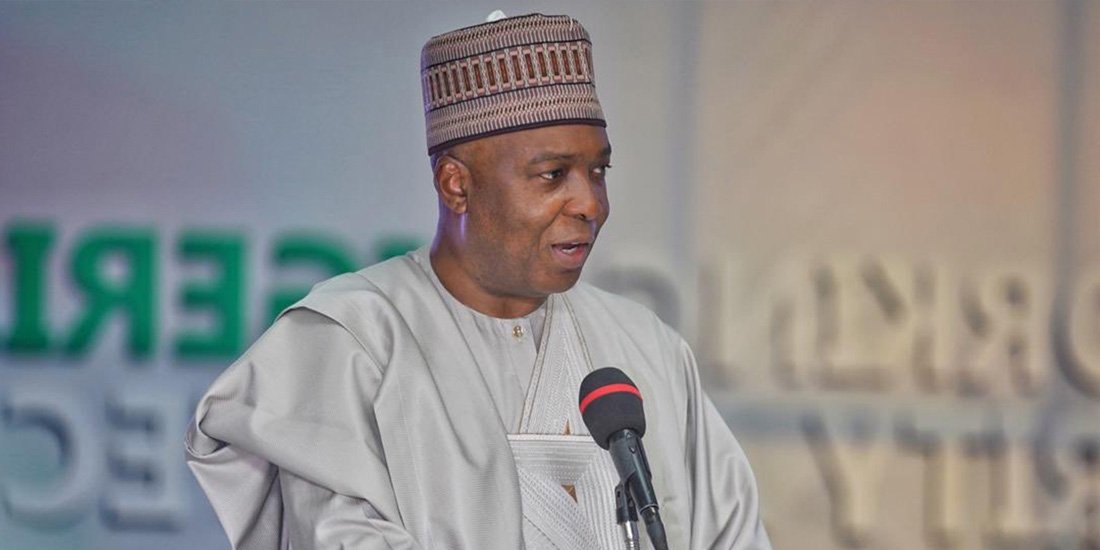
Former Senate President, Dr. Bukola Saraki, has said Africa cannot rely on foreign development assistance to close its annual infrastructure financing gap, estimated at between $130 billion and $170 billion, urging the continent to focus instead on domestic resource mobilisation, industrialisation and stronger institutions.
Saraki made the remarks during a panel session at the Global Strategic Advisory Group (GSAG) meeting held at Villa La Collina in Lake Como, Italy, where participants examined the implications of the United States’ withdrawal from international development assistance.
Speaking on the theme, “Development Policies—Withdrawal of the U.S. from International Development: Opportunities and Challenges,” Saraki described the shift in U.S. foreign aid policy as one of the most significant changes in the global development landscape since the end of the Cold War.
While acknowledging that the reduction in American development assistance would have immediate humanitarian consequences, he argued that the development presents Africa with an opportunity to redefine its growth strategy and become less dependent on foreign aid.
According to him, the restructuring of USAID programmes and Washington’s increasing focus on domestic priorities signal a long-term transformation rather than a temporary policy adjustment, making it necessary for African countries to rethink their approach to development.
Saraki noted that funding cuts have already disrupted health supply chains, emergency nutrition programmes and support for civil society organisations, warning that millions of additional HIV infections could occur if financing gaps are not addressed.
However, he stressed that replacing lost donor funding should not become Africa’s primary objective.
Instead, he urged African leaders to build a development model anchored on stronger governance, sustainable financing, local value addition and strategic partnerships.
“I believe the current moment should not be viewed as a threat to development, but as its greatest opportunity for renewal,” Saraki said. “Africa must seize this moment not to replace one dependency with another, but to redefine development cooperation altogether.”
Reflecting on Africa’s economic history, Saraki argued that many countries on the continent still operate economic systems inherited from the colonial era, exporting raw materials while importing higher-value finished products.
He also said donor priorities have often shaped Africa’s development agenda, sometimes at the expense of the continent’s own long-term needs.
Drawing from his experience as Senate President, Saraki recalled that attempts to strengthen legislative oversight of foreign borrowing frequently met resistance because governments often viewed external loans as easy financing options without sufficient consideration for repayment obligations or long-term economic benefits.
He further criticised donor-funded programmes that, in his view, created more economic opportunities for donor countries than for African economies.
Saraki identified three major weaknesses in the traditional development assistance model.
First, he said aid has never been sufficient to meet Africa’s financing needs. While the continent requires between $130 billion and $170 billion annually for infrastructure, official development assistance has averaged only about $34 billion in recent years.
He emphasised that development assistance should complement—not replace—domestic revenue generation and private sector investment.
Secondly, he argued that most donor-funded projects are too short-term to build lasting institutions.
According to him, developing efficient public institutions, independent judicial systems, accountable public finance structures and professional civil services requires decades of sustained investment rather than the typical three-to-five-year project cycles.
Thirdly, Saraki said the current global development framework has failed to address trade structures that keep African economies dependent on raw commodity exports.
He pointed out that although Africa produces more than 70 per cent of the world’s cocoa, it earns less than five per cent of the estimated $130 billion global chocolate market.
He also cited Nigeria’s role as a leading producer of raw shea nuts while receiving only a small share of the global shea products industry, arguing that inadequate local processing costs the continent more than $100 billion annually in lost value.
Despite these challenges, Saraki said the changing geopolitical environment presents Africa with new opportunities as global powers, including China, Europe, India, the Gulf states, Turkey and Russia, increasingly seek stronger economic ties with the continent.
He cautioned, however, that African countries must negotiate from a position of strength by developing clear economic priorities rather than merely responding to external offers.
Saraki called for greater investment in industrialisation and local processing of strategic resources such as lithium, cocoa, bauxite, cotton and timber, saying value addition would create jobs, promote technology transfer and increase export earnings.
He also urged European countries to reform trade policies to provide better market access for manufactured African products instead of encouraging continued exports of raw materials.
On domestic reforms, the former Senate President stressed the need to improve tax collection, strengthen fiscal accountability and enhance legislative oversight of public finances.
He noted that Sub-Saharan Africa’s average tax-to-GDP ratio remains significantly lower than that of developed economies, with Nigeria ranking among the lowest globally.
Saraki also advocated greater mobilisation of African capital, highlighting increasing diaspora remittances and the growing role of African financial institutions, including Afreximbank, in financing development across the continent.
He maintained that transparent institutions, credible elections, independent judiciaries and sound public financial management remain critical to attracting investment and reducing dependence on foreign assistance.
He further described Africa’s youthful population as one of its greatest assets, urging governments to invest more in education, digital skills, entrepreneurship and innovation to transform the continent’s demographic advantage into sustainable economic growth.
Saraki also called for faster implementation of the African Continental Free Trade Area (AfCFTA), noting that intra-African trade remains well below levels recorded in Europe despite the bloc’s estimated $3.4 trillion single market.
He concluded by urging African governments to deepen regional integration, strengthen democratic institutions and pursue production-driven economic policies.
“The question before us is not how quickly we replace what has been withdrawn,” Saraki said. “The question is whether we have the wisdom and determination to build something better. Africa does not need new patrons; it needs genuine partners willing to invest in its institutions, industries, infrastructure, innovation and people.”