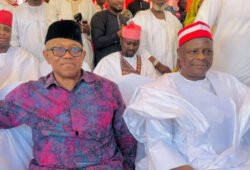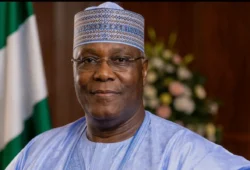
Peter Obi and Rabiu Musa Kwankwaso have formally defected to the Nigeria Democratic Congress in a seismic political development that analysts are already describing as the most consequential opposition realignment in Nigeria since the merger that produced the All Progressives Congress ahead of the 2015 general elections, fundamentally altering the balance of political forces and injecting unprecedented energy into what had until now been a fragmented and directionless opposition landscape.
The announcement, which sent immediate shockwaves through political circles in Abuja and state capitals across the country, brings together two of the most recognisable, battle-tested, and regionally influential figures in Nigerian opposition politics under a single organisational roof at a moment when the ruling establishment had appeared increasingly comfortable with the prospect of facing a divided and strategically incoherent opposition in 2027.
That comfort, political observers now suggest, may have evaporated overnight.
The Road to Realignment
The decision did not emerge suddenly. Sources with direct knowledge of the negotiations revealed that senior political operatives and trusted intermediaries had been holding discreet, high-level consultations for several weeks, working through the complex personal, ideological, and strategic considerations that had previously kept both leaders on separate and sometimes competing political trajectories.
The discussions were reportedly driven by a shared and sobering analysis of opposition arithmetic in Nigeria, one that concluded that the combined forces of Obi and Kwankwaso operating on separate platforms would once again divide the anti-incumbency vote, hand the ruling party an advantage it had not necessarily earned, and repeat the painful pattern of 2023 in which a fragmented opposition collectively outperformed the ruling party in public enthusiasm but was outmaneuvered in electoral outcomes.
Both leaders are said to have arrived at the conclusion that the structural logic of Nigerian electoral politics in 2027 demanded consolidation, not competition, and that the NDC, under the leadership of Senator Seriake Dickson, offered a platform with sufficient institutional credibility and organisational infrastructure to serve as the vehicle for a genuinely unified opposition campaign.
The final decision was made after extensive individual consultations with close political associates, party elders, regional stakeholders, and community leaders whose buy-in both figures considered essential before making any commitment that would reshape not only their own political futures but the expectations of millions of supporters who had invested personal trust in their leadership.
What Each Leader Brings
The political significance of this realignment derives not merely from the fact of its occurrence but from the extraordinary complementarity of what each figure brings to the new arrangement.
Peter Obi enters the NDC as perhaps the most electronically visible and emotionally resonant opposition figure in contemporary Nigerian politics. His 2023 Labour Party presidential campaign generated a level of popular passion, particularly among young, urban, educated, and economically frustrated Nigerians, that no opposition candidacy had produced in living memory. The movement that coalesced around him, loosely described as the Obidient movement, demonstrated a capacity to mobilise first-time voters, command social media narratives, and sustain civic energy across months of campaigning in ways that conventional party machinery could not manufacture.
His appeal extends across religious and to some degree ethnic boundaries, drawing support from Christian communities in the South-East and South-South, educated voters in Lagos and other major urban centres, and diaspora Nigerians whose remittances and social media influence have become increasingly relevant to domestic political discourse. His reputation for personal frugality, administrative competence as a former Anambra governor, and consistent messaging around economic productivity and governance accountability has given him a brand that transcends conventional party loyalty.
Kwankwaso brings an entirely different but equally formidable set of political assets. A former governor of Kano State, former Minister of Defence, and senator with decades of political experience across multiple parties, he commands loyalty across one of Nigeria’s most populous states and has built the Kwankwasiyya movement into a durable grassroots political organisation with real penetration into the wards and local government councils where Nigerian elections are actually won and lost.
His influence in Kano alone, a state with over three million registered voters and a history of determining presidential outcomes in the North-West, makes him a figure that any serious presidential campaign must reckon with. Beyond Kano, his network extends across Jigawa, Katsina, and other northern states where personal political relationships and the patronage structures he has cultivated over decades translate directly into voter delivery capacity.
The combination of Obi’s mass urban appeal and Kwankwaso’s deep northern roots addresses two of the most critical electoral geography challenges any opposition presidential candidate must solve. Together, they potentially assemble the outline of a winning coalition.
The NDC as the Chosen Vehicle
The choice of the NDC as the platform for this realignment was itself a deliberate and consequential decision. The party, led by its national leader Senator Seriake Dickson, the former Bayelsa State governor, had been quietly building its organisational capacity and expanding its membership base over the preceding months, welcoming several prominent political figures including former Adamawa governorship candidate Senator Aishat Binani in moves that suggested a systematic effort to position the party as the credible alternative home for opposition-minded politicians.
Dickson had been vocal in his framing of the NDC as a party that genuinely valued women, youth, and grassroots participation over the elite-dominated transactional politics he argued characterised the established parties. His consistent rhetoric about building a policy-driven, membership-owned party appears to have resonated with both Obi and Kwankwaso as a framework consistent with their own stated political philosophies.
The party’s growing membership numbers in key states, its increasingly visible national secretariat operations, and the calibre of figures it had attracted provided a structural foundation that a new movement built entirely from scratch would have taken years to replicate. For both leaders, joining the NDC offered the opportunity to lead a party with existing institutional infrastructure while simultaneously reshaping its direction and expanding its reach.
The Immediate Political Impact
The announcement has already produced immediate and measurable effects on Nigeria’s political temperature. In Abuja, political operatives from multiple parties were described as scrambling to assess the implications for their own organisations’ positioning. State governors, legislators, and party officials who had been watching the opposition landscape with cautious detachment were suddenly confronted with a realignment that demanded a response.
Within the ruling APC, sources described a mix of concern and calculated scepticism, with some officials acknowledging privately that the development changed the competitive calculus for 2027 while others argued publicly that governing performance rather than opposition configuration would ultimately determine electoral outcomes. Regardless of how the ruling party chose to interpret the development publicly, the private urgency of its response was itself revealing.
Within the Peoples Democratic Party, already battered by the Supreme Court’s nullification of its Ibadan convention and struggling to project credibility as a united force, the defection of two figures who had previously been seen as potential PDP alliance partners further complicated its already difficult path to relevance in 2027. The party’s inability to serve as the unifying platform for opposition forces, despite its historical stature and national infrastructure, was now more starkly apparent than ever.
The Reform Agenda
Both leaders, in their respective public remarks following the announcement, were careful to frame the defection in terms that extended beyond electoral calculation. Obi spoke of the NDC as the platform through which a new governance philosophy could be translated into national policy, emphasising his longstanding themes of productivity over consumption, investment in human capital, and the redistribution of government priorities away from recurrent expenditure toward capital development.
Kwankwaso similarly emphasised the need for a governance approach that genuinely addressed the economic desperation of ordinary northern Nigerians, arguing that the region’s chronic underdevelopment, insecurity, and youth unemployment were fundamentally products of poor governance choices rather than structural inevitabilities. He framed his alignment with Obi not as a marriage of political convenience but as a convergence of diagnostic agreement about what ailed Nigeria and what its recovery required.
Together, they committed to a policy development process that would produce a serious, detailed, and independently costed governance programme rather than the vague aspirational language that had characterised opposition campaigns in previous electoral cycles. The credibility of that commitment will be tested in the months ahead as the NDC moves to translate political momentum into substantive policy architecture.
What Happens Next
With the realignment now public, attention shifts to the structural work that will determine whether the political energy generated by the announcement can be sustained and translated into electoral outcomes. Several immediate priorities will define the NDC’s capacity to capitalise on the moment.
The party will need to move quickly to establish a functional presence in all 36 states and the Federal Capital Territory, moving beyond the pockets of strength it currently possesses in states where its founders and prominent members have established networks. Ward-level organising, membership registration, and the cultivation of credible local candidates for National Assembly and governorship races will be as important as the presidential contest in determining whether the party can sustain momentum across a full electoral cycle.
The management of the internal dynamics between the Obi and Kwankwaso camps will also require skilful leadership. Both figures arrive with distinct political organisations, loyalist networks, and strategic preferences that have not always aligned in the past. The history of Nigerian opposition politics is littered with promising alliances that collapsed under the weight of competing ambitions and irreconcilable differences over candidate selection, resource allocation, and decision-making authority.
Preventing a repeat of that history will require institutional structures, transparent internal processes, and a shared commitment to collective discipline that must be demonstrated rather than merely asserted. Both leaders are aware of this challenge and are said to have discussed governance mechanisms for the alliance explicitly as part of the negotiations that preceded the announcement.
The question of presidential candidacy, inevitably the most contested decision any coalition must make, has not been publicly resolved and will eventually require a transparent and credible internal process whose outcome both men and their supporters can accept. How that process is managed will be a defining test of the NDC’s institutional maturity.
A New Political Era
What is beyond reasonable dispute, regardless of how 2027 ultimately unfolds, is that Nigerian opposition politics has entered a qualitatively new phase. The convergence of Obi and Kwankwaso under the NDC platform has introduced a level of strategic seriousness, popular anticipation, and competitive pressure into the opposition space that was entirely absent before this announcement.
For millions of Nigerians who have grown increasingly frustrated with governance performance, economic hardship, and security deterioration under the current administration, the development offers something that has been in short supply since the disappointments of 2023, namely a reason to believe that the political system may yet produce a genuine alternative rather than simply recycling familiar faces in familiar formations.
Whether that belief is ultimately rewarded will depend on the quality of leadership, the discipline of execution, and the integrity of the process through which the NDC develops and presents its offer to the Nigerian electorate. The promise of the moment is real. So too are the challenges that stand between this announcement and the outcome it portends.
The countdown to 2027 has begun in earnest. And for the first time in a long time, the ruling establishment may have genuine reason to take it seriously.