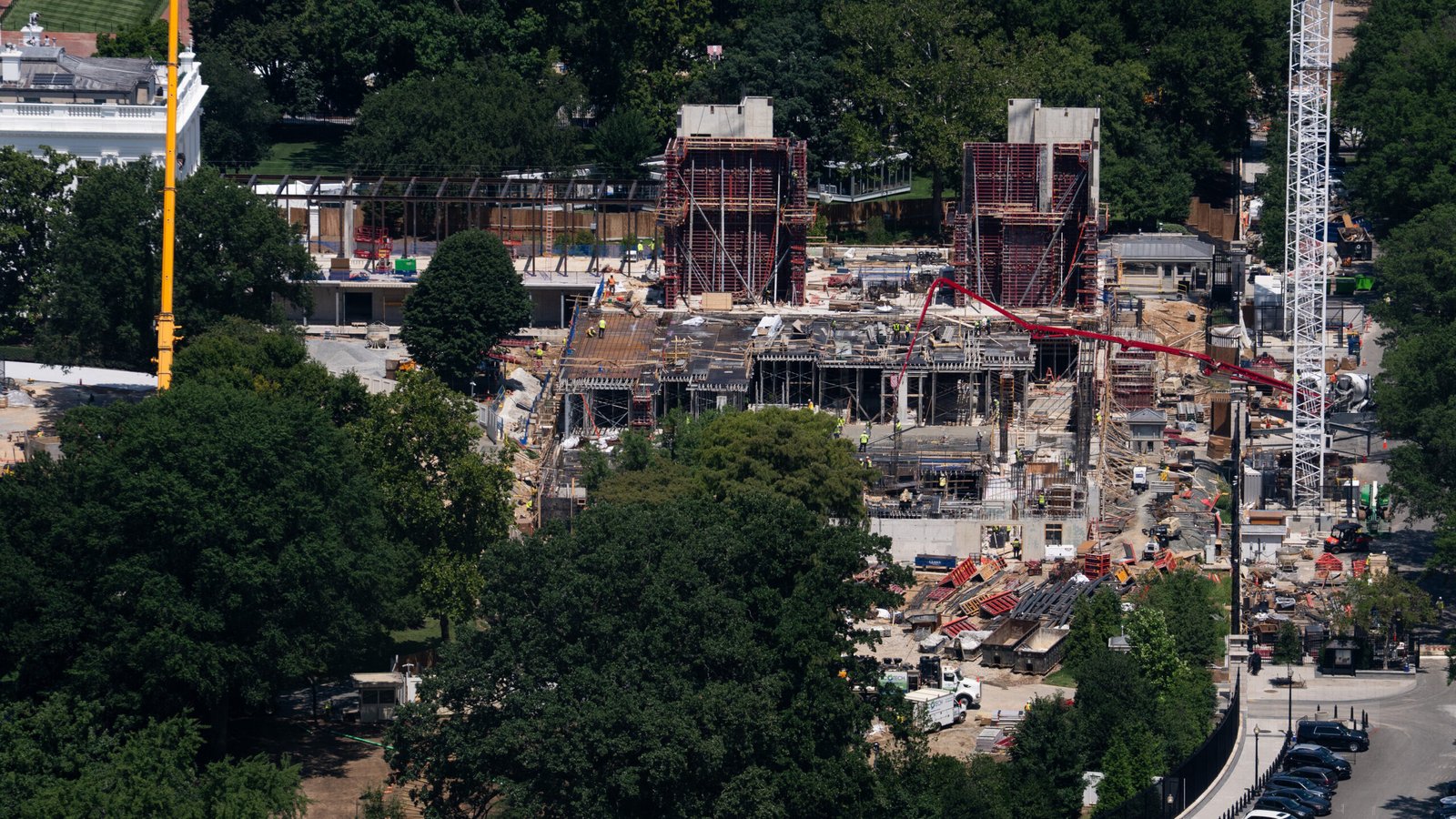
A US federal appeals court has ordered the Donald Trump administration to halt above-ground construction of a proposed $400 million ballroom at the White House, dealing a major setback to the president’s plans to transform the site of the demolished East Wing.
The US Court of Appeals for the District of Columbia Circuit ruled 2-1 that the administration could not proceed with the construction without congressional approval.
The court’s majority stressed that the president is only a temporary occupant of the White House and cannot unilaterally undertake major changes to the historic complex.
“Each President is a temporary tenant, not the owner, of the White House,” the judges said, according to Reuters.
The ruling upheld a preliminary injunction secured by the National Trust for Historic Preservation, which challenged the project after the administration demolished the East Wing and began work on the proposed 90,000-square-foot ballroom without seeking approval from Congress.
“Whether or not a massive ballroom should be constructed is for Congress to decide,” the majority ruled.
The appeals court has suspended the effect of its decision for 14 days to give the Trump administration time to appeal to the US Supreme Court.
Trump has strongly criticised the ruling and indicated that his administration would take the case to the Supreme Court.
Describing the decision as “horrendous” and politically motivated, Trump argued that the project was necessary for White House security. He has increasingly described the proposed ballroom as a security facility, saying it would include bomb shelters, medical facilities and protection against drones and missiles.
“This unjust decision must be overturned by the Supreme Court in its entirety,” Trump said in a post on Truth Social.
The National Trust for Historic Preservation welcomed the court’s decision. Its president, Brent Leggs, described the ruling as “a great day for our country” and for Americans’ right to participate in decisions concerning historic places.
The case followed two earlier rulings by US District Judge Richard Leon, who blocked above-ground construction while allowing underground work to continue.
During arguments before the appeals court, Justice Department attorney Yaakov Roth argued that the courts should not interfere with the privately funded project, maintaining that national security concerns outweighed objections to the construction.
However, Democratic-appointed Circuit Judges Patricia Millett and Brad Garcia rejected the administration’s argument that national security could override legal requirements.
“National security arguments are not an automatic get-out-of-law-free card,” the majority said.
The judges said their ruling did not permanently prevent construction of a ballroom but halted above-ground work while the legal challenge continues and until the administration obtains congressional approval.
Circuit Judge Neomi Rao, a Trump appointee, dissented, arguing that the lower court had exceeded its authority by intervening in construction at the White House.
“The district court seized supervision of construction at the White House, and my colleagues affirm this judicial overreach,” Rao wrote.
The ballroom project is among several controversial efforts by Trump to reshape prominent government and cultural sites in Washington. The administration has defended the project as necessary to accommodate large formal events while improving security at the presidential residence.