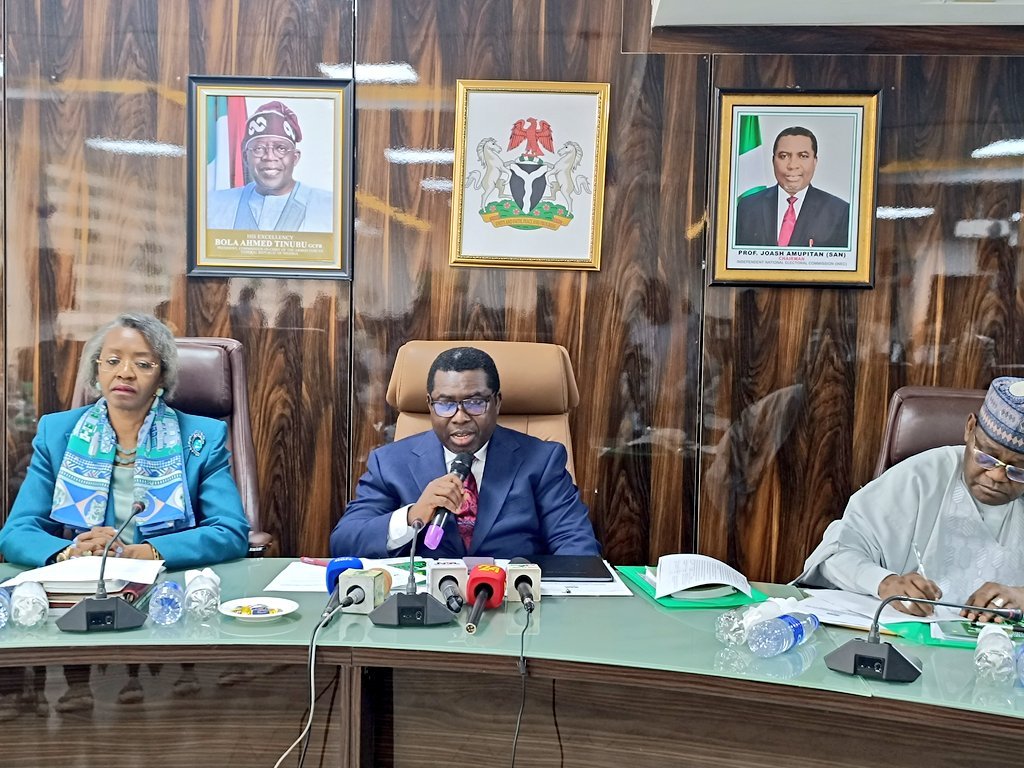
The Chairman of the Independent National Electoral Commission, Prof. Joash Amupitan, has explained the Commission’s decision to challenge two recent Federal High Court judgments concerning aspects of its Timetable and Schedule of Activities for the 2027 General Election, saying a lack of coordinated electoral timelines could create uncertainty and hinder effective election management.
Prof. Amupitan made the clarification on Tuesday during the Second Quarterly Consultative Meeting with leaders of political parties held at the Commission’s headquarters in Abuja.
According to the INEC chairman, the first judgment, delivered on May 20, 2026, in the case of Youth Party v. INEC, questioned certain timelines contained in the Commission’s electoral schedule. A second ruling, delivered on May 26, 2026, in Social Democratic Party (SDP) v. INEC, affirmed INEC’s authority to issue an election timetable but nullified specific timelines relating to the nomination and substitution of candidates.
Amupitan said the rulings raised significant legal questions regarding the scope of the Commission’s constitutional and statutory powers in coordinating and regulating electoral activities.
“These judgments raise important legal questions concerning the extent of the Commission’s constitutional and statutory powers in coordinating and regulating electoral activities,” he said.
The INEC chairman disclosed that the Commission had filed appeals against both judgments and taken the necessary legal steps to obtain definitive interpretations from the appellate courts.
He emphasized that electoral activities contained in the timetable are interconnected processes that must be implemented within a coordinated framework to ensure the smooth conduct of elections.
According to him, several critical election-related activities are not assigned specific timelines under the Electoral Act but must still be incorporated into the overall election calendar. These include the submission and verification of political party membership registers, monitoring of party primaries nationwide, uploading of primary election results to the Commission’s portal, printing of ballot papers and result sheets, quality assurance processes, configuration of the Bimodal Voter Accreditation System (BVAS), and compliance with statutory requirements such as allowing political parties to inspect election materials.
“The Commission considers it imperative that all electoral activities be harmonised within a coherent and workable framework that promotes certainty, transparency, administrative efficiency and equal treatment of all political parties,” Amupitan stated.
He assured political parties and the public that despite the pending appeals, INEC remains committed to conducting the 2027 General Election in full compliance with the Constitution and the Electoral Act.
Ekiti Governorship Election Preparations on Track
Speaking on preparations for the upcoming governorship election in Ekiti State scheduled for June 20, 2026, Amupitan disclosed that the state’s voter register now contains 1,059,360 registered voters.
He explained that the figure includes 66,664 new registrants added through the Continuous Voter Registration exercise to the 2023 voter register of 987,647 voters. He added that 2,103 cases of double registration had been detected and invalidated to safeguard the integrity of the register.
The INEC chairman said logistics, technology deployment, and the training of election personnel were progressing as planned. He reaffirmed the Commission’s commitment to ensuring that all 2,445 polling units across the 16 local government areas of Ekiti State open simultaneously at 8:30 a.m. on election day.
Amupitan urged political parties and stakeholders to continue supporting the Commission’s efforts to deliver credible, transparent, and peaceful elections.