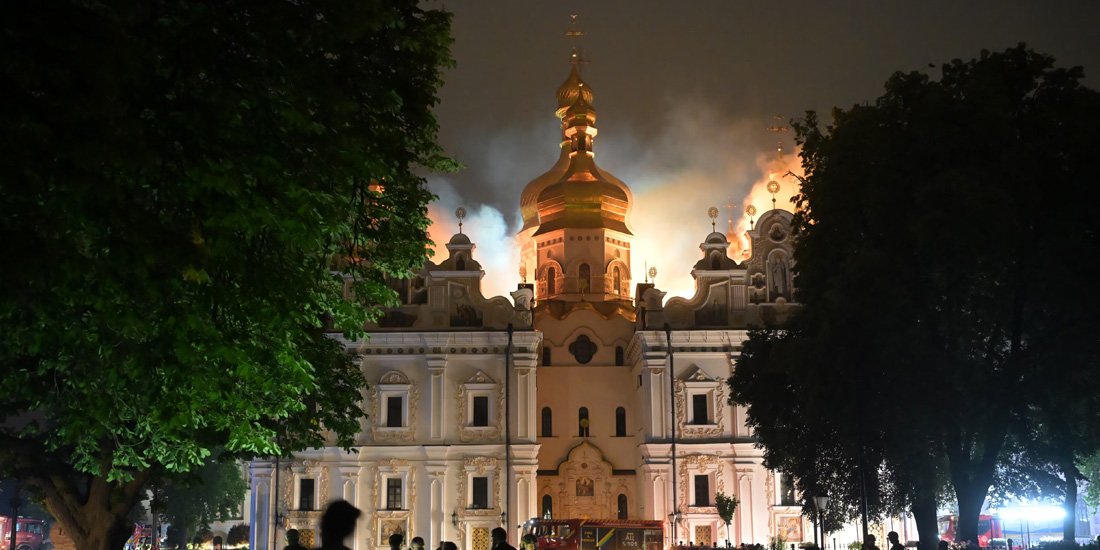
A devastating barrage of Russian missiles has struck several major Ukrainian cities, killing at least nine people and leaving Kyiv’s iconic, UNESCO-listed Dormition Cathedral in flames. The widespread escalation on Monday morning highlights the brutal reality of a conflict now entering its fifth year, contrasting sharply with recent diplomatic breakthroughs in the Middle East where a newly announced U.S.-Iran deal has begun to open a path toward peace.
In the capital city of Kyiv, the strikes killed four people and triggered a massive fire on the grounds of the historic Kyiv-Pechersk Lavra monastery complex. Firefighters swarmed the site, deploying more than a dozen fire trucks and using aerial platforms to battle a raging blaze on the roof of the landmark Dormition Cathedral. Witnesses described a scene of chaos as residents fled for cover while air defense systems intercepted projectiles overhead, showering the city in glowing debris. The targeted cathedral sustained severe structural damage, with a gaping hole ripped into one side of the building and its roof partially destroyed.
The attack drew fierce condemnation from Ukrainian leaders. Tymur Tkachenko, head of the local military administration, denounced the “direct strike” on the historic complex, while Kyiv’s Metropolitan Epiphanius labeled the attack a “crime against humanity, history, and Christianity.” The strike further complicates the fraught history of the golden-domed monastery. In recent years, Ukrainian authorities expelled its resident monks over alleged ties to Moscow. The Orthodox Church of Ukraine officially severed ties with Russia in 2022, following the full-scale invasion, and the Ukrainian government subsequently banned the Russian-linked branch of the church due to its institutional alignment with President Vladimir Putin. Beyond the cultural devastation, the strikes in Kyiv left at least 23 people injured and cut off electricity to roughly 140,000 residents in the city’s northern districts.
The assault also heavily targeted the northeastern city of Kharkiv, where a secondary strike turned fatal for first responders. According to Ukraine’s Interior Minister, Igor Klymenko, five State Emergency Service rescuers were killed and nine others injured when a follow-up Russian missile struck the area while they were actively fighting a fire from an initial hit. In the Dnipropetrovsk region, local military head Oleksandr Hanzha confirmed that the city of Dnipro was hit, leaving one person wounded. Meanwhile, in the northeastern Sumy region, regional head Oleg Grygorov reported three injuries, including a child.
As Russia pounded Ukrainian urban centers, Kyiv launched its own cross-border aerial response. A Ukrainian drone strike successfully penetrated Russian airspace, striking the city of Tula, located roughly 200 kilometers south of Moscow. Regional Governor Dmitry Milyaev confirmed on Monday that the drone attack killed three people and left three others wounded. In recent weeks, Ukraine has increasingly stepped up its long-range aerial campaigns, primarily aiming to disrupt Russia’s oil infrastructure and choke off the revenues funding the Kremlin’s war machine.
The surge in violence on the ground coincided with a flurry of diplomatic activity behind the scenes. Both Ukrainian President Volodymyr Zelensky and Russian President Vladimir Putin held separate telephone conversations with U.S. President Donald Trump on Sunday to discuss the trajectory of the war. President Zelensky described his call as a substantive discussion on measures that “could help bring about peace now.” Conversely, the Kremlin indicated that Putin’s conversation with Trump leaned heavily on broader geopolitical negotiations involving the United States and Iran. Kremlin adviser Yury Ushakov noted that U.S. presidential special representatives Steve Witkoff and Jared Kushner, who are currently managing Iranian diplomatic affairs, are expected to return to Russia in the near future. Despite the back-channel political maneuvering, the bloodshed on Monday underscores the immense human cost of Europe’s worst conflict since World War II, which has already claimed the lives of thousands of civilians and hundreds of thousands of military personnel.