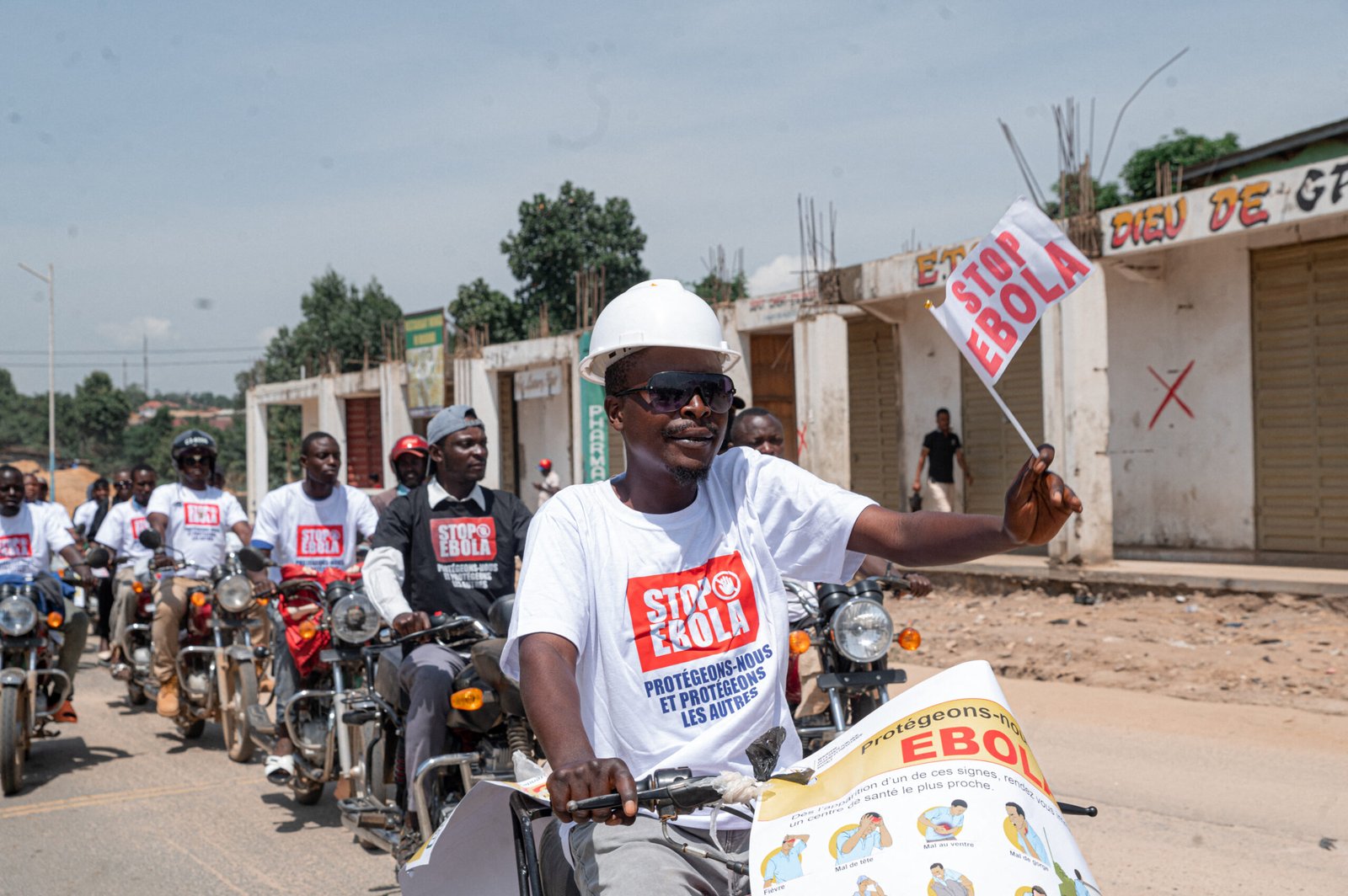
Anxiety is mounting among displaced families in eastern Democratic Republic of Congo (DRC) as fears grow that an Ebola outbreak could sweep through overcrowded camps already struggling with poor sanitation and limited access to clean water.
At the Kingonze displacement camp on the outskirts of Bunia in Ituri province—one of the epicentres of the current outbreak—residents say they are terrified of what would happen if the virus enters their community of more than 25,000 people.
“If Ebola comes, we’ll be wiped out as we’re packed like sardines,” said Dorcas Mapenzi, one of thousands sheltering in the camp.
The Ebola virus, which spreads through close contact and bodily fluids, has intensified concerns in a region already weakened by years of armed conflict that has forced millions from their homes into overcrowded settlements.
Nearly one million displaced people are currently living in Ituri province, where insecurity and humanitarian challenges have made disease prevention efforts increasingly difficult.
The World Health Organization (WHO) has warned that eastern DRC is facing what it described as a “catastrophic collision of disease and conflict,” with ongoing violence hindering response efforts.
WHO Director-General Tedros Adhanom Ghebreyesus, who recently visited Bunia, called for increased international support and funding to contain the outbreak and strengthen community awareness. He also stressed the need to address misinformation and build trust among affected populations.
The current Ebola outbreak, officially declared on May 15 in both the DRC and neighbouring Uganda, has already recorded hundreds of cases. As of early June, WHO reported 515 confirmed cases and 91 deaths in the DRC, alongside 19 cases and two deaths in Uganda.
‘We live in impossible conditions’
While no infections have yet been confirmed in the Kingonze camp, humanitarian conditions are raising alarm among health experts.
Residents describe extreme overcrowding and poor sanitation, conditions that could accelerate the spread of infectious diseases.
“We displaced people here have no hygiene,” said Mapenzi. “Our children play next to filthy toilets and even relieve themselves on the ground in the middle of the tarpaulins that serve as our homes.”
Another resident, Deborah Nzale, who lives with nine family members in a small tarpaulin shelter, said social distancing would be impossible in the camp.
“We sleep piled on top of each other,” she said. “Given these conditions, how are we going to protect ourselves when everyone tells us to distance ourselves to fight Ebola?”
No vaccine or specific treatment exists for the Bundibugyo strain of Ebola driving the current outbreak, leaving authorities reliant on isolation, hygiene measures, and contact tracing to contain its spread.
“If a single person gets infected here in this camp, everyone will die,” Nzale warned.
‘We don’t even have soap’
Residents say basic preventive resources remain unavailable. While awareness posters warning that “Ebola really kills” are displayed at camp entrances, many complain that hygiene supplies are lacking.
“I don’t even have soap to wash my hands,” said Budjo Amos, another displaced resident. “People come to raise awareness, but we don’t have the kit we need to protect ourselves.”
With only one borehole serving the entire camp, access to clean water is severely limited, with residents often queuing for hours as supplies run low.
“The most urgent thing is to give us clean water,” Amos added.
Calls for urgent intervention
Humanitarian officials and local authorities have warned that without urgent intervention, the outbreak could spread rapidly through displacement sites across Ituri.
Lieutenant General Johnny Luboya Nkashama, the provincial military governor, said the region hosts around 61 displacement camps sheltering nearly 970,000 people, many of whom lack access to adequate healthcare facilities.
“We need to deploy equipment and qualified, specialist medical staff as quickly as possible to spare this province from disaster,” he said.
Aid groups have also raised concerns about delays in the response, noting that essential supplies such as isolation tents and medical equipment remain insufficient in many health centres.
As the outbreak continues, displaced families like those in Kingonze say they are left waiting—and hoping—that Ebola does not reach their already fragile community.