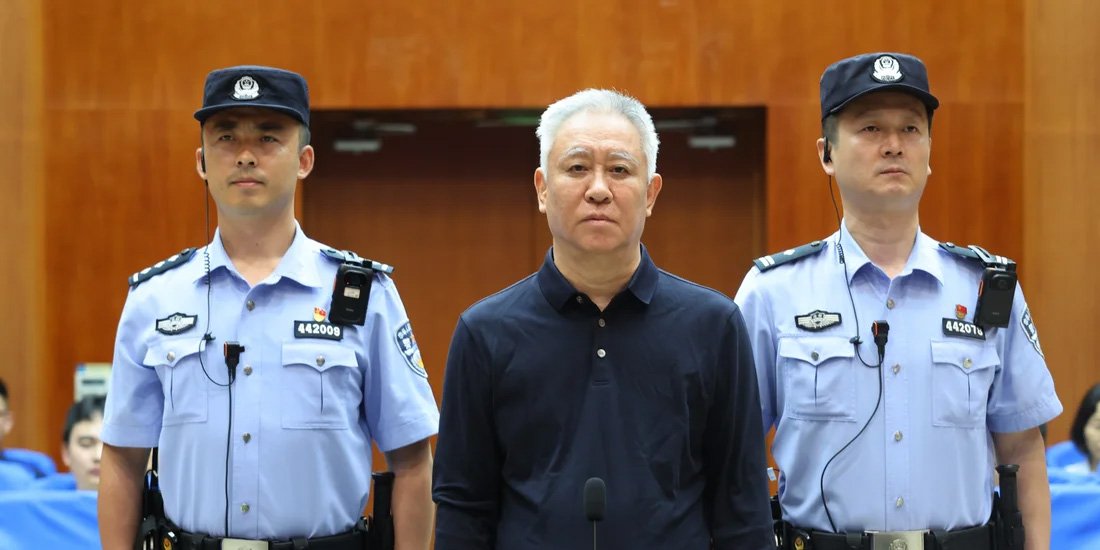
A Chinese court has sentenced Hui Ka Yan, founder of China Evergrande Group, to life imprisonment over a series of financial crimes linked to the collapse of the heavily indebted property developer.
Hui, once regarded as Asia’s richest man, was sentenced on Thursday in the southern city of Shenzhen, five years after Evergrande’s financial troubles sent shockwaves through China’s property sector and financial markets.
According to Reuters, Hui pleaded guilty in April to eight charges, including misuse of funds, fundraising fraud, illegally taking public deposits, illegally extending loans, fraudulent issuance of securities and bribery.
The court also ordered the confiscation of all of Hui’s personal property.
Evergrande, once China’s largest property developer by contracted sales, has defaulted on most of its approximately $300 billion in liabilities. Its collapse has become a major symbol of the prolonged crisis in China’s property sector, which has continued to weigh on the world’s second-largest economy.
In a statement, the court said the criminal activities involving Evergrande, its main subsidiary Hengda Real Estate and Hui involved “particularly huge amounts” and had caused significant economic losses and serious social harm.
The court also fined Evergrande 8.82 billion yuan (about $1.31 billion) and Hengda Real Estate 7 billion yuan.
Five other senior Evergrande executives were sentenced to prison terms ranging from six to 18 years and were also fined. State broadcaster CCTV reported that a total of 56 people linked to Evergrande, excluding Hui, received sentences on Thursday.
The ruling is unlikely to immediately provide relief to Evergrande’s domestic and international creditors, who continue to face significant losses following the company’s collapse.
Evergrande’s liquidators declined to comment on Hui’s sentence, while Reuters said it was unable to reach his legal representatives. Hui had not been seen publicly since Chinese authorities detained him in 2023 following the company’s default.
The collapse of Evergrande also triggered protests by investors after the company failed to repay billions of dollars invested in wealth-management products. Many of the affected investors were ordinary citizens who lost significant portions of their savings.
Comments posted by Evergrande homeowners on a social media group reflected anger and frustration over the company’s collapse, with some questioning what would happen to their money.
Hui founded Evergrande in 1996 after growing up in a rural village in central China’s Henan province. A former steel technician raised by his grandmother, he built the company into a property giant through an aggressive expansion strategy heavily dependent on borrowing.
His wealth reached an estimated $45.3 billion in 2017, making him the richest person in Asia at the time, according to Forbes.
The company’s fortunes subsequently deteriorated as China’s property market weakened and authorities tightened restrictions on excessive borrowing by developers.
A Hong Kong court ordered Evergrande to be liquidated in 2024, while the Hong Kong Stock Exchange delisted the company last year, effectively ending its dramatic rise and collapse.
The liquidation process has progressed slowly. According to the company’s liquidators, only about $255 million worth of assets had been sold as of last August, compared with creditors’ claims of approximately $45 billion.
Outside mainland China, liquidators have also pursued legal action to freeze offshore assets belonging to Hui and his former spouse as they seek to recover about $6 billion in dividends and remuneration allegedly paid to the founder and other former executives.
In a separate action in 2024, China’s securities regulator fined Hui $6.6 million and banned him from participating in the securities market for life after determining that Evergrande’s flagship unit had inflated its earnings and committed securities fraud.
Hui’s life sentence marks a dramatic end to the career of a businessman whose rise once epitomised China’s property boom, while the fallout from Evergrande’s collapse continues to reverberate across the country’s economy and financial system.