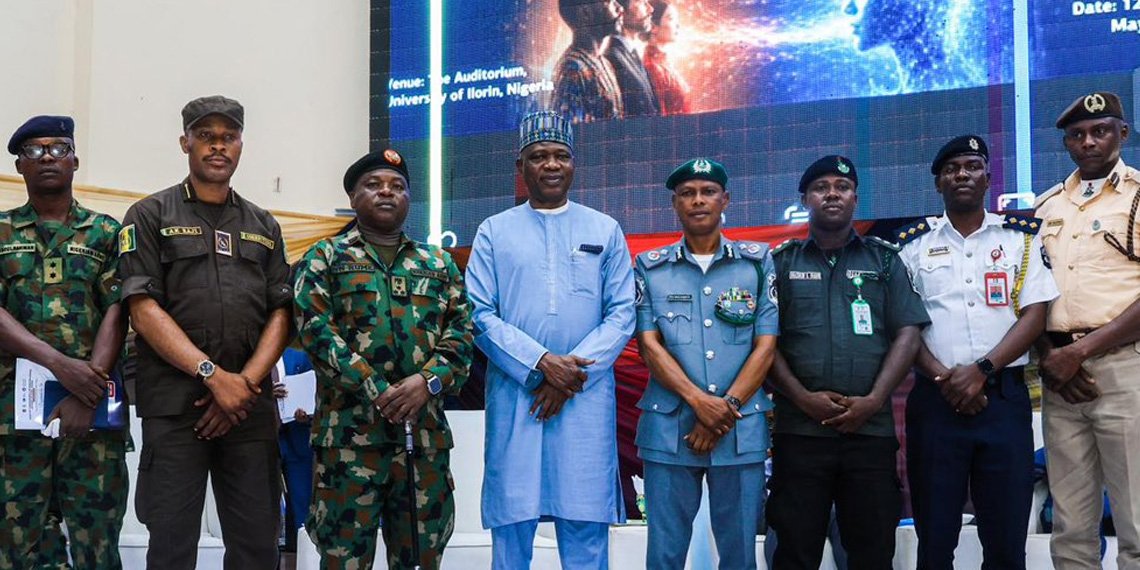
The Comptroller-General of the Nigeria Customs Service, Adewale Adeniyi, has reaffirmed his commitment to responsible digital transformation and innovation-driven governance while delivering a keynote address at the 4th Biennial International Conference hosted by the University of Ilorin.
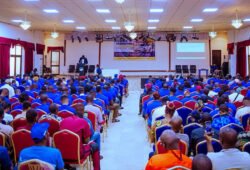
The conference, organised by the university’s Faculty of Communication and Information Sciences in collaboration with the Faculty of Philology of RUDN University, was held on Wednesday at the university’s main auditorium in Ilorin.
The event, themed “Disruptive Technology: Human and Artificial Intelligence in the Digital Economy,” attracted academics, communication experts, researchers, policymakers, and heads of government agencies to discuss the growing influence of digital innovation and artificial intelligence on governance, education, trade, and economic development.
Speaking during the conference, Adeniyi stressed the importance of balancing technological advancement with human responsibility, noting that the future of the digital economy depends not only on artificial intelligence but also on ethics, leadership, and institutional competence.
“The digital age is, in the end, a human story, and the real test of our generation is not how powerful our machines become, but how wisely our societies choose to use them,” he said.
The Customs boss observed that disruptive technologies such as digital payments, e-commerce, artificial intelligence, and smart systems have already transformed global operations, adding that societies are no longer preparing for disruption but are already operating within it.
According to him, government institutions must ensure that innovation strengthens transparency, accountability, and operational efficiency rather than undermining public trust.
Drawing from the experience of the Nigeria Customs Service, Adeniyi highlighted ongoing digital reforms within the agency, particularly the deployment of the B’Odogwu Unified Customs Management System.
He stated that the platform has significantly improved trade facilitation, cargo processing, and inter-agency collaboration.
The Comptroller-General disclosed that the system generated more than N230 billion at the PTML Command within its first eight months of operation, while reducing cargo clearance timelines for compliant traders to less than eight hours.
“The partnership, not the rivalry, between human and artificial intelligence is where the real value lies,” Adeniyi said, stressing that technology is most effective when guided by strong ethical standards and institutional purpose.
He added that although artificial intelligence can enhance efficiency, decision-making, and risk management, human leadership and expertise remain critical to governance and enforcement operations.
“Technology changes processes; leadership and expertise still deliver the results,” he noted.
Adeniyi also called for stronger collaboration between universities, research institutions, and public agencies to address emerging digital and governance challenges.
He urged academic institutions to move beyond theoretical teaching and become active contributors to innovation, policy development, and practical problem-solving.
The Customs chief identified areas where academia could support customs modernisation efforts, including digital compliance systems, AI-driven risk targeting, governance of cross-border data flows, and public trust communication strategies.
He further called on African nations to develop digital governance frameworks tailored to the continent’s realities, legal systems, and developmental priorities, stressing that technological progress must remain accountable to citizens.