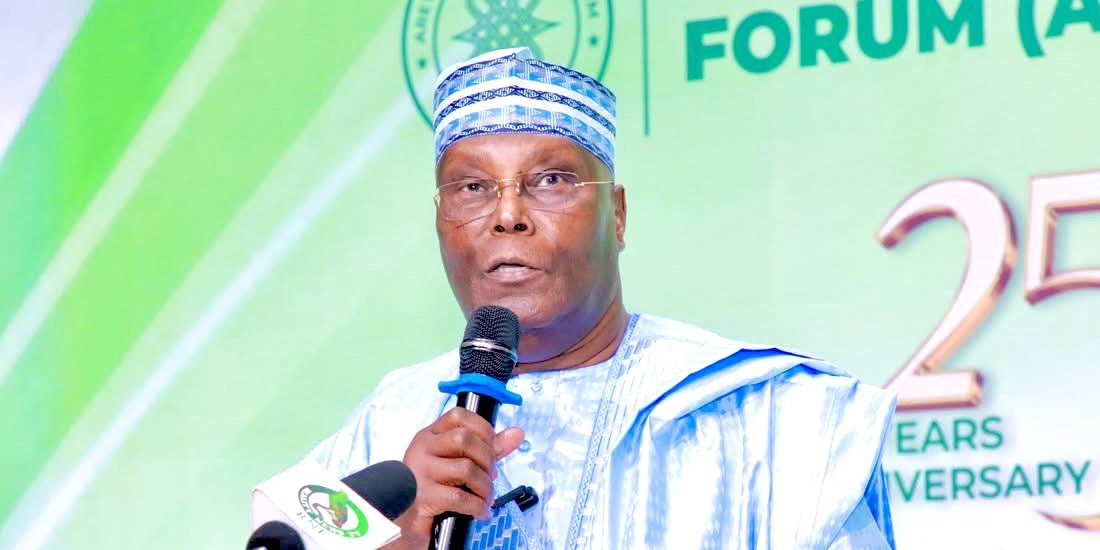
The presidential candidate of the African Democratic Congress (ADC), Atiku Abubakar, has criticised the Federal Government’s celebration of rising allocations from the Federation Account Allocation Committee (FAAC), describing the increase as a “money illusion” that does not reflect genuine economic growth.
Atiku, in a statement issued by his Senior Special Assistant on Public Communication, Phrank Shaibu, argued that the increase in nominal naira allocations had been eroded by currency depreciation, inflation and declining purchasing power.
He said Nigerians should not be misled by the growing trillions of naira announced after monthly FAAC meetings when the value of the currency had fallen significantly.
Atiku compared FAAC allocations in 2019 and 2025, saying distributions rose from approximately N7.85 trillion to N21.9 trillion in nominal terms, while their estimated dollar value fell from about $25.6 billion to $14.6 billion.
“That is not an economic miracle. That is money illusion. You cannot batter the currency, allow inflation to ravage purchasing power and then wave bigger naira figures before Nigerians as evidence that the country has become richer,” he said.
The former vice president also cited the minimum wage to illustrate what he described as the declining real value of Nigerians’ incomes.
According to him, N30,000 was worth approximately $83 in 2019 and about $65 by May 2023, while the current N70,000 minimum wage, at an exchange rate of about N1,320 to the dollar, was worth roughly $53.
Atiku argued that despite the nominal increase in wages, workers could still afford less food, transportation, electricity, healthcare and housing because of inflation and the depreciation of the naira.
He said the true measure of economic performance should be what government revenues can purchase, the debts they can settle, the infrastructure they can deliver and the improvement they bring to citizens’ living standards.
“If FAAC is truly booming, then where is the boom? Where is it in the price of food? Where is it in transport? Where is it in electricity, healthcare, housing and jobs?” he asked.
Atiku also questioned why state governments remained heavily indebted despite what he described as unprecedented increases in federal allocations.
He cited a September 2026 report based on Debt Management Office data, which he said showed that 12 states whose governors are nearing the end of their tenures had a combined debt burden of about N5.3 trillion, comprising N2.16 trillion in domestic debt and approximately $2.33 billion in foreign obligations.
He therefore challenged the Federal Government and state governments to explain how increased revenues were being utilised while significant debts, pension obligations, unpaid contractors’ bills and other liabilities persisted.
“If the money is as unprecedented as we are constantly told, Nigerians have every right to ask the most elementary question: where has the money gone?” Atiku said.
He maintained that higher government revenue should translate into improved infrastructure, stronger public services, debt reduction and better living conditions for Nigerians.
“Revenue is not an achievement merely because it enters a government account. The achievement is what that revenue buys, what debts it settles, what infrastructure it delivers and how much better it makes the lives of the people,” he stated.