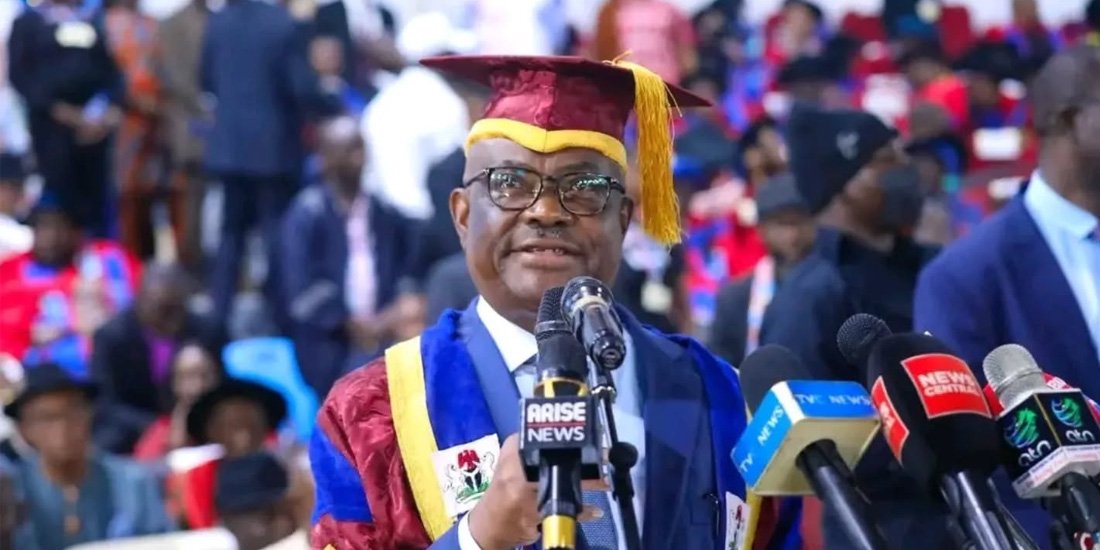
The Minister of the Federal Capital Territory (FCT), Nyesom Wike, has praised President Bola Ahmed Tinubu for what he described as courageous leadership, strategic vision and strong political will, saying the administration’s infrastructure agenda is laying the foundation for Nigeria’s transformation.
Wike made the remarks on Saturday while delivering a convocation lecture at the 36th Convocation Ceremony of University of Port Harcourt. His lecture, titled “Leadership and Infrastructure Development in Nigeria: Lessons for Future Leaders,” focused on the role of leadership in driving national development through infrastructure investment.
According to the FCT minister, the scale and pace of ongoing infrastructure projects across the country demonstrate the Tinubu administration’s commitment to addressing Nigeria’s longstanding development challenges.
He said President Tinubu has shown the courage to make difficult decisions, mobilize national resources and prioritize infrastructure as a key tool for economic growth and national development.
“What the present moment offers is a rare and defining possibility, a window in which purposeful leadership can begin, in earnest, to narrow the enduring gap between Nigeria’s vast potential and its historically uneven performance,” Wike said.
He argued that infrastructure remains one of the most reliable indicators of effective governance, noting that investments in roads, railways, electricity, housing and digital connectivity are essential for sustainable economic progress and improved living standards.
Wike acknowledged that some projects were inherited from previous administrations but said the current government had brought renewed momentum and a more coordinated approach to their execution.
The minister cited major infrastructure projects, including the Lagos-Calabar Coastal Highway, the Sokoto-Badagry Super Highway, the Abuja-Kaduna-Zaria-Kano Road, the East-West Road and access roads to the Second Niger Bridge, as examples of efforts aimed at boosting economic activity and strengthening national integration.
He also highlighted investments in the railway sector, including the rehabilitation of the Port Harcourt-Maiduguri rail corridor and the expansion of the country’s standard-gauge rail network.
In the power sector, Wike pointed to the implementation of the Presidential Power Initiative in partnership with Siemens, as well as ongoing rural electrification and mass metering programmes designed to improve electricity supply and enhance consumer confidence.
The minister further commended the administration’s energy transition policies, including the Presidential Compressed Natural Gas (CNG) Initiative and the National Hydrogen Policy, describing them as forward-looking measures that position Nigeria for future energy demands.
He also referenced government investments in housing, aviation, broadband infrastructure, security and education, including the Nigeria Education Loan Fund, which he said is expanding access to higher education.
Wike described the removal of fuel subsidy as one of the administration’s most significant policy decisions, arguing that it has increased fiscal resources available to federal and state governments for infrastructure and development projects.
“Transformative leadership often requires the courage to choose long-term stability over short-term comfort,” he said.
The former Rivers State governor stressed that infrastructure development should be measured by the successful completion and impact of projects rather than the number of initiatives announced.
He warned that Nigeria’s aspirations for economic growth and development would remain difficult to achieve without sustained investment in critical sectors such as transportation, power, healthcare and education.
Calling for continued support for the government’s development agenda, Wike said long-term progress would depend on consistency in policy implementation and sustained commitment to national development goals.
The lecture was one of the highlights of the university’s 36th convocation ceremony, attended by academics, students, alumni, government officials and other dignitaries from across the country.