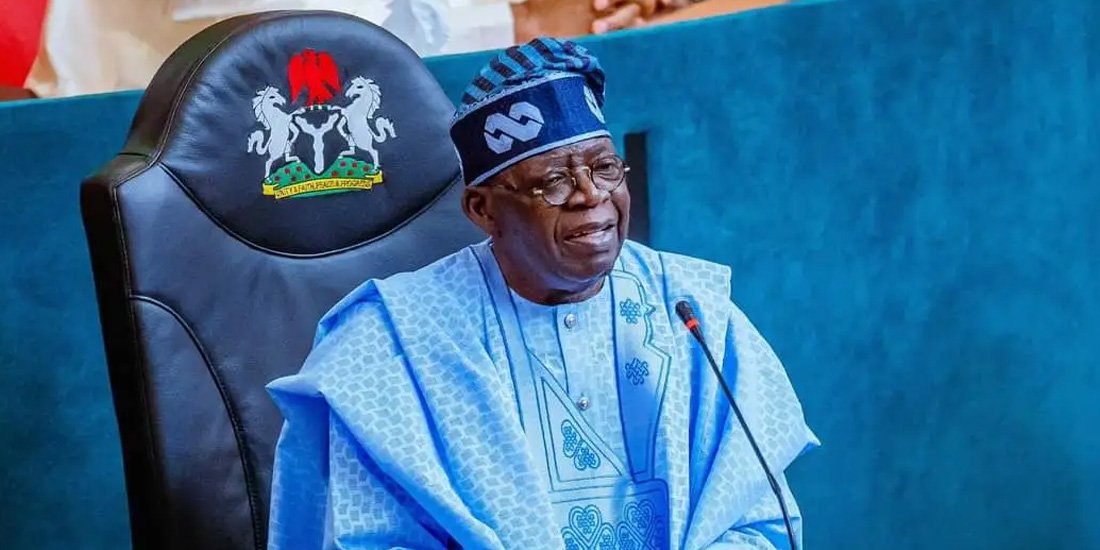
President Bola Tinubu has disclosed that funds saved from the removal of fuel subsidy are being used to pay salaries at all levels of government and finance critical infrastructure projects across the country.
The President made the disclosure on Thursday while receiving the newly elected leadership of the Nigeria Union of Petroleum and Natural Gas Workers (NUPENG) at the Presidential Villa, Abuja.
Tinubu said the fuel subsidy removal, announced on May 29, 2023, was yielding benefits for Nigerians despite concerns raised by critics over the policy’s impact on living costs. He added that the Federal Government would soon begin publishing details of how the savings from the policy are being utilized.
According to him, the resources freed up from subsidy payments are helping governments meet salary obligations and fund major road projects nationwide.
“Fuel subsidy is gone for the benefit of our great country. I will soon publish the utilisation of what it is,” Tinubu said.
Responding to criticisms that the policy had negatively affected ordinary Nigerians, the President argued that regular payment of salaries to local government, state and federal government workers was one of the direct benefits of the reform.
“Who are the people receiving the salaries in the local government administration? Are they not common men and women? Those receiving salaries regularly at the state and federal levels are ordinary Nigerians, and the impact extends to market women and families across the country,” he said.
Road Projects Benefiting from Savings
Tinubu cited several ongoing infrastructure projects that are being funded through increased government revenues and savings generated from economic reforms.
These, according to him, include the Lagos-Ibadan Expressway, Abuja-Kaduna Highway, Abuja-Kano Road, Sokoto-Badagry Highway, and other major road networks aimed at improving economic activities and enhancing public safety.
“I’m glad you have seen the effect of being able to find funding for long-term projects. Lagos-Ibadan Road, Abuja-Kaduna Highway, Abuja-Kano and Sokoto-Badagry highways, among many others, are all for the good of our economy and the safety of our people,” he stated.
Refineries Will Return, Says Tinubu
The President also expressed confidence that Nigeria’s four state-owned refineries would eventually resume operations but stressed that they must become commercially viable rather than merely functional.
According to Tinubu, his administration is undertaking reforms to ensure the facilities operate efficiently and generate value for the economy.
“The refineries are going to come back to work. We are building a firm reset and structural reworking of the economics around them. The ordinary flame and smoke of a refinery do not mean it is working until it is profitable and delivers the value for which it was built,” he said.
Tinubu added that fixing inherited challenges within the petroleum sector remains part of his responsibility as President.
“I’ve accepted the assets and liabilities of my predecessors. It is my responsibility now as President to fix them and make them work for the benefit of the Nigerian people,” he said.
Call for Wider Benefits of CNG Initiative
The President also called on NUPENG leaders to ensure that the benefits of the government’s Compressed Natural Gas (CNG) initiative are passed on to commuters.
He observed that much of the savings from the use of CNG-powered vehicles appeared to be benefiting transport operators and truck owners rather than ordinary passengers.
“We will encourage you, but ask your drivers to let it trickle down to commuters too. Whatever benefit is coming from CNG is going into the pockets of truck owners. It should spread faster than it is currently doing,” Tinubu said.
NUPENG Raises Concerns Over Casualisation
Earlier, NUPENG President Comrade Akanni Oladiti appealed to the Federal Government to address the growing casualisation of workers in the oil and gas sector, particularly in upstream operations.
Oladiti described the trend as unhealthy and said efforts by labour unions to persuade companies to abandon the practice had yielded little success.
“For a sector that remains the economic lifeline of the nation, these practices are unacceptable. We urge Mr. President to use his office to stop the casualisation of workers in the industry,” he said.
The union leader, however, commended the Tinubu administration for ongoing rehabilitation and construction of major highways, noting that improved road infrastructure had enhanced safety for tanker drivers and reduced transportation risks.
He also praised efforts to revive the Warri and Port Harcourt refineries, while urging the government to extend similar attention to the Nigerian Pipelines and Storage Company (NPSC) depots across the country.
According to Oladiti, revitalising the depots would complement refinery rehabilitation efforts and strengthen petroleum product distribution nationwide.
The NUPENG president further called on the Federal Government to ensure full implementation of local government financial autonomy in line with the Supreme Court judgment, arguing that grassroots development would be accelerated if councils had direct access to their allocations.