The Federal Government has ruled out an increase in electricity tariffs as it intensifies efforts to stabilize the power sector, release stranded equipment, expand metering and improve transmission capacity.
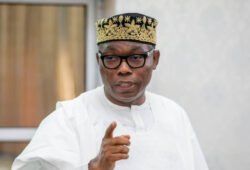
Minister of Power Joseph Tegbe said the government was focused on improving electricity supply rather than increasing the financial burden on consumers.
Speaking at a media briefing in Abuja marking his first 100 days in office, Tegbe said there was no plan to raise tariffs.
“Let me categorically state, and this is not a political statement, we have no plan to increase electricity tariffs,” he said.
The minister also disclosed that more than 300 containers of power-sector equipment delayed at Nigerian ports had been released through collaboration with relevant government agencies.
He said the release would allow the equipment to be deployed to unfinished and stalled projects.
Tegbe reported that power generation and transmission had remained above 5,000MW in recent weeks, compared with the 3,700MW to 4,700MW range before June.
He said generation peaked at 5,330MW in August and September.
The minister, however, acknowledged that a national generation peak did not necessarily reflect the experience of every electricity consumer.
“Our next task is to sustain these gains and translate them into more dependable supply at customer level,” he said.
Tegbe said the 375MW Alaoji open-cycle power plant had returned to the national grid after being offline for three years.
He also announced transmission upgrades in Lagos and Abuja.
New transformers at Apapa, Ijora, Alausa and Lekki, he said, had unlocked 672MW of transmission capacity, while a 300MVA transformer at Katampe in Abuja added another 240MW.
On metering, Tegbe said approximately 350,000 meters had been installed during his first 100 days in office.
He put cumulative meter installations at 1,004,260 as of August 2026.
The minister said the resolution of litigation involving AMMON had unlocked procurement of about 1.4 million smart meters across affected programmes.
He added that 90,000 meters had been installed in military formations.
Tegbe said the government considered metering central to consumer confidence, billing accuracy and improved revenue accountability.
He also disclosed that 5,000 young Nigerians were undergoing training under the Power Force programme to become smart-meter installers.
Beyond the national grid, the minister said 62 solar and mini-grid projects had been completed across 30 states.
The projects, he said, represented about 43.6MW of solar capacity and 41,735 new connections, benefiting more than 208,000 people.
Tegbe said the government had launched the Renewable Asset Management Company to improve the long-term management of publicly financed renewable-energy infrastructure.
The company is expected to oversee assets and engage operators responsible for metering, billing, collections and maintenance.
Looking ahead, the ministry plans to concentrate grid-stabilization efforts along the Lagos, Enugu-Port Harcourt and Abuja-Kaduna-Kano corridors.
Tegbe said technical audits had already commenced to identify weak points and prioritize investments with measurable system impact.
The minister also referred to commitments secured from Chinese companies around major power projects, including the 1.9GW Presidential Power Initiative, the $116 million Zungeru evacuation project and a proposed $500 million industrial park for manufacturing power equipment.
He said the first transmission lines under the Presidential Power Initiative were scheduled for delivery in the first quarter of 2027.
On the Mambilla Hydropower Project, Tegbe said the government welcomed Nigeria’s recent arbitration victory and had directed the contractor to examine practical options for delivering the project, including a phased approach if necessary.
The minister also said the government had raised about N1.23 trillion towards settling legacy power-sector debts as part of a broader programme addressing approximately N3.3 trillion in sector liabilities.
He said the liquidity intervention was necessary because unpaid obligations weakened gas supply, plant maintenance and market confidence.
Tegbe stressed that the government’s challenge was not simply to build new power plants but to repair the physical and commercial systems required to keep electricity flowing.
He acknowledged that many Nigerians still faced unreliable power supply and expensive self-generation.
The ministry, he said, would judge progress over the coming months by improvements in reliability, billing accuracy and the speed with which faults and complaints are resolved.