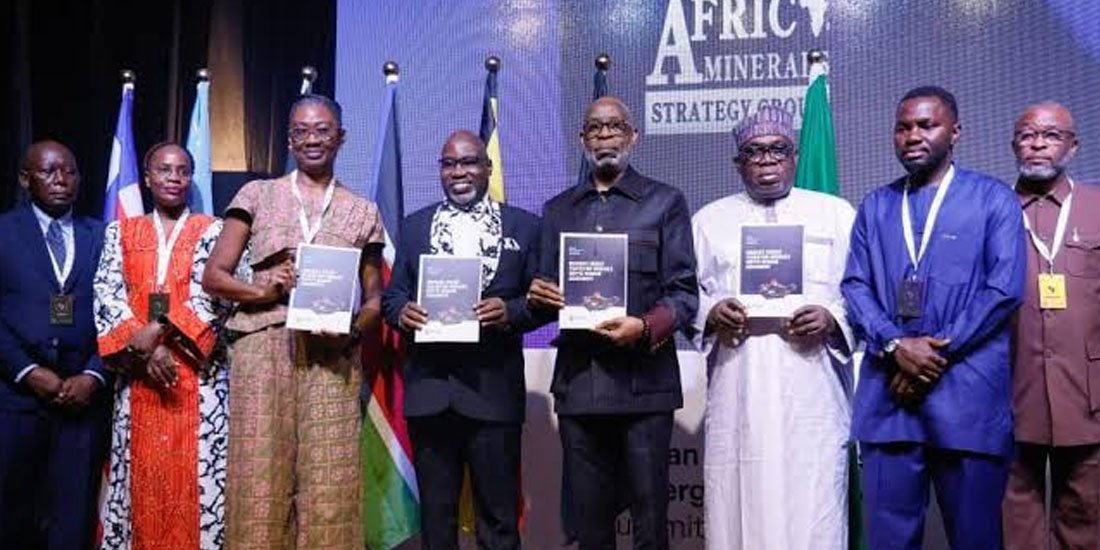
Government officials, development institutions, private-sector representatives and civil society groups have called for a major shift in Nigeria’s critical-minerals strategy, arguing that the country must move beyond raw-material exports and use its resources to build domestic industrial capacity.
The call was made at a high-level stakeholder meeting in Abuja on advancing green industrialization through critical minerals.
The forum was convened by the National Council for Climate Change with support from the Africa Policy Research Institute and the Ford Foundation.
Speakers argued that Nigeria risked repeating the economic pattern of the petroleum era if it simply replaced crude oil exports with unprocessed mineral exports.
Environment Minister Balarabe Lawal, represented by Iniobong Abiola-Awe of the ministry’s Climate Change Department, said mineral development must not become a justification for environmental degradation.
He said investment should combine economic value with technology transfer, skills development, local processing and strong environmental safeguards.
Lawal warned that poorly managed mining could damage land, water resources, biodiversity and ecosystems.
He said environmental and social impact assessments should be treated as planning tools rather than mere regulatory formalities.
National Council for Climate Change Director-General Tenioye Majekodunmi said Nigeria needed to decide where the processing plants, factories, jobs and wealth associated with the green economy would be located.
She argued that a genuine industrial strategy must capture more of the mineral value chain inside Nigeria through refining, manufacturing, battery assembly, logistics, technology and local enterprise participation.
Majekodunmi said the country also had to ensure that its minerals were produced under credible environmental and traceability standards as international markets became more sensitive to carbon intensity and responsible sourcing.
She added that private capital would be essential because government alone could not finance the required infrastructure.
Senior Adviser on Mining and Policy Amira Waziri said Nigeria should treat critical minerals as strategic national assets rather than ordinary export commodities.
She argued that negotiations with foreign investors should include questions about local processing, technology transfer, infrastructure, skills and long-term industrial capability.
Africa Policy Research Institute Executive Director Olumide Abimbola said global competition for lithium, copper, cobalt, nickel, graphite and rare earths had accelerated as countries sought secure supply chains for energy transition and digital technologies.
He said APRI’s research had identified nearly 100 mineral-related partnerships between African countries and international actors, most signed within the past decade.
Ford Foundation Regional Director Chichi Aniagolu-Okoye said domestic beneficiation, manufacturing and local-content enforcement should be central to Nigeria’s policy.
A representative of the Solid Minerals Development Fund also argued that Nigeria needed bankable projects, credible geological information and predictable regulation if it wanted to capture higher-value segments of the mineral economy.
The Rural Electrification Agency said Nigeria’s growing renewable-energy market could provide a domestic demand base for battery assembly and other clean-energy manufacturing.
Stakeholders agreed that the central objective should be to transform mineral wealth into jobs, technology, industrial capacity and sustainable local development rather than simply exporting raw ore.