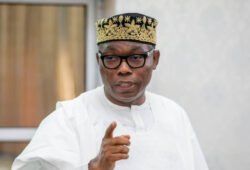
Vice President Kashim Shettima has said Nigeria’s ambition of building a $1 trillion economy can only be achieved through stronger corporate governance and deeper collaboration between the public and private sectors.
Shettima made the remarks at the 2026 National Corporate Governance Summit in Lagos, themed “Implementing Good Governance for Economic Acceleration: Consolidating Public/Private Sector Partnership.” He was represented by the Special Adviser to the President on Economic Affairs, Dr. Tope Kolade.
The summit was organised by the Institute of Directors Centre for Corporate Governance (IoDCCG) in collaboration with the Financial Reporting Council of Nigeria (FRC), the Ministry of Finance Incorporated (MOFI), and the Institute of Chartered Secretaries and Administrators of Nigeria (ICSAN).
According to the Vice President, the Tinubu administration has initiated major economic reforms, including foreign exchange liberalisation, tax reforms and fuel subsidy removal, but stressed that sustainable economic growth would depend on improved governance standards across both government and private institutions.
“This government is committed to reforms. Whether in foreign exchange, tax or subsidy reforms, significant progress has been made. However, public sector reforms must align with private sector reforms because good governance on both sides is essential to moving Nigeria forward,” he said.
Shettima noted that beyond macroeconomic reforms, the government was implementing industrial and investment policies while pursuing reforms in the power sector to improve the country’s competitiveness.
He also urged Nigerians to embrace innovation and prepare for the future, particularly as artificial intelligence continues to reshape global industries and labour markets.
The Vice President called for greater emphasis on domestic investment, arguing that local investors should receive as much attention as foreign investors.
“We tend to focus excessively on foreign investors, but Nigerians are investing significantly across the country. We should encourage our people to reinvest their wealth at home because Nigeria still offers some of the best investment returns,” he said.
Shettima further stressed the need for Nigeria to move beyond exporting raw materials by embracing industrialisation, innovation and value addition.
Chairman of the summit, Kyari Abba Bukar, said strong corporate governance remains the most effective safeguard against institutional failure, noting that many Nigerian businesses collapse after the death of their founders because governance structures are weak.
He urged business leaders to institutionalise governance practices that would ensure organisations outlive their founders.
Delivering the keynote address, Chairman of Nigerian Breweries Plc, Mrs. Juliet Anammah, called for what she described as Nigeria’s “economic rebirth,” saying the country must transition from a lower-middle-income economy to an upper-middle-income nation through industrialisation supported by stable governance.
She said government should focus on providing infrastructure, quality education and technical skills, while the private sector drives innovation, investment and productivity.
Anammah also encouraged organisations to adopt artificial intelligence strategically to improve operational efficiency and productivity.
Chief Host of the summit and Chairman of the Board of Governors of the IoD Centre for Corporate Governance, Mr. U.K. Eke, said the event marked a shift from discussing governance principles to implementing practical reforms.
He stressed the need to recruit competent leaders based on merit rather than political considerations, adding that sustainable economic growth depends on building strong institutions with effective governance systems.
Participants at the summit agreed that strengthening transparency, accountability, ethical leadership and institutional continuity across public and private institutions would be critical to accelerating Nigeria’s economic transformation and boosting investor confidence.
The summit concluded with renewed calls for stronger collaboration among government, regulators, corporate boards, investors and civil society to make good governance the foundation of sustainable national development.