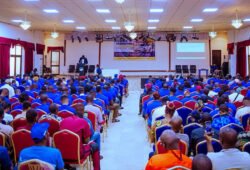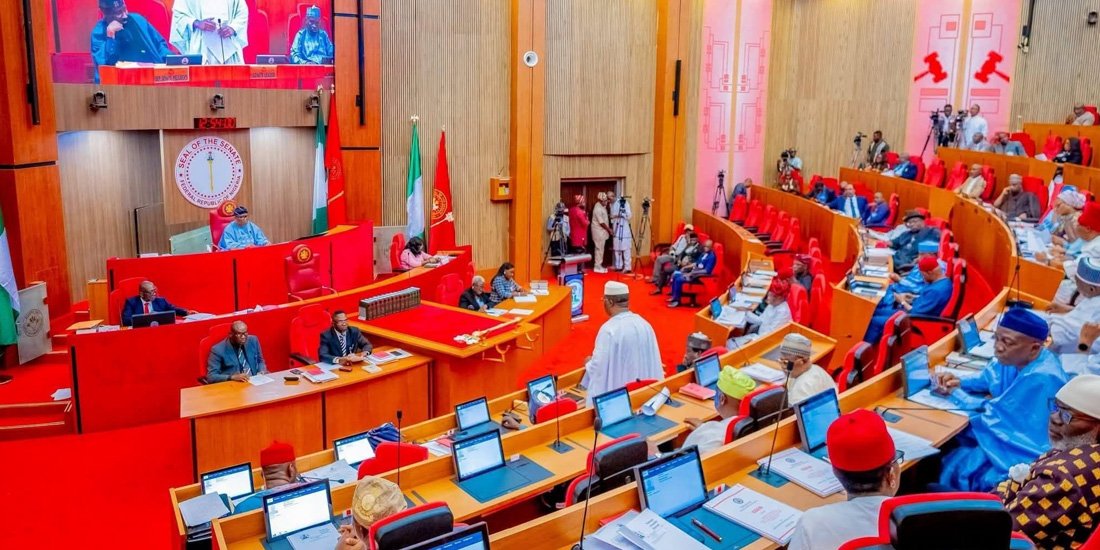
The Senate Committee on Finance has opened an investigation into roughly N34 trillion worth of Import Duty Exemption Certificates issued by the federal government between March 2000 and December 2025, pressing the Nigeria Customs Service to explain the revenue impact even as Customs defended the waivers as deliberate fiscal tools addressing security, economic and social needs.
Committee Chairman Sani Musa also used the hearing to warn several ministries, departments and agencies that have repeatedly skipped the panel’s ongoing investigation into remittance of internally generated revenue and operating surplus to the Consolidated Revenue Fund between 2023 and 2025, threatening legislative and administrative sanctions and warning that persistent non compliance could be reported directly to President Bola Tinubu. Comptroller General of Customs Bashir Adewale Adeniyi told the committee that nearly 60 percent of the N34 trillion in approved exemptions covered military hardware imported to strengthen Nigeria’s security architecture amid ongoing challenges, with the remainder covering compressed natural gas, electric and hybrid vehicles, healthcare equipment and medical supplies, industrial machinery, manufacturing inputs and food import intervention programmes meant to ease inflationary pressure. Fiscal incentives should not be judged purely on revenue generation, Adeniyi argued, but also on their wider economic goals, stimulating industrial production, lowering the cost of essential goods, improving healthcare and strengthening national security, though he recommended government build stronger monitoring mechanisms to confirm that waiver beneficiaries actually deliver those promised outcomes, including lower consumer prices, increased local production and better healthcare access.
On Customs’ broader revenue performance, Adeniyi disclosed the service collected N3.2 trillion against a N3.67 trillion target in 2023, an eight percent shortfall, before improving sharply in 2024 with N6.1 trillion against a N5.079 trillion target, more than 20 percent above goal. For 2025, Customs brought in about N7.2 trillion against a N6.584 trillion target, while revenue as of June 2026 stood at roughly N4.5 trillion against a full year target of N11 trillion, fluctuations he attributed to external shocks including disrupted global cargo movement from the Russia Ukraine war and Middle East tensions, particularly the Iran crisis, though he expressed optimism that cargo volumes were recovering, with July figures showing encouraging improvement. The Fiscal Responsibility Commission told lawmakers that government approved duty waivers on food commodities like maize and rice had substantially cut into Customs revenue, but confirmed all revenue Customs does collect is remitted directly into the Treasury Single Account as required.
Senators also pressed Customs on the federal government’s recent reduction of import duties on vehicles, with Senator Adams Oshiomhole questioning whether lowering duties on categories including fairly used vehicles could undermine Nigeria’s local automobile assembly industry, arguing that while Customs merely implements government policy rather than setting it, cheaper imports could still discourage investment in domestic manufacturing. Adeniyi responded that Customs has no role in formulating fiscal policy and only implements decisions the federal government approves, acknowledging the reduced tariffs will cost Customs revenue but explaining the measure was introduced specifically to make vehicles more affordable for Nigerians facing rising economic hardship. On the National Single Window project, Adeniyi said implementation has entered its second phase, with relevant government agency systems already integrated and extensive sensitisation carried out for importers, exporters, shipping companies, airlines and port operators, acknowledging operational challenges along the way but describing them as expected for a project of this scale and expressing confidence it will improve transparency, trade efficiency and Nigeria’s competitiveness. He also credited Customs’ modernisation programme, including electronic payment platforms, digital declarations, geospatial intelligence and surveillance technology, with strengthening both revenue collection and border enforcement, and disclosed that Nigeria’s export trade has grown roughly 70 percent over the past three years since a dedicated export command was established in 2023.
The Fiscal Responsibility Commission separately told the committee that Customs has not submitted audited financial statements beyond 2019, leaving an estimated outstanding operating surplus liability of about N8.9 billion that can only be confirmed once more recent accounts are reconciled, prompting the committee to direct Adeniyi to submit comprehensive revenue records and updated audited statements within one week.
The Corporate Affairs Commission also came under scrutiny, with the Fiscal Responsibility Commission disclosing an outstanding N13.9 billion in unremitted revenue from CAC operations covering 2023 to 2025 after Musa asked the FRC representative to verify CAC’s remittances. Registrar General Hussaini Ishaq Magaji confirmed the liability but assured the committee the sum is being paid down gradually; senators commended CAC’s overall revenue performance as impressive while still questioning the size of the outstanding balance, and Musa directed CAC, the FRC and the committee to hold a joint meeting to reconcile the exact figures.
Proceedings later shifted to NNPC Limited’s scheduled appearance, which was postponed after the Group Chief Executive Officer failed to attend; Financial Controller Tajudeen Karim told the committee the Chief Financial Officer was receiving medical treatment, but senators insisted only the GCEO and relevant top executives could adequately answer questions under investigation, adjourning NNPC’s appearance to the following week and directing that the GCEO and senior finance officials appear in person to address the company’s remittances to the Federation Account, compliance with Executive Orders, monthly revenue reconciliation and the gains from ongoing reforms.
Closing the hearing, Musa expressed displeasure at the absence of several invited agencies, naming the Office of the Accountant General of the Federation, the Industrial Training Fund, the Nigerian Communications Commission, the Nigerian Maritime Administration and Safety Agency, the Federal Airports Authority of Nigeria, the Nigerian Railway Corporation, the National Environmental Standards and Regulations Enforcement Agency, the Nigerian Civil Aviation Authority, the Small and Medium Enterprises Development Agency of Nigeria, the Nigerian Institute of Transport Technology, the Institute for Agricultural Research in Zaria, the Nigeria Agricultural Quarantine Service, the Federal Medical Centre in Jabi, and the Veterinary Council of Nigeria as defaulters, warning the Senate would no longer tolerate repeated disregard for its invitations and that every agency handling public resources must fully account for revenue collected on the federal government’s behalf.