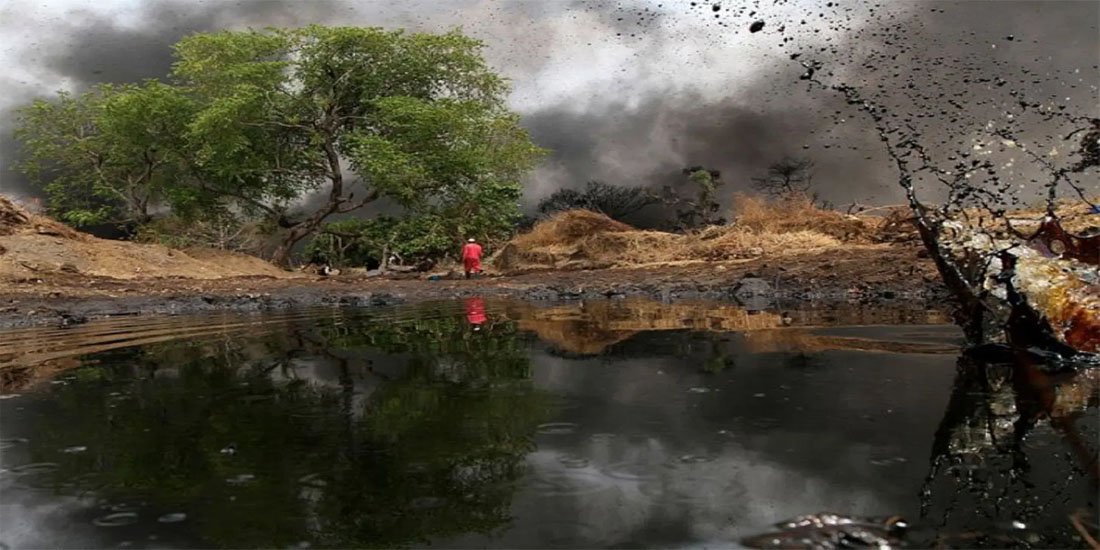
YENAGOA — Panic has gripped several fishing communities in Nembe Local Government Area of Bayelsa State following an oil spill reportedly linked to crude oil loading operations at the Nembe Creek oilfield.
The affected oilfield, located within Oil Mining Lease 29 (OML 29), is operated by Nembe Exploration & Production Limited, formerly known as Aiteo Eastern Exploration and Production Limited.
A field assessment by the Environmental Conservation Agriculture and Rural Development (ECARD) found crude oil along the Nembe Creek, including the creek’s banks and mangrove areas.
ECARD’s Lead Field Monitor, Chief Alagoa Morris, said the strong smell of crude oil was detected about two kilometres from Nembe Creek during the organisation’s inspection.
According to ECARD, the spill has spread to several fishing settlements, disrupting fishing activities and damaging fishing equipment.
The Paramount Ruler of the Nembe Creek communities, HRH Agent Waya, said the incident had compounded the economic difficulties confronting residents who depend largely on fishing for their livelihoods.
Waya said community members alerted naval personnel after they allegedly received no immediate response from officials of the oil company.
He added that women from the affected communities later protested at the company’s facility, demanding immediate relief materials, an assessment of the damage and compensation.
The traditional ruler said the communities had given the operator three days to provide relief materials, stressing that residents were unable to continue fishing because of the pollution.
According to him, the spill allegedly occurred during the loading of crude oil into a barge, which tilted and discharged crude into the river.
He listed Mile 1, Mile 2, Mile 3, Roka, Williamkiri, Atonbarakiri, Korukiri and Madam Wanwakiri among the affected communities.
Other affected areas, according to Waya, include Ewelesuo, Kpongbokiri, Victorkiri, Victorkiri, ‘Abuja’ 1, 2 and 3, Pipeline 1, 2, 3 and 4, Kalakububogo and Etikiri.
The Women Leader, Mrs Ebi Otokolo, said the pollution had rendered the river unsafe for fishing, domestic activities and other livelihood purposes.
Otokolo said the strong smell of crude oil had forced some residents to remain indoors, while fishermen had been cut off from their primary source of income.
Another resident, Mrs Love Mark, said several fishing nets had been contaminated and rendered unusable by the crude oil.
Mark disclosed that a fishing net could cost between N150,000 and N170,000, urging the operator to provide urgent assistance to affected residents.
Similarly, a former youth president of neighbouring Ewelesuo community, Mr Daukoru Benjaka, called for the inclusion of the community and its fishing camps in the Joint Investigation Visit into the incident.
Benjaka said the spill had reduced fish catches and affected other aquatic resources, including periwinkles, warning that the situation posed a serious threat to the livelihoods of fishing communities.
ECARD said its assessment showed substantial crude oil on the surface of the water and around mangrove roots, despite reports from residents that tidal movements had reduced the visible concentration of the pollution.
The environmental group warned that rising tides could transport the crude further into the mangrove ecosystem, potentially affecting aquatic organisms such as crabs, oysters and periwinkles.
ECARD further said information obtained from the Bayelsa State Ministry of Environment and the Nembe Oil and Gas Committee indicated that a Joint Investigation Visit had attributed the incident to operational failure.
However, the organisation noted that as of August 26, the exact volume of crude discharged and the full extent of the affected area had yet to be conclusively determined.
ECARD described the latest incident as part of a history of oil spills associated with operations in OML 29, urging prompt intervention to prevent further environmental damage and protect the livelihoods of affected communities.