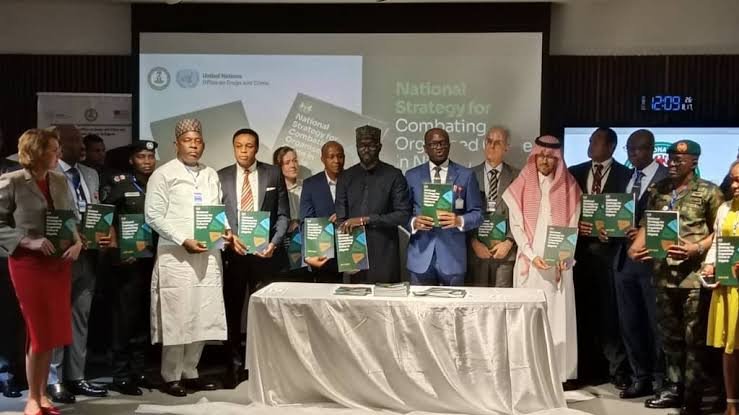
Nigeria has unveiled a National Strategy for Combating Organised Crime aimed at creating a more coordinated response to cybercrime, drug trafficking, human trafficking, migrant smuggling and other transnational criminal activity.
The strategy was launched in Abuja with participation from government institutions, security agencies, international partners and civil society groups.
It was developed through multi agency consultation with technical support from the United Nations Office on Drugs and Crime.
National Counter Terrorism Centre Coordinator Adamu Laka said organised crime could no longer be confronted effectively by agencies working in isolation.
The framework places strong emphasis on intelligence sharing, joint investigations, specialist operational capacity and deeper regional and international cooperation.
It also provides for stronger protection of victims and witnesses.
Officials said organized criminal networks were increasingly exploiting technology, cross border movement, economic vulnerabilities and illicit financial channels.
International reports cited at the launch highlighted the continuing growth of global drug markets and trafficking in persons.
UNODC Country Representative Cheikh Toure welcomed Nigeria’s whole of government approach.
The United States Department of State’s Bureau of International Narcotics and Law Enforcement Affairs also expressed support for the strategy.
Participants identified operational readiness, regional cooperation, rule of law safeguards and sustained institutional coordination as important conditions for success.
The National Counter Terrorism Centre and consultants presented an implementation roadmap, an assessment of organized crime threats in Nigeria and the Gulf of Guinea, and a monitoring and evaluation framework.
The strategy is expected to provide a common national structure for confronting multiple forms of organised crime rather than leaving agencies to pursue separate responses.
Implementation will now be measured by the extent to which intelligence is shared, criminal networks are disrupted, victims are protected and prosecutions produce credible results.