
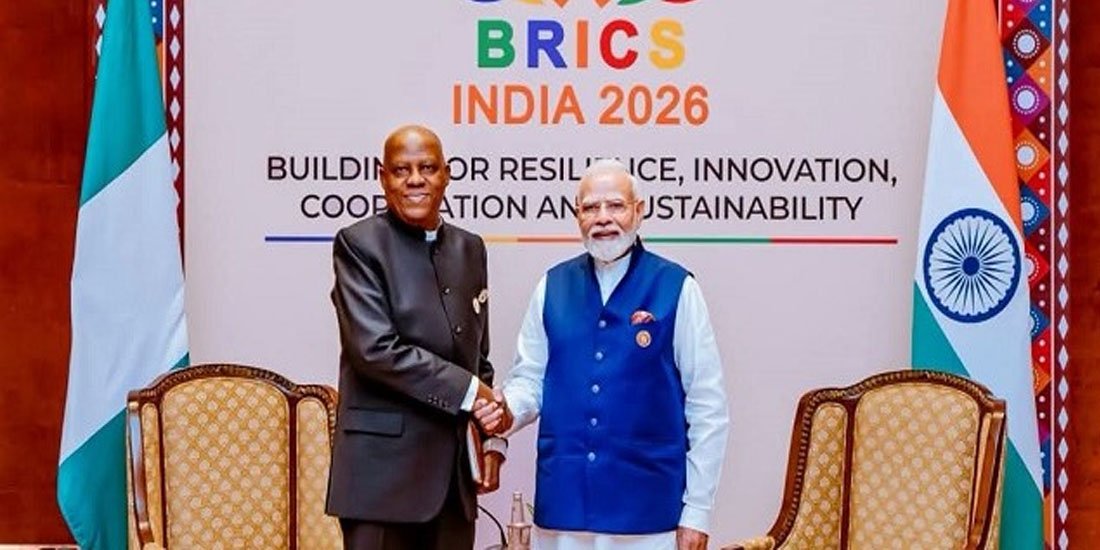
Nigeria and India have agreed to deepen economic cooperation as both countries seek to restore bilateral trade toward its previous high of nearly $15 billion, with Indian Prime Minister Narendra Modi calling for renewed purchases of Nigerian crude oil.
The issue featured in bilateral talks between Vice President Kashim Shettima and Modi on the sidelines of the BRICS Leaders’ Summit in New Delhi.
Trade between both countries stood at about $14.95 billion in the 2021-2022 financial year before declining sharply as India reduced purchases of Nigerian crude.
The figure fell to about $7.13 billion in 2024-2025 before recovering to roughly $9 billion in 2025-2026, according to figures disclosed by Indian High Commissioner Abhishek Singh.
Modi said stronger energy trade could help restore commercial exchanges between both countries to previous levels.
Shettima said Nigeria would examine India’s request as part of the Tinubu administration’s wider effort to attract investment and expand strategic economic partnerships.
The Vice President said Nigeria wanted the relationship to move beyond commodity trade into sectors capable of creating jobs, transferring technology and expanding domestic productive capacity.
He identified pharmaceuticals, defence, digital technology and the creative industries as areas of particular interest.
Both leaders also discussed cooperation in renewable energy, power, healthcare, financial technology, digital infrastructure and capacity building.
Shettima said the administration was seeking partnerships that would support value addition inside Nigeria rather than simply expand raw-material exports.
Crude oil has historically accounted for a large share of Indian imports from Nigeria, making energy trade a key driver of bilateral commerce.
Modi also acknowledged the substantial Indian business and expatriate community in Nigeria and thanked the country for its hospitality.
Both sides agreed that stronger private-sector participation would be central to the next phase of the relationship.
Nigeria also highlighted opportunities to learn from India’s experience in women-led financial inclusion and grassroots enterprise.
Women Affairs Minister Imaan Sulaiman-Ibrahim said Nigeria was drawing lessons from India’s self-help group model through the Nigeria for Women Program Scale-Up.
She said Women Affinity Groups were being used to connect women with finance, skills and markets as part of efforts to expand female participation in productive economic activity.
Nigeria and India said they would continue high-level engagement through bilateral and multilateral platforms, including the broader India-Africa partnership framework.