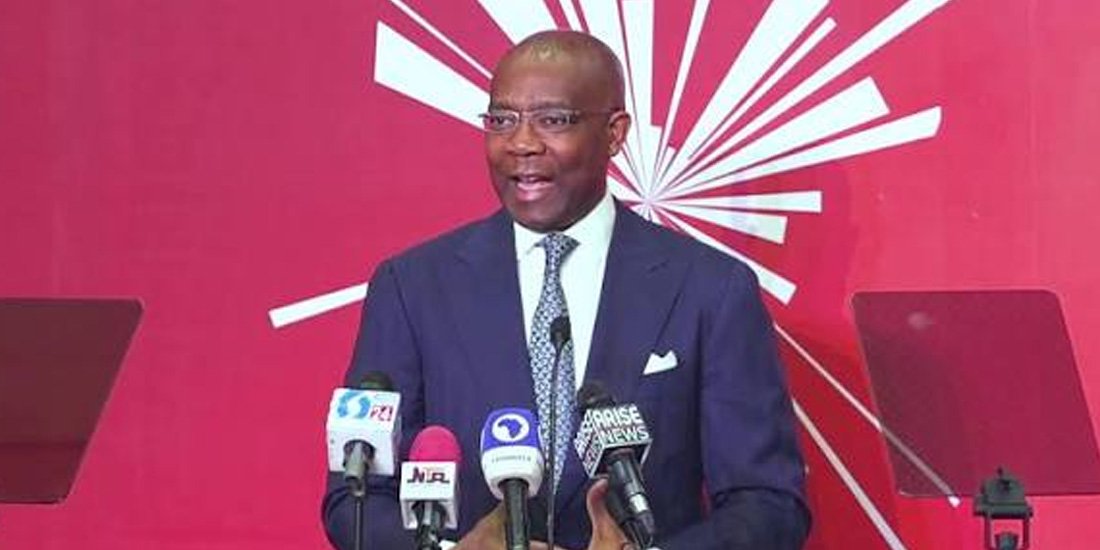
Chairman of Access Holdings and Coronation Group, Aigboje Aig-Imoukhuede, has said the Niger Delta received about $160 billion in federal allocations and development funding over the past 27 years, yet poverty and underdevelopment remain widespread across the region.
Aig-Imoukhuede made the remarks while delivering the keynote address at the 2026 Niger Delta Economic and Investment Summit in Port Harcourt, Rivers State.
He said the critical issue was no longer the amount of resources that had accrued to the region, but the extent to which the funds had been converted into productive assets capable of driving sustainable economic development.
According to him, the nine Niger Delta states and their local governments received an estimated $140 billion in federal allocations since 1999. He said the figure rose to about $160 billion over 27 years when resources channelled through the Niger Delta Development Commission (NDDC) were included.
“The question is no longer how much came to the Niger Delta. The question is, what stock of productive capital did this $160 billion leave behind?” he asked.
Region Faces ‘Conversion Problem’
Aig-Imoukhuede identified the inability to convert the region’s resource wealth into productive capital as a major economic challenge.
He said the resources should have translated into infrastructure, industrial capacity, competitive businesses and sustainable employment opportunities.
“The Niger Delta has a conversion problem. Natural resources do not create prosperity by themselves. Natural resources create possibilities, but it is institutions that determine what happens to our possibilities and our dreams,” he said.
He called for a shift from what he described as a “rent-focused economy” towards a productive economy, while advocating greater integration among the nine states.
According to him, the region must move away from fragmented public spending towards integrated economic platforms and develop a more coherent regional economy.
Aig-Imoukhuede also cautioned against relying solely on debates over derivation, revenue allocation and federal intervention, stressing that the distribution of resources does not automatically translate into economic development.
Call for Regional Investment Compact
The business leader proposed the establishment of a Niger Delta Development and Investment Compact involving the nine states, the Federal Government, NDDC, private-sector operators, communities, development institutions and long-term investors.
He said the proposed framework should focus on a limited number of regional priorities capable of delivering measurable economic transformation.
Aig-Imoukhuede also urged political, business, professional, traditional, academic and religious leaders in the region to accept collective responsibility for addressing its development challenges rather than placing the blame entirely on government.
He said the Niger Delta could leverage its natural resources to build institutions and financial assets capable of transforming the region.
He cited the African Export-Import Bank (Afreximbank) as an example of what could be achieved through strategic investment and institution-building with a fraction of the resources that had passed through the region.