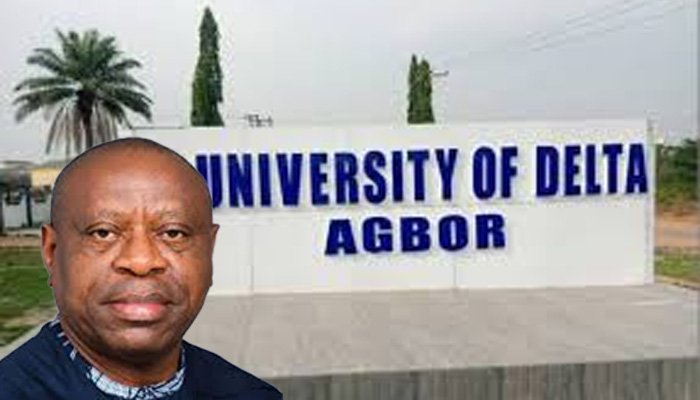
Professor Eric Eboh has formally assumed office as the second Vice-Chancellor of the University of Delta in Agbor, pledging to build a research-driven, digitally enabled institution of national and global relevance through a strategic development framework he described as the most ambitious and systematic growth agenda the university had yet seen.
Speaking at his assumption of duty ceremony, Eboh outlined a comprehensive development blueprint titled “Project RAISE UNIDEL Higher,” anchored on five interconnected pillars designed to simultaneously strengthen the institution’s academic standing, research output, technological infrastructure, workforce quality, and operational environment.
The five pillars are Research and Innovation, Academic Excellence, ICT optimisation across teaching, learning, and administration, Staff professional development and welfare, and the creation of a conducive environment for staff, students, and all institutional stakeholders.
On research and innovation, Eboh said the university would work to build a robust ecosystem capable of generating knowledge with direct national impact, positioning the institution as a hub for solution-driven inquiry rather than merely a centre of theoretical learning. The academic excellence pillar, he explained, would ensure rigorous adherence to the highest standards in teaching, learning, curriculum design, and academic management across all faculties and departments.
The ICT component would drive comprehensive digitalisation across teaching, research, and administrative service delivery, reducing bureaucratic friction and expanding access to learning resources for students and faculty alike. He described the staff development and welfare pillar as foundational to the entire agenda, arguing that a motivated, professionally fulfilled, and adequately supported workforce was the single most important variable in achieving any institutional objective.
The fifth pillar, focused on the physical and social environment, would ensure that the university maintained conditions that genuinely supported academic inquiry, creative thinking, and productive administrative activity for everyone on campus.
Eboh, who becomes the institution’s second vice-chancellor, said his administration would build on the foundations laid by the pioneer leadership while charting a more ambitious course for the years ahead. He said the university would align closely with its founding vision and mission while also embracing global best practices in academic and research management.
He committed his administration to being guided at every level by transparency, integrity, accountability, collaboration, and genuine consultation with staff, students, and stakeholders. He said feedback from the university community would not be treated as a formality but as a genuine input into institutional decision-making.
“I solicit the cooperation and collaboration of all stakeholders as we work together to move the university forward,” he said, adding that no administration, however visionary, could achieve meaningful transformation without the active participation and goodwill of the people it served.
His assumption of office was described by observers as opening a new and consequential chapter in the development of the University of Delta, Agbor, with expectations running high for accelerated reforms, strengthened academic programmes, and measurable improvements in institutional performance under his leadership.