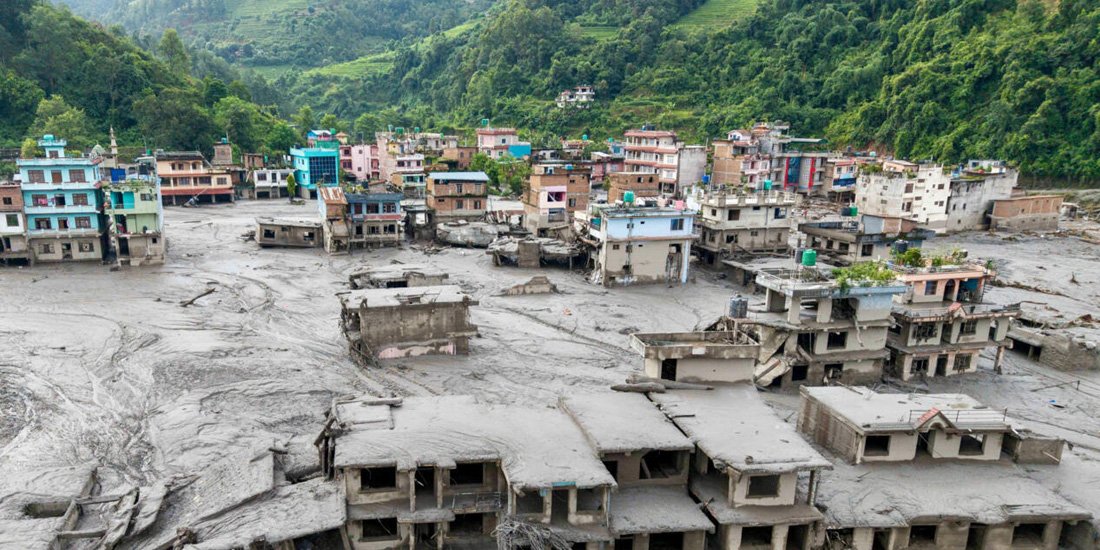
At least 546 people have been killed and more than 2,000 others remain missing following devastating flash floods and landslides along the Nepal-Tibet border, triggering a large-scale search-and-rescue operation.
The disaster struck on Wednesday morning in Nepal’s northern Rasuwa district, near the border with Tibet, after a massive surge of water, ice and debris swept through communities along the Trishuli River.
Authorities said the flooding destroyed buildings, bridges and roads and caused widespread devastation on both sides of the Nepal-China frontier.
Nepal’s National Disaster Risk Reduction and Management Authority said hundreds of bodies had been recovered, while nearly 2,000 people remained unaccounted for. At least 4,451 people had been rescued or injured, including 129 foreign nationals, while more than 8,000 police personnel had been deployed for rescue and recovery operations.
Across the border in Tibet, Chinese state media reported three confirmed deaths and 558 missing persons.
The figures have continued to fluctuate as rescue teams gain access to communities that were initially cut off by floodwaters, landslides and destroyed roads.
Among those still missing are about 90 US citizens, according to a US State Department spokesperson. Five Americans had been evacuated as of Friday.
The flooding reportedly began at about 8:40 a.m. local time on Wednesday after a massive landslide approximately 12 miles northeast of the Rasuwagadhi border post.
The United States Geological Survey (USGS) recorded seismic activity associated with the landslide at magnitude 5.2. The agency initially classified the event as a 4.4-magnitude earthquake before correcting its assessment and identifying the cause as the landslide.
Scientists are investigating what triggered the massive slope failure. Preliminary assessments suggest that the landslide may have swept away a large glacier or part of one in a Himalayan mountain pass.
The USGS estimated that more than 100 million cubic metres of ice, rock and debris may have been displaced, although researchers said the full scale of the event would take time to establish.
Verified video footage and satellite imagery showed that the powerful flow of water and debris caused destruction extending at least 62 miles downstream from the Nepal-Tibet border.
The disaster has left families desperately searching for information about relatives who remain missing.
The Nepalese government has established an Emergency Control Room to coordinate rescue operations, verify information and provide assistance to foreign nationals affected by the disaster.
Rescue teams are using helicopters and other emergency equipment to reach stranded survivors, while those rescued are being moved to safer locations and temporary camps.
However, damaged roads and bridges and isolated communities have made the operation extremely challenging.
US President Donald Trump described the disaster as a “terrible thing” and said Washington was in contact with Nepalese authorities.
“We are sending aid, and we’ve spoken to the leadership and let them know anything they want will happen,” Trump said.
Nepal’s Office of the Prime Minister has expressed condolences to families affected by the disaster as rescue operations continue.
Authorities warned that the death toll and number of missing people could change as emergency teams reach previously inaccessible areas and recover additional victims.