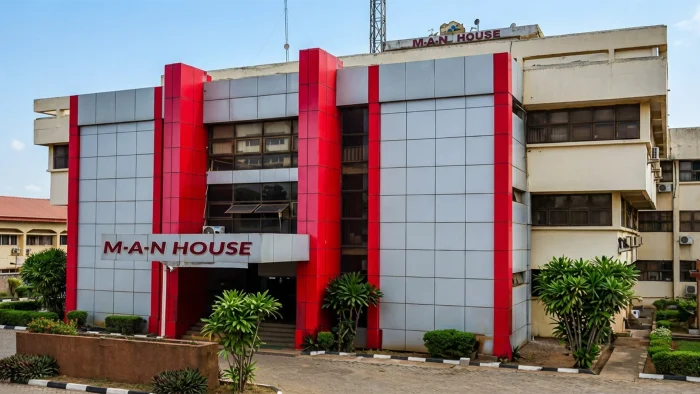
The Manufacturers Association of Nigeria has decried severe financial constraints besetting the sector, which it said suffered a credit contraction of N1.92 trillion in 2025.
MAN made the disclosure in a statement by its Director General, Segun Ajayi-Kadir, titled “MAN Position on the Sharp Decline in Credit to the Manufacturing Sector,” warning that a persistent credit squeeze could directly sabotage the successful execution of the Nigeria Industrial Policy, 2025.
The association said commercial borrowing costs remained actively hostile, at an average of 24.4 per cent prime lending rates and 33.8 per cent maximum lending rates, making long term capital investment unviable. “It is practically impossible to build a 21st century industrial economy when forcing factories to fund their capital footprint through 19th century primitive capital constraints,” it said.
According to the data, commercial bank credit to manufacturing contracted by N1.92 trillion, from N8.53 trillion in December 2024 to N6.61 trillion in December 2025, a year on year drop of 22.5 per cent, one of the largest contractions among top sectors, surpassed only by general services at minus 25 per cent.
Ajayi-Kadir said the decline left manufacturing far behind the oil and gas industry (N10.59 trillion) and a booming finance sector (N9.24 trillion), reflecting a systemic preference for speculative and rent seeking activities over tangible productivity.
He contrasted Nigeria’s squeeze with global peers, noting that India’s bank credit to industry grew 9.6 per cent year on year by late 2025, while Vietnam targeted 19 to 20 per cent credit growth to fuel its manufacturing engines.
MAN said the contraction was rooted in prohibitive interest rates, structural bureaucracy and policy misalignment. As of May 2026, it said, manufacturers’ borrowing costs remained at an average of 27 per cent prime and 35.6 per cent maximum lending rates, while a Cash Reserve Ratio of up to 45 to 50 per cent constrained loanable bank liquidity.
The association also faulted the non implementation of the N1 trillion Manufacturing Stabilization Fund, included in the Accelerated Stabilization and Advancement Plan since 2024. “For two years, we have awaited this fund to ameliorate the credit crunch in the sector. There appears to be no visible effort at delivering on that score,” Ajayi-Kadir said.
He urged the central bank to establish independent, transparently managed channels capable of delivering single digit interest rates directly to manufacturers, and called for an urgent sector audit, warning that Nigeria’s ambition to become a competitive manufacturing powerhouse would remain stalled until policy promises were translated into accessible capital.