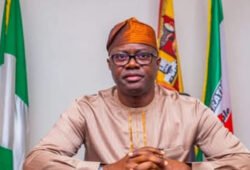

Oyo State Governor and presidential candidate of the Allied Peoples Movement (APM), Seyi Makinde, has called on opposition parties to form an alliance and support the presidential candidate with the strongest electoral prospects to challenge the ruling All Progressives Congress (APC) in the 2027 general election.
Makinde, who confirmed that discussions on a possible opposition coalition were ongoing, said he was willing to work with former Vice-President Atiku Abubakar or the presidential candidate of the Nigeria Democratic Congress (NDC), Peter Obi, if either emerged as the strongest candidate capable of defeating the APC.
The governor made the remarks during an exclusive interview with ARISE News, stressing that the choice of a candidate should be guided by data, policy proposals, previous performance and public opinion rather than personal preferences.
Asked whether he was open to an alliance with other opposition leaders, Makinde said discussions were already underway.
He declined to endorse either Atiku or Obi at this stage, insisting that the opposition must carefully assess available evidence before reaching a decision.
According to him, political parties must consider their manifestos, historical performance and the sentiments of Nigerians before deciding who should lead a possible coalition.
Drawing from his experience in the oil and gas industry, Makinde explained that competing businesses could become partners when circumstances required collaboration to achieve a common objective.
He said the same principle could apply to the 2027 presidential contest, noting that political figures could remain rivals, become collaborators or enter into other forms of political arrangements depending on developments before the election.
Asked whether he would work with Atiku if the former vice-president emerged as the strongest opposition candidate, Makinde responded in the affirmative, saying he was willing to work with any Nigerian in the interest of the country.
He cited the 1999 presidential election, when Olu Falae secured considerable support in the South-West but failed to translate his regional popularity into a national victory, as an example of the limitations of fragmented opposition efforts.
Makinde also referenced South Africa’s experience with political cooperation, arguing that negotiations among opposition parties should focus on national interests rather than individual ambitions.
The governor further claimed that the APM had the backing of most of the political structure that supported his emergence as Oyo State governor under the PDP.
He acknowledged that the APM was relatively new but argued that its limited electoral history would not prevent it from making a strong showing in 2027.
To support his position, Makinde cited the performances of the Labour Party and the New Nigeria Peoples Party (NNPP) in the 2023 general election.
He recalled that the Labour Party recorded about 6,000 votes nationally in 2019 before Peter Obi joined the party and secured more than six million votes in the 2023 presidential election.
He also pointed to the NNPP’s performance after former Kano State Governor Rabiu Kwankwaso joined the party, noting that its national vote increased from approximately 6,000 to 1.4 million.
Responding to questions about his political experience, Makinde said his emergence as Oyo governor demonstrated that a candidate did not necessarily need an extensive record in public office to attract electoral support.
The governor also defended his presidential ambition, arguing that Nigeria required fundamental changes in governance rather than gradual policy adjustments.
He criticised President Bola Tinubu’s administration over electricity supply, questioning whether the government’s promise to fix the power sector had been fulfilled.
Makinde said Nigeria was underachieving and that existing policies were not delivering sufficient improvements in the lives of ordinary citizens.
He also dismissed arguments that improvements in macroeconomic indicators would eventually translate into better living conditions for Nigerians, insisting that government performance should be measured by its impact on households.
He questioned whether families were now better able to afford food and other basic necessities amid the rising cost of living.