
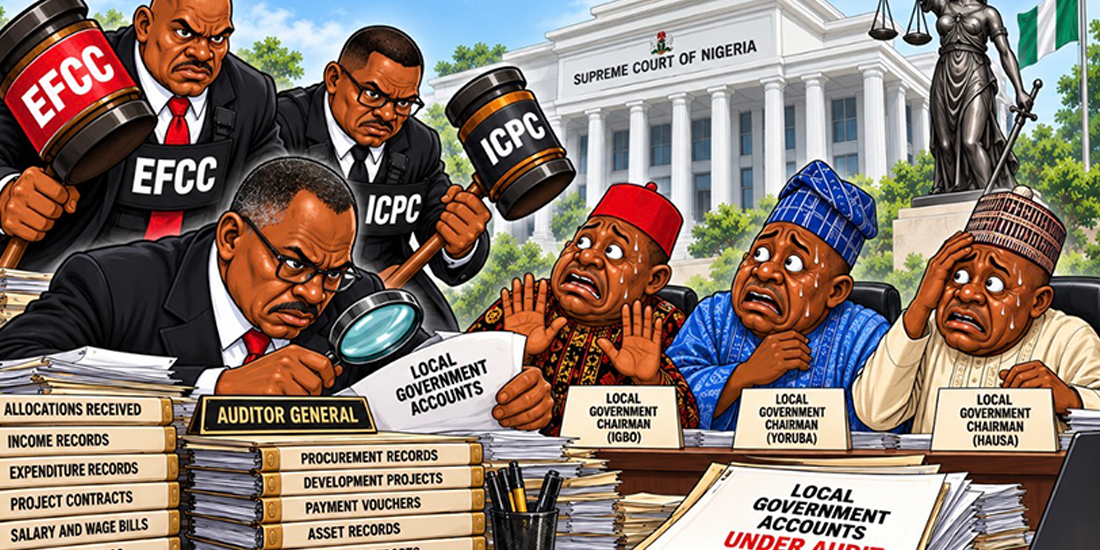
The Supreme Court’s affirmation of financial autonomy for local governments must be accompanied by strict transparency. Every local government council should publish its income, expenditure, wage bill, contracts and audited accounts covering the past eight completed financial years.
Financial autonomy for local governments was meant to free grassroots administration from excessive state control and bring governance closer to the people. It must not become a license for another layer of unchecked corruption.
On July 11, 2024, the Supreme Court delivered its landmark judgment in Attorney General of the Federation v Attorney General of Abia State and 35 Others (Suit No. SC/CV/343/2024). The court directed that allocations belonging to Nigeria’s 774 local government councils be paid directly into their accounts. It also restrained state governments from retaining or spending council funds and rejected the administration of local governments by unelected caretaker committees.
President Bola Tinubu welcomed the judgment as an affirmation of local governments’ constitutional rights, saying it would let citizens hold council leaders responsible for their actions and failures. The expectation was that councils would finally have the resources and freedom to deliver essential services without blaming state governors for every shortcoming.
More than two years on, however, implementation remains uneven nationwide. While some councils reportedly now run independent accounts, investigations suggest the old joint-account structure and state control persist in several states. That uncertainty makes transparency more urgent than ever. Nigerians must be able to establish what was allocated to each council, what was actually released, what deductions were made, and who authorized every expenditure.
Autonomy Is Not Immunity
The Supreme Court judgment did not abolish accountability — it relocated it.
Local government chairmen can no longer demand control of public funds without accepting full responsibility for how those funds are managed. Councillors cannot celebrate legislative independence while abandoning their duty to examine budgets, question expenditure and represent their wards.
Autonomy must never mean a council chairman receiving hundreds of millions of naira, distributing contracts among political associates, keeping expenditure records from public view, and returning months later with photographs of a few poorly executed projects.
Council money is not the chairman’s personal income. It is public money held in trust for communities.
For June 2026 revenue alone, the Federation Account Allocation Committee (FAAC) allocated a combined ₦591.390 billion to the 774 local government councils — a figure that illustrates the sheer scale of public resources flowing through the third tier of government. Money of that magnitude cannot be managed in secrecy.
The Fourth Schedule of the Constitution gives local governments responsibilities that touch everyday life directly: local roads, streets, drains, markets, motor parks, refuse disposal, public conveniences, and participation in primary education, agriculture and health services.
If councils receive substantial public funds while rural roads remain impassable, drains stay blocked, markets lack basic facilities and primary health centers go without medicines, Nigerians have every right to demand documentary explanations.
Nigeria Needs an Eight-Year Audit
Every one of Nigeria’s 774 local government councils should be required to prepare and publish complete accounts covering at least the eight completed financial years from 2018 to 2025. Their 2026 accounts should also be published quarterly through the end of the financial year.
This exercise must cover elected administrations, caretaker committees, transition committees and every other arrangement through which council resources were managed during the period.
The audit should not be designed to target only current chairmen. For the years when allocations passed through State Joint Local Government Accounts, state governments must disclose the amount allocated to every council, the amount released, every deduction made, and the authority under which each deduction was taken.
Council officials should be held responsible for the funds they controlled. State officials must equally account for funds withheld, deducted or spent on councils’ behalf. Accountability must follow the money wherever it went.
An eight-year review is not a declaration that every chairman or councillor is corrupt. It is a chance for honest officials to show that public resources were properly managed — and a way to identify councils that may have been denied access to funds officially recorded in their names.
What Every Council Must Disclose
Each local government should publish its annual approved budget, supplementary budget and budget performance report.
Disclosures should show the council’s monthly FAAC entitlement, the amount actually received, payment dates, statutory contributions from the state, internally generated revenue, grants, donations and every other source of income.
On the expenditure side, councils must disclose wage bills, staff strength, pension obligations, overhead costs, capital expenditure, debts, outstanding liabilities and closing bank balances.
Every contract should appear in a public register showing the contractor, contract value, project location, approval date, amount paid, any variations, expected completion date and current status. The beneficial owners of contracting companies should also be disclosed, to prevent serving officials from secretly awarding contracts to themselves or their associates.
Payroll records should undergo biometric verification to root out ghost workers and unexplained salary payments. Capital projects should be physically inspected and matched against payment vouchers, procurement records and council resolutions.
Security-related expenditure may be presented in a way that protects genuinely sensitive operational information, but it must not be exempt from independent audit. Security cannot remain a convenient label for untraceable spending.
Findings must be available online and displayed at council headquarters and ward offices, so that citizens without reliable internet access are not shut out of information about money belonging to their communities.
Councillors Must Stop Acting as Rubber Stamps
Accountability cannot rest on the chairman alone. Councillors form the legislative arm of local government and must provide meaningful oversight.
They should debate proposed budgets openly, examine quarterly expenditure reports, inspect projects, question accounting officers and hold public hearings in their wards. Council resolutions approving major contracts, loans, supplementary expenditure and the disposal of public assets should be properly recorded and made available for public inspection.
A councillor who signs blank resolutions, approves expenditure without supporting documents, or accepts personal benefits in exchange for silence has betrayed the people of the ward.
Local legislatures must become genuine institutions of accountability, not extensions of the chairman’s political office.
Independent Auditors Must Follow the Money
The statutory authorities responsible for auditing local government accounts in every state must be properly funded and protected from political interference.
Where state laws provide for an Auditor-General for Local Governments, that office should lead the audit process. Independent professional firms may also be engaged through transparent procurement, published terms of reference, conflict-of-interest disclosures and periodic rotation.
Any audit involving suspected diversion, fictitious contracts, ghost workers or unexplained transfers should include a forensic review — examining bank statements, payment instructions, procurement files, payroll records, project certificates and contractor ownership information together.
The Office of the Accountant-General of the Federation, FAAC and the Revenue Mobilization Allocation and Fiscal Commission should publish council-by-council allocation schedules in accessible formats. State governments should publish all transactions passing through joint accounts, while councils should disclose the amounts entering their own accounts.
Together, this would let citizens and auditors compare what was allocated, what was released, what was received and what was spent.
Anti-Corruption Agencies Must Look Beyond Abuja
The Economic and Financial Crimes Commission, the Independent Corrupt Practices and Other Related Offenses Commission, and the Nigerian Financial Intelligence Unit must pay greater attention to financial misconduct at the local government level.
Their focus should include suspicious cash withdrawals, payments to shell companies, contract splitting, inflated projects, abandoned projects recorded as completed, transfers to personal accounts, ghost workers, and payments unsupported by council approval.
These agencies must act professionally and without political selectivity. An audit should never become a tool for intimidating opposition chairmen while shielding officials aligned with those in power.
Where evidence establishes wrongdoing, prosecution should follow. Where officials are cleared, the public record should reflect that too.
Citizens Must Take Ownership
Nigerians often pay closer attention to federal and state budgets while ignoring the tier of government closest to their homes. That must change.
Residents should know their council’s monthly allocation. Community associations, professional bodies, traditional institutions, journalists and civil society organizations should monitor budgets and verify projects on the ground.
Every council chairman should be able to answer six basic questions: How much money came in? Who approved its use? What was purchased or constructed? Who received the contract? Where is the project? What balance remains?
Those answers must be backed by documents, not political speeches.
The Supreme Court judgment created a real opportunity to rebuild grassroots governance. But financial autonomy without public accountability would simply relocate corruption, not eliminate it.
Nigeria must insist on one national standard: 774 councils, eight years of accounts, independent audits, full public disclosure, and lawful consequences wherever public money cannot be explained.
Autonomy is not a blank cheque. It is a public trust — and every naira must be accounted for.