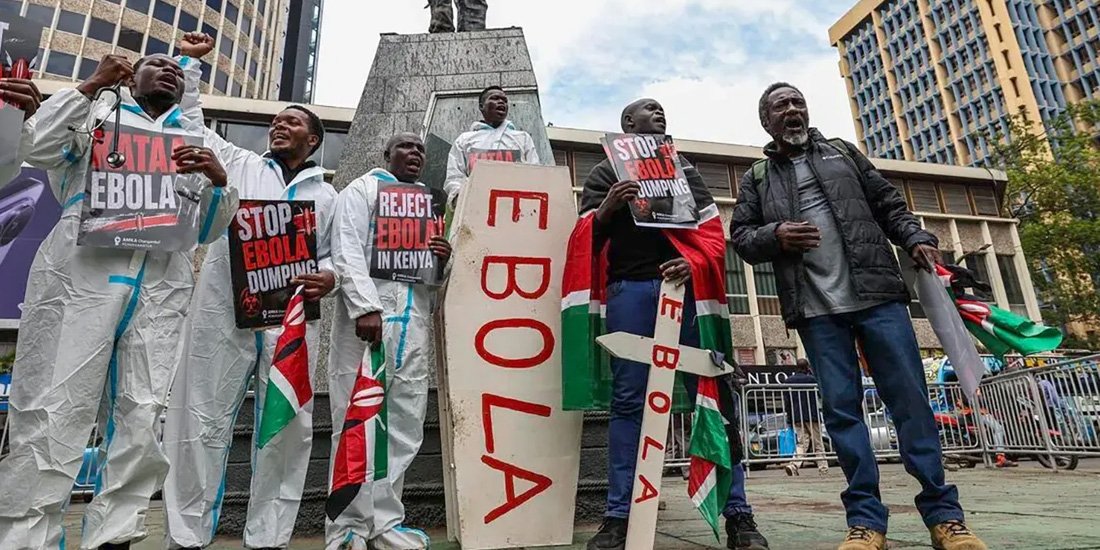
NAIROBI, Kenya — Demonstrators across Kenya have rallied against plans to establish a U.S.-funded Ebola isolation facility for Americans exposed to the virus overseas, fueling a wider debate about sovereignty, public health risks, and the changing nature of U.S.-Africa relations under President Donald Trump.
Chants of “Kenya is not an American colony” echoed through Nairobi and other major cities last week as protesters voiced opposition to the proposed facility, which critics say could expose the country to a disease it has never recorded within its borders.
The controversy has become a flashpoint in a broader conversation unfolding across Africa, where governments and civil society groups are increasingly questioning foreign agreements they believe place disproportionate burdens on African nations while advancing American strategic interests.
Concerns Over Ebola Isolation Facility
The proposed isolation ward would be designed to accommodate Americans exposed to Ebola abroad. Critics argue that Kenya would be assuming health and safety risks that the United States itself would be unwilling to accept.
Although Ebola outbreaks remain concentrated more than 1,500 miles away in eastern Democratic Republic of Congo and neighboring Uganda, opponents fear the project could increase the country’s vulnerability to future outbreaks.
A Kenyan court has temporarily suspended construction pending a legal challenge. However, government support for the project has continued, intensifying public criticism.
President William Ruto defended the initiative, describing it as a humanitarian responsibility and a reflection of Kenya’s longstanding partnership with Washington.
“It would be very inhuman for us to reject a facility funded by the United States after years of receiving American assistance,” Ruto said.
Former Deputy President Rigathi Gachagua, impeached in 2024, sharply disagreed with the proposal, accusing Washington of applying a double standard.
“We find it unpalatable that if Americans are not willing to take care of their own patients in their own country because it’s risky to the rest of the population, they would decide that this can be done in Kenya,” Gachagua told CNN.
“We find it unfair. We find it a double standard.”
He described the arrangement as “totally insensitive” and argued that it prioritizes American interests over Kenyan concerns.
A New Era of U.S.-Africa Engagement
The backlash comes shortly after Kenya signed a $1.6 billion health agreement with the United States, prompting questions about whether the Ebola facility forms part of a wider shift in Washington’s engagement with Africa.
Since returning to office, President Trump has paused many foreign aid programs and terminated thousands of aid contracts worldwide. The administration has also accelerated the restructuring of the U.S. foreign assistance framework, significantly reducing the role of traditional aid mechanisms across Africa.
For decades, American-funded programs were central to efforts to combat HIV/AIDS, malaria, and tuberculosis across the continent. Those initiatives are now being reshaped under an “America First” approach that prioritizes direct bilateral agreements over conventional aid programs.
U.S. officials argue that the strategy promotes self-reliance and mutual benefit. Critics contend that it increasingly links assistance to broader strategic and economic objectives.
Growing Concerns Over Health Agreements
Kenya is not alone in expressing concerns.
Several African governments have raised questions about the terms attached to new U.S.-backed health agreements.
In Zambia, Foreign Minister Mulambo Haimbe recently indicated that his government was hesitant to accept a proposed $2 billion healthcare package because of provisions related to preferential access for U.S. companies and concerns surrounding data privacy.
Zambia’s vast copper reserves make the country strategically important in global supply chains supporting renewable energy technologies, electric vehicles, and modern power infrastructure.
The debate intensified after outgoing U.S. Ambassador Michael Gonzales urged Zambia to increase domestic healthcare spending rather than relying heavily on foreign assistance. While Gonzales denied claims that healthcare aid was tied to mineral access, he emphasized that future cooperation should generate benefits for both countries.
Similar concerns have emerged in Zimbabwe and Ghana, where officials have questioned provisions involving health data sharing and access to biological resources.
“We need partnerships without strings attached,” Ghanaian Health Minister Kwabena Mintah Akandoh told reporters last month.
Zimbabwean officials have also expressed concern that biological data and resources could be shared without guarantees that the country would benefit from resulting vaccines, treatments, or scientific breakthroughs.
“Development aid should empower nations, not create dependencies or serve as a vehicle for strategic extraction,” government spokesperson Nick Mangwana wrote in a February blog post.
Strategic Resources Under the Spotlight
Questions surrounding U.S. intentions extend beyond healthcare partnerships.
In the Democratic Republic of Congo, critics have scrutinized Washington’s diplomatic efforts aimed at ending decades of conflict in the country’s mineral-rich eastern region.
The area contains some of the world’s largest reserves of coltan, a key mineral used in smartphones, computers, and other electronic devices. As global competition for critical minerals intensifies, analysts and activists argue that geopolitical interests are increasingly shaping international engagement across the continent.
For many African leaders, the debate has evolved beyond traditional discussions about aid.
Instead, it centers on sovereignty, the balance of power in international partnerships, and whether foreign investment and assistance genuinely deliver shared benefits.
The protests in Kenya have become the latest symbol of that debate—one that is likely to grow louder as Washington expands its deal-based approach to engagement across Africa.