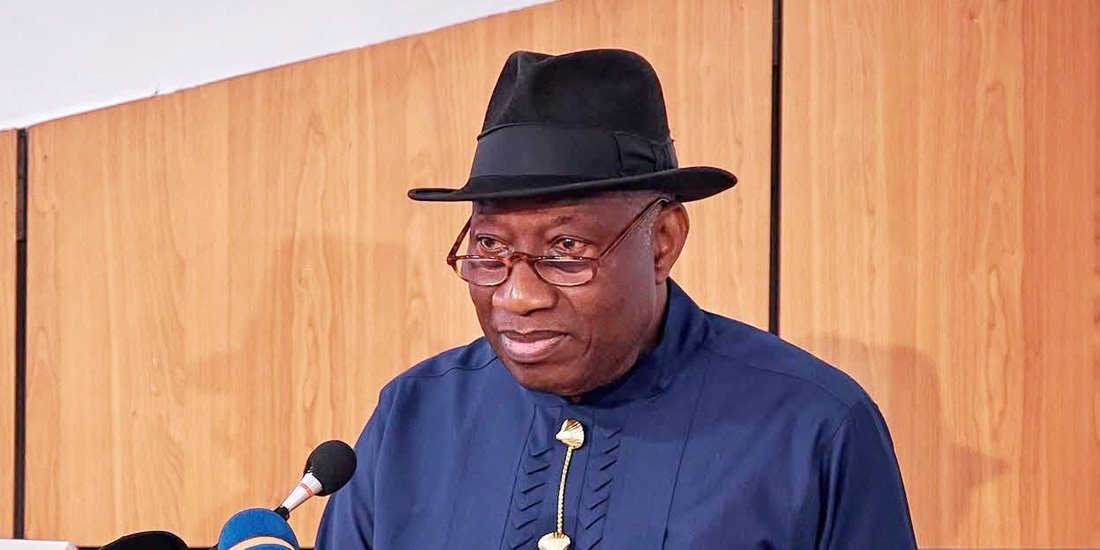
Former President Goodluck Jonathan has urged Nigeria’s political class to embrace purposeful, honest and visionary leadership, warning that the country’s democracy and international reputation risk further decline if current political practices persist.
Speaking at the third edition of the annual Paul Alaje Colloquium (TPACOLLOQUIUM) in Abuja, themed “The Brand Nigeria,” Jonathan said the nation needed leaders dedicated to development and citizens’ welfare rather than personal enrichment and the pursuit of political office at all costs.
“Please don’t burn Nigeria down, no matter the appetite you have for the office,” Jonathan cautioned, stressing that leadership should be driven by service and national interest.
The former president lamented what he described as the deteriorating quality of politics in the country, arguing that some practices within Nigeria’s political space fall short of democratic standards.
“Some of what goes on in our political space does not represent democracy. The brand of politics we are playing will set us backwards. Democracy has standards,” he said.
Jonathan called on political leaders to emulate the late Chief Obafemi Awolowo, whose vision and commitment to compulsory education transformed the old Western Region. He noted that Awolowo’s policies produced far-reaching results, recalling that the South-West once had more professors than the rest of the country combined.
He also criticised what he described as the culture of primitive wealth accumulation among political leaders, urging them to invest more in the younger generation.
“Why will you stomach what you are supposed to invest in the younger generation at a time you know your time on earth is really not much?” he asked.
The former president further expressed concern that many politicians lacked a clear understanding of their parties’ manifestos, claiming that such documents were often prepared by consultants without genuine commitment from candidates.
Jonathan described a nation’s brand as its identity, reputation and standing in the international community, noting that Nigeria once enjoyed considerable influence and respect globally but had suffered significant reputational setbacks over the years.
According to him, insecurity, corruption, economic challenges, unemployment, political instability and negative perceptions of public institutions have weakened Nigeria’s image abroad.
He highlighted the limitations faced by holders of the Nigerian passport, noting that its relatively weak global standing often subjects citizens to visa restrictions and travel difficulties.
Despite these challenges, Jonathan maintained that the country’s problems should not be mistaken for a lack of human potential.
“Our problem is not a shortage of human potential. It is our failure to translate that potential consistently into effective institutions, responsible leadership and national progress,” he said.
Reflecting on Nigeria’s past achievements, Jonathan recalled the country’s leading role in the liberation struggles of Southern Africa and the fight against apartheid, as well as its contributions to peacekeeping operations in Liberia and Sierra Leone.
He said Nigerian professionals, entrepreneurs, academics, athletes and creatives had also played a significant role in projecting a positive image of the country internationally.
The former president cited icons such as Dick Tiger, Nwankwo Kanu and Austin “Jay-Jay” Okocha as examples of Nigerians whose accomplishments elevated the nation’s global profile. He added that Afrobeats, Nollywood, literature and other creative industries continue to enhance Nigeria’s international identity.
Jonathan argued that a strong national brand would attract investment, tourism and global partnerships while fostering patriotism at home and respect abroad.
He expressed confidence that Nigeria could reverse its declining image by adopting lessons from countries such as India, South Korea, Malaysia and Singapore.
“The lesson is not that Nigeria must become Singapore. It is that national transformation requires purposeful leadership, institutional discipline and long-term commitment to the public good,” he said.
Jonathan stressed that restoring Nigeria’s reputation would require more than slogans and publicity campaigns, insisting that the country must confront the underlying issues shaping international perceptions.
He called for the revival of integrity, discipline, hard work and patriotism as core national values, urging families, schools, religious bodies and communities to instill these virtues in younger generations.
The former president also advocated stronger governance, transparency, accountability, meritocracy and respect for the rule of law, emphasizing that public office should be treated as a trust.
He further called for reforms in political leadership recruitment, stronger internal party democracy, credible elections and a political culture that rewards competence, ideas and character instead of money and patronage.
Jonathan urged the government to focus on building a secure and productive economy capable of creating jobs, stimulating enterprise and improving living standards. He identified education, healthcare, agriculture, manufacturing, technology and infrastructure as critical sectors requiring sustained investment.
He also called for greater support for Nigeria’s cultural and sporting sectors, describing Afrobeats, Nollywood, fashion, literature and football as powerful tools for cultural diplomacy and economic growth.
Earlier, convener of the colloquium, Dr Paul Alaje, said Nigeria’s challenge was no longer a lack of conferences, reports or development plans but the failure to implement recommendations and policies.
According to Alaje, national development will depend on placing productivity at the center of governance, while rewarding efficiency, innovation, value addition and competitiveness. He added that rebuilding public trust would require transparency, accountability, consistency and effective service delivery.