Less than 24 hours after a new ceasefire between Israel and Hezbollah was announced, violence continued across southern Lebanon, with Israeli airstrikes reportedly killing around two dozen people and raising concerns about the durability of the agreement.
Lebanese officials said at least 23 people were killed in Israeli attacks on Saturday, including 16 in the Nabatieh district and seven in neighbouring Saida. Several others were reported injured as Israeli warplanes, drones and artillery targeted multiple locations across the south.
According to Lebanese state media, a family of four — a father, mother and their two children — was among those killed in the town of Barish.
The Israeli military said it had carried out strikes on dozens of Hezbollah targets after the group launched more than 50 projectiles toward Israeli forces operating in southern Lebanon.
The renewed violence comes despite a ceasefire announced on Friday following a US-brokered agreement aimed at reducing tensions linked to the wider conflict involving Iran and its regional allies.
Washington has expressed concern over Israel’s continuing military operations in Lebanon, warning that ongoing clashes could undermine a broader peace framework with Iran. The agreement reportedly includes commitments to end hostilities across multiple fronts, including Lebanon.
US special envoy Steve Witkoff is expected to travel to Switzerland for preliminary talks with Iranian officials as efforts continue to strengthen the fragile agreement.
While the ceasefire may have helped prevent a broader regional escalation, major issues remain unresolved, including Israel’s military presence in southern Lebanon and the future status of Hezbollah’s arsenal.
A Hezbollah official told the BBC that the group does not recognise the ceasefire announced by US officials and rejects Israel’s demand for operational freedom inside Lebanese territory.
Senior Hezbollah official Hassan Fadlallah said the group reserved the right to respond to Israeli attacks.
“Our concern is that the enemy fully respects the ceasefire and does not seek to attack our country, our villages, or occupy new positions,” Fadlallah said, according to Lebanon’s state-run National News Agency.
In a statement, the Israel Defense Forces (IDF) said it had “struck dozens of Hezbollah terrorist infrastructure sites and terrorists in southern Lebanon” in response to repeated attacks.
The military described Hezbollah’s rocket fire as “repeated and ongoing violations of the ceasefire agreement.”
Previous ceasefires between Israel and Hezbollah have frequently been marked by mutual accusations of violations and continued cross-border attacks.
Prior to Friday’s announcement, Israel had stated that it would not withdraw its forces from Lebanon and maintained that its campaign against Hezbollah was separate from its conflict with Iran.
Earlier on Friday, Lebanon’s Health Ministry reported that 47 people were killed and 97 wounded in Israeli airstrikes, while the Israeli military said four soldiers were killed in separate incidents.
Ali, a Red Cross first responder in Nabatieh, described the latest wave of attacks as “the most intense night” he could remember.
The strikes followed the signing of an initial peace agreement between the United States and Iran, intended to halt hostilities across the region with immediate effect. However, fighting has continued despite the announcement.
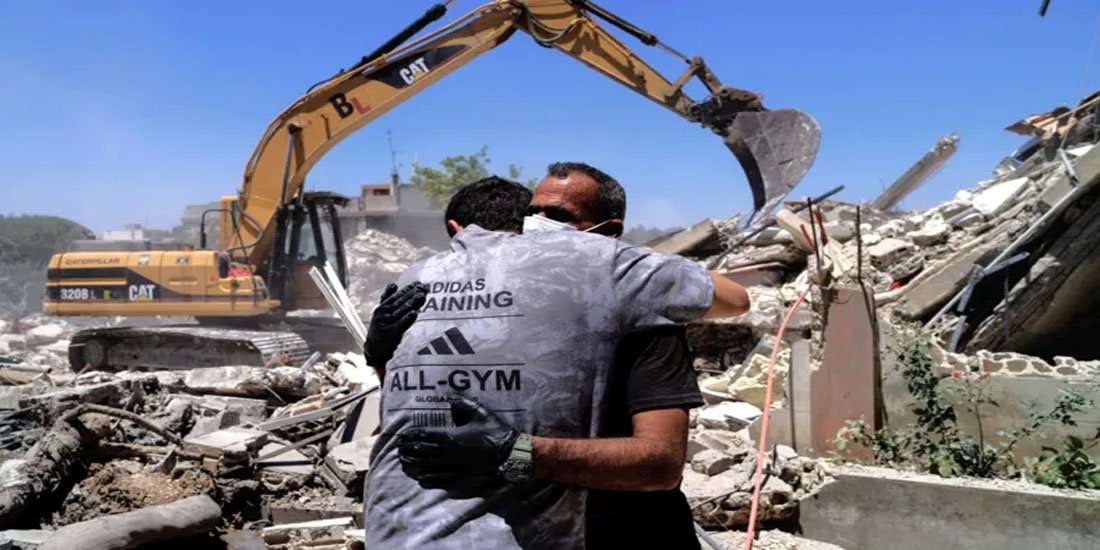
The humanitarian impact remains visible across southern Lebanon. Hospitals continue to treat large numbers of wounded civilians, while emergency crews increasingly shift from rescue operations to recovering bodies.
At Najdi Hospital in Nabatieh, ambulances were reportedly directed straight to the morgue as facilities struggled to cope with the number of casualties.
Many residents had returned to their villages following earlier ceasefires and temporary truces, hoping the worst of the conflict had passed. The latest escalation has once again cast doubt on the prospects for lasting stability along the Israel-Lebanon border.