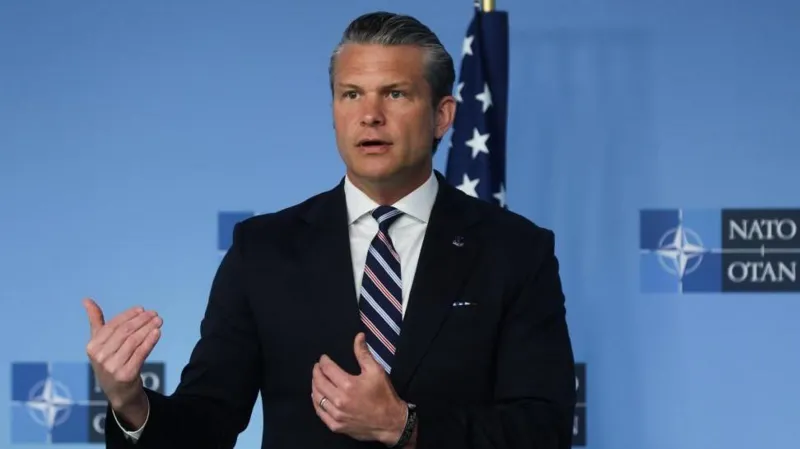
US Defense Secretary Pete Hegseth has announced a six-month review of American military deployments across Europe, while delivering a sharp critique of some NATO allies over defence spending and burden-sharing within the alliance.
Speaking at a meeting of NATO defence ministers in Brussels, Hegseth said the review would assess whether member states were contributing adequately to European security.
“Some countries will fail, and others will pass with flying colours,” he said, accusing certain allies of continuing to rely too heavily on US military support.
Push for Greater European Responsibility
Hegseth described the initiative as part of a broader effort to create a “NATO 3.0,” aimed at accelerating Europe’s leadership in its own defence and reducing dependence on Washington.
“The goal is to ensure that NATO is moving fast and irreversibly toward Europe leading on security on the continent,” he said.
The review comes as the United States seeks to shift more responsibility for regional security to European allies and increase pressure on member states to meet defence spending commitments.
NATO members have agreed to work towards spending 5% of their gross domestic product (GDP) on defence and related security investments, including 3.5% on core military capabilities and 1.5% on supporting infrastructure.
According to Hegseth, some countries have yet to provide credible plans showing how they intend to meet those targets.
US Contributions Tied to Defence Spending
The Pentagon chief warned that future US contributions to NATO could be linked to the level of commitment shown by individual allies.
“NATO’s annual dues will be contingent on other countries meeting their defence spending targets,” Hegseth said. “Where other allies do not spend with urgency, our dues contributions will go down.”
He also criticised member states that placed restrictions on assistance to US forces during the recent conflict involving Iran, although he did not identify specific countries.
“Some of NATO’s largest economies and richest nations still seem to think the era of free-riding is here,” he added.
NATO Says Europe Is Increasing Defence Investment
NATO Secretary-General Mark Rutte pushed back against concerns that Europe was not doing enough, highlighting a significant increase in defence spending across the alliance.
Rutte said European members boosted defence expenditure by €90 billion last year, representing a rise of nearly 20%, and argued that allies were already compensating for reductions in some US commitments.
He acknowledged, however, that not every capability being withdrawn by Washington could be fully replaced immediately.
Details of the planned reductions have not been publicly released, though officials have indicated that air and naval assets may be among the capabilities affected.
Changes to NATO Force Commitments
The review follows a US decision to scale back its role in NATO’s high-readiness force structure, known as the NATO Force Model (NFM).
The NFM is designed to provide NATO’s Supreme Allied Commander Europe with military forces that can be deployed rapidly during crises.
A senior NATO official said some adjustments were already taking effect, while Rutte confirmed that further work was underway to manage the transition.
Troop Deployment Uncertainty
Questions over US troop levels in Europe have intensified in recent months.
In May, Washington announced plans to withdraw 5,000 troops from Germany following tensions between US President Donald Trump and German Chancellor Friedrich Merz over the conflict involving Iran.
That same month, Poland was informed that 4,000 US troops could be withdrawn before Trump later reversed the proposal and pledged to deploy 5,000 troops instead.
Polish Defence Minister Władysław Kosiniak-Kamysz said the United States remained open to discussions about establishing a permanent American military base in Poland, though any final decision would depend on the details of a future agreement.
Pressure Ahead of NATO Summit
The debate over defence spending is expected to dominate discussions ahead of the NATO summit in Ankara on 7–8 July.
Rutte said member states would be expected to demonstrate how they plan to fulfil commitments made at last year’s summit in The Hague.
“I expect nations to present clear, concrete and credible plans to reach that goal,” he said. “Ideally, well ahead of the agreed timeline. Many are already showing that they are doing exactly that.”
The upcoming summit is likely to provide the clearest indication yet of how NATO members intend to respond to growing US demands for greater defence investment and a larger European role in the alliance’s security responsibilities.