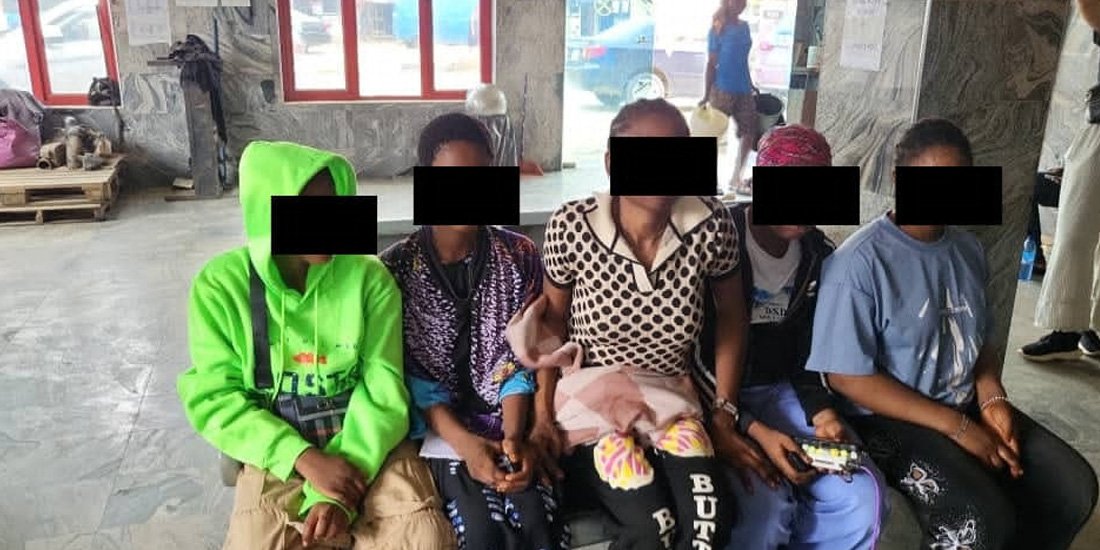
The National Agency for the Prohibition of Trafficking in Persons (NAPTIP), in collaboration with the Global Anti-Human Trafficking Organisation (GAHTO), has rescued seven young Nigerian women who were allegedly trafficked to Mali, Burkina Faso and Côte d’Ivoire under false promises of legitimate employment.
The victims, who hail from Plateau, Cross River and Edo states, were returned to Nigeria following a coordinated intervention by anti-trafficking authorities and advocates. The survivors recounted harrowing experiences of deception, exploitation and coercion after being lured abroad with promises of jobs in boutiques, restaurants, phone accessory shops, domestic services and other businesses.
According to the victims, they only discovered upon arrival in their destination countries that they had allegedly been trafficked into prostitution networks and were expected to engage in commercial sex work to repay debts reportedly ranging up to 1.5 million CFA francs.
Several of the rescued women disclosed that many other Nigerian girls remain trapped in similar conditions across Mali, Burkina Faso and other African countries.
Victims Recount Ordeal
One of the survivors, 22-year-old Sandy Sophia from Barkin Ladi Local Government Area of Plateau State, said she was persuaded to travel by a friend who claimed to be working in Senegal.
“I repeatedly asked if the job involved prostitution, and they kept assuring me it did not. It was only after we arrived in Burkina Faso that they admitted it was prostitution,” she said.
Another victim, 19-year-old Rose, a graduate of Plateau State Polytechnic, said she accepted the offer in hopes of supporting her education and assisting her family financially.
“I was told I would be working in a boutique and helping with cooking. My mother was initially reluctant because of stories about trafficking, but I was assured it was a genuine opportunity. When we arrived in Mali, we discovered the truth,” she said.
The survivors alleged that traffickers frequently used intimidation and spiritual threats to maintain control, warning victims that refusal to comply or failure to repay their debts could result in severe consequences.
Seventeen-year-old Esther said she was recruited while working in Lagos after being promised employment as a domestic worker. She eventually escaped with the help of a Nigerian resident in Mali who assisted several victims.
Another 17-year-old victim from Cross River State said she and her sister were recruited by a man identified as Peter, who promised them jobs in businesses owned by his sister abroad. Upon arrival, they were allegedly informed that they would be required to engage in prostitution to settle transportation and migration expenses.
Edo Victims Describe Exploitation
In a related development, two young women from Edo State, identified as Augusta and Elizabeth, narrated how they were trafficked to Burkina Faso and Côte d’Ivoire under the guise of employment opportunities.
Twenty-year-old Augusta said she travelled in February 2026 after being convinced by a relative that she would secure a better future abroad.
Upon arrival in Burkina Faso, however, she discovered she was expected to engage in commercial sex work. She alleged that when she refused, she was physically assaulted and pressured to recruit other girls, including her sister, into the trade.
Augusta further claimed that although she generated substantial income for her handlers, she was never provided with clear records of her earnings or debts.
Similarly, Elizabeth said she travelled after being promised legitimate employment in Côte d’Ivoire, only to discover that the promised jobs did not exist.
She described harsh living conditions, saying she was compelled to surrender most of her earnings to traffickers while receiving little support. According to her, threats and intimidation were routinely used to force victims to continue working despite difficult circumstances.
Both women, who were pregnant during part of their ordeal, said they eventually sought help after realising they were trapped in a cycle of exploitation, abuse and debt bondage.
Community Leaders Raise Concern
Speaking during the handover of some of the rescued victims to community leaders from Plateau State, President of the Birom Community Association in Lagos, Julius Bodiacubb, expressed concern over the increasing incidence of human trafficking involving young Nigerian women.
He called for stronger collaboration among government agencies, communities and civil society groups to combat trafficking networks and protect vulnerable youths.
Rescue Operation and Warning
The rescue operation was facilitated by GAHTO following a request from NAPTIP’s Benin Zonal Command. The victims were formally received by NAPTIP officials upon their return to Nigeria.
GAHTO representative Prosper, who assisted in coordinating the rescue and repatriation efforts, reaffirmed the organisation’s commitment to combating human trafficking and supporting vulnerable Nigerians trapped in exploitation networks across Africa and beyond.
The rescued victims urged young Nigerians to exercise caution when considering employment opportunities abroad, warning that seemingly attractive offers often conceal trafficking and exploitation schemes.
“I am very happy to be back home,” one of the survivors said. “I want other girls to verify every opportunity properly and avoid travelling based on promises that cannot be confirmed.”
The victims also appealed to government authorities, security agencies and anti-trafficking organisations to intensify efforts to dismantle trafficking syndicates that continue to lure unsuspecting Nigerians into exploitation under the guise of overseas employment.
GAHTO and NAPTIP reiterated calls for families, communities and prospective migrants to remain vigilant and promptly report suspicious recruitment activities to the relevant authorities.