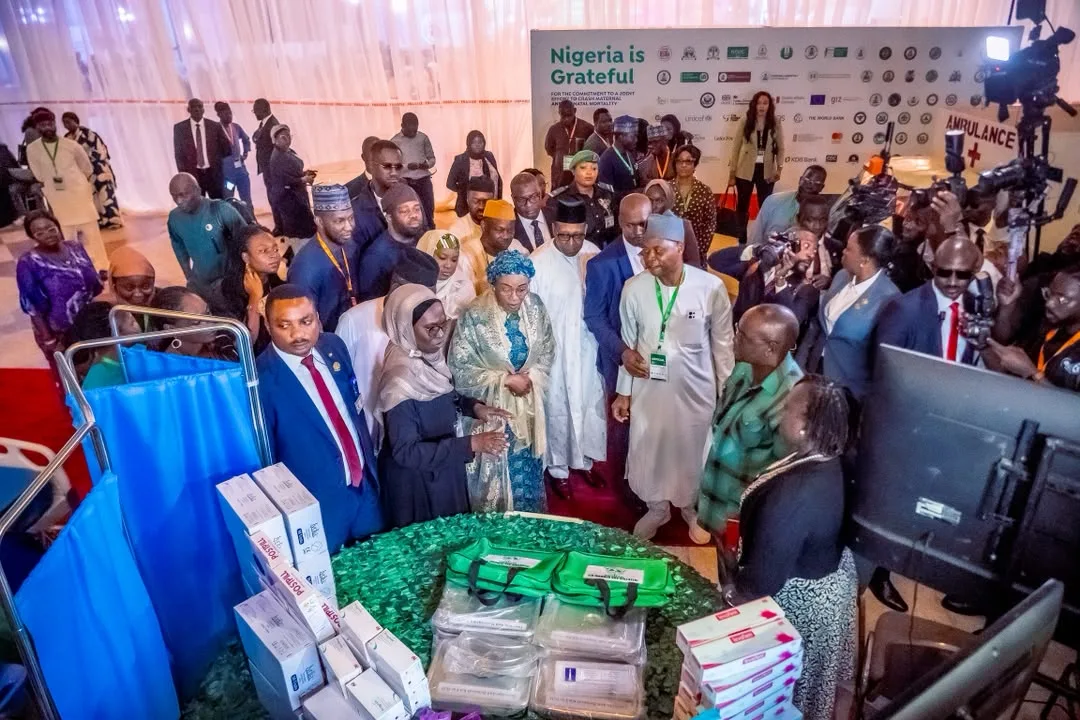
First Lady Oluremi Tinubu has called for stronger collaboration among federal, state and local governments, traditional and religious institutions, development partners and philanthropists to reduce Nigeria’s maternal and newborn mortality rate.
The call came as the Federal Government commenced the distribution of 215,000 MAMA kits, 40,000 maternal food-support packs and 40,000 sets of newborn clothing to vulnerable women and families across the country.
Mrs Tinubu made the call on Monday during the national flag-off of the distribution at the State House Conference Centre in Abuja.
She said pregnancy and childbirth should be occasions of hope and joy rather than a threat to the lives of Nigerian women.
The intervention is being implemented under the Maternal and Neonatal Mortality Reduction Innovation Initiative (MAMII) of the Federal Ministry of Health and Social Welfare.
Mrs Tinubu said the programme was designed to encourage greater use of antenatal, delivery and postnatal healthcare services.
“This occasion represents a further step towards ensuring that every Nigerian child has a healthy start in life and that no woman loses her life while giving birth,” she said.
She explained that the 215,000 MAMA kits represented the second batch of the intervention, following the distribution of 110,000 kits in 2025.
According to her, the federal government is complementing the kits with maternal food support and essential newborn clothing.
She said the programme would subsequently be expanded to additional local government areas where uptake of MAMII services remained low.
Mrs Tinubu urged state and local governments, traditional rulers, religious leaders, development partners and philanthropists to support the Federal Government in ensuring that the interventions reached women in poor, underserved and hard-to-reach communities.
She also highlighted interventions she had supported in maternal and child healthcare, including the provision of professional kits to midwives, retraining of frontline health workers and advocacy against mother-to-child transmission of HIV, syphilis and hepatitis.
FG rolls out incentives for pregnant women
Minister of State for Health and Social Welfare, Dr Iziaq Salako, said the Federal Government was providing free emergency medical services, including emergency obstetric and neonatal care, to vulnerable women and children.
He said the incentives were aimed at encouraging pregnant women to register early for antenatal care, deliver in health facilities and attend postnatal follow-up.
“Today’s flag-off of incentives is our next deliberate step — rewarding and reinforcing the very behaviours we know save lives: early antenatal registration, facility delivery and postnatal follow-up,” Salako said.
He disclosed that MAMII was launched in November 2024 and currently targets 172 local government areas across 33 states.
According to him, the programme aims to reduce maternal mortality by 30 per cent and neonatal mortality by 20 per cent in the targeted areas by 2028.
He said the initiative was expected to reach 2.9 million pregnant women with free, timely and comprehensive care.
Salako added that more than 250 health facilities were already implementing MAMII in states including Bauchi, Borno, Kaduna, Kano, Katsina and Ogun.
He disclosed that more than 32,000 women and 1,700 newborns had benefited directly from emergency obstetric and neonatal care under the programme.
Through the National Emergency Medical Services and Ambulance System, he said nearly 79,000 beneficiaries had been transported to healthcare facilities, with pregnant women accounting for about 60 per cent.
The minister also disclosed that fourth-visit antenatal care attendance in MAMII-supported local government areas increased by 20 per cent in one quarter.
Meanwhile, National Coordinator of MAMII, Dr Dayo Adeyanju, identified cultural practices as one of the factors discouraging pregnant women from accessing skilled maternal and neonatal healthcare, particularly in rural communities.
He said the government needed stronger community engagement to address reliance on traditional birth attendants and encourage women to use skilled healthcare providers.