
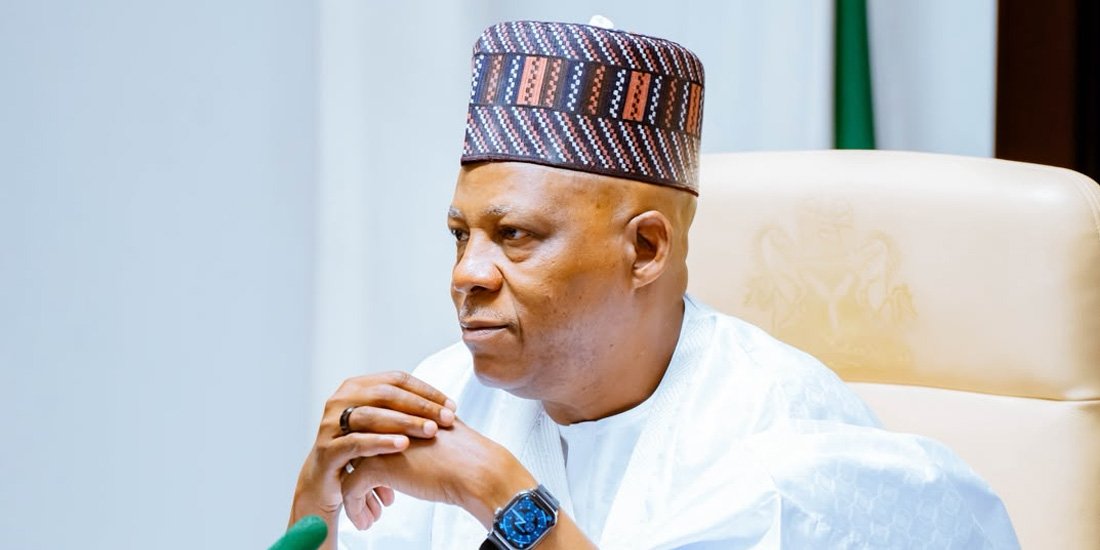
Vice President Kashim Shettima has called for stronger collaboration between government and economic stakeholders, insisting that small business owners should have a direct voice in shaping government policies and decisions.
Speaking at the Micro, Small and Medium Enterprises (MSMEs) Stakeholders’ Meeting held on Friday at the Presidential Villa in Abuja, Shettima said enterprises and governance are closely linked and that business owners must play a more active role in public policy discussions.
To deepen engagement, the Vice President directed the Special Adviser to the President on Job Creation and MSMEs, Temitola Adekunle-Johnson, to expand the membership of the stakeholders’ forum and ensure it meets quarterly.
“Business owners must have a more decisive voice in our deliberations, and each meeting must account for the decisions taken at the previous one,” Shettima said.
Highlighting the importance of MSMEs to Nigeria’s economy, the Vice President described small businesses as the backbone of countless households across the country, noting that their success or failure has far-reaching social and economic consequences.
He reaffirmed the Tinubu administration’s commitment to supporting entrepreneurs, stating that President Bola Tinubu has placed access to finance at the centre of his economic agenda.
According to Shettima, the Federal Government has approved a ₦200 billion business support package comprising ₦50 billion in grants, ₦75 billion in loans for MSMEs, and ₦75 billion for manufacturers. Eligible manufacturers, he added, can access up to ₦1 billion through the Bank of Industry.
“The woman who can fulfil a larger order and the artisan who can afford better equipment are helping to build the economy we seek,” the Vice President said, acknowledging the challenges business owners face due to the rising cost of operations.
Shettima noted that government agencies, financial institutions, state governments and private sector partners have played key roles in translating policy commitments into practical support for businesses nationwide.
Earlier, Minister of State for Industry, Trade and Investment, Senator John Owan-Enoh, described MSMEs as the true foundation of Nigeria’s economy and called for sustained government support to strengthen their contributions to national development.
“These are people who run businesses that we see every day. They are the Nigerian economy,” he said.
The Special Adviser to the President on Job Creation and MSMEs, Temitola Adekunle-Johnson, attributed recent achievements in the sector to strong collaboration between government and stakeholders, assuring entrepreneurs of continued support in areas such as affordable financing and access to modern production facilities.
Representatives of key institutions, including SMEDAN, the Nigerian Export Promotion Council, NEXIM Bank and the Industrial Training Fund, also pledged to expand interventions focused on training, affordable finance, market access and production equipment.
Business leaders attending the meeting urged the Federal Government to increase support for small businesses. President of the Association of Women in Textile and Garments, Hauwa Abubakar, called for improved access to funding, training and international markets for women entrepreneurs.
Similarly, President of the National Association of Small Scale Industrialists, Solomon Daniel Vongfa, urged the government to implement deliberate measures to strengthen MSMEs, describing the sector as critical to Nigeria’s industrialisation and job creation efforts.