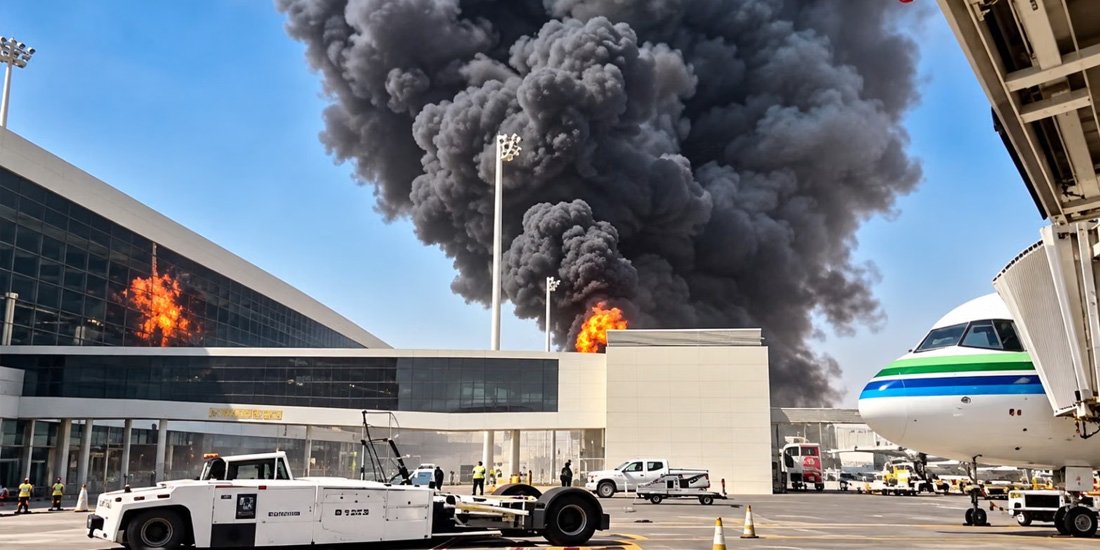
Saudi Arabia has vowed to deliver a decisive response following a series of deadly attacks by Yemen’s Houthi movement targeting the kingdom’s airports and energy infrastructure, escalating tensions in the region and raising fresh concerns over security and energy stability.
Saudi Energy Minister Prince Abdul Aziz bin Salman issued the warning on Monday during the opening of the WPC Energy Congress in Riyadh, describing the recent attacks as grave and demanding an equally robust reaction from the kingdom.
“The events of recent weeks are serious. Our response must be equally serious,” the minister said while addressing delegates at the international energy gathering.
The statement came after multiple strikes on Saudi airports over the past week that left several people dead, including foreign nationals, and disrupted air travel operations.
According to Saudi authorities, a Pakistani resident was killed on Sunday after a projectile struck Terminal 4 of King Khalid International Airport in Riyadh. The incident followed an earlier attack on Saturday when a missile hit Terminal 3, killing 13 people and forcing the temporary closure of the facility.
Authorities also reported that three Saudi citizens, including a pilot employed by national carrier Saudia, were killed in separate attacks last Thursday targeting an airport facility and an aircraft on the ground.
Victims of the Terminal 3 strike included four Saudi nationals, two Bangladeshi citizens, and one person each from the United States, Egypt, Jordan, Syria, Palestine, Sudan, and India, highlighting the international impact of the attacks.
The General Authority of Civil Aviation further disclosed that King Fahd International Airport in Dammam was targeted on Sunday evening. While no casualties were recorded in that incident, the attack added to growing concerns over the security of critical infrastructure in the kingdom.
Saudi military officials later announced that coalition forces had intercepted a drone over the Eastern Province and destroyed a missile launched toward Khamis Mushait in the country’s southwest.
Speaking at the congress, held roughly 10 kilometres from Riyadh’s main airport, which has reportedly come under attack four times within a week, Prince Abdul Aziz sought to reassure international delegates, industry executives, and policymakers attending the event.
He thanked participants for travelling to the kingdom despite the heightened security risks and emphasized Saudi Arabia’s commitment to ensuring their safety.
The minister acknowledged that the attacks had tested the country’s resilience, warning that energy security could no longer be taken for granted.
“Recent developments have tested our infrastructure, our institutions, our people, and our resilience,” he said, stressing that Saudi Arabia remained determined to overcome the challenges.
“We, as Saudis, are fearless, combatant and determined people. We shall prove to the world that whatever we are going through, we will overcome it,” he added.
The Houthi movement, which controls large parts of western Yemen, claimed responsibility for the attacks, describing them as retaliation for what it called continued Saudi military operations in Yemen.
On Sunday evening, Houthi military spokesman Yahya Sarea said the group had launched a coordinated operation involving missiles and drones against airports in Riyadh and Dammam, as well as two oil and gas facilities in Saudi Arabia’s Eastern Province.
Sarea claimed the attacks were a response to 124 Saudi-led airstrikes carried out in Yemen over the previous 24 hours. He also warned airlines and passengers against using Saudi airports and airspace, except for flights travelling to and from the Islamic holy cities of Mecca and Medina.
The spokesman further declared that the Houthis would continue their military campaign inside Saudi territory until airstrikes in Yemen cease and what the group describes as a blockade on areas under its control is lifted.
There was no immediate response from Houthi officials following the Saudi energy minister’s warning of a stronger retaliation.
Meanwhile, the Houthi-run health ministry reported that a child was killed and six other people injured in a Saudi airstrike that allegedly hit a residential property in Yemen’s capital, Sanaa, on Sunday.
The latest exchange underscores the continuing intensity of the conflict between the Iran-aligned Houthi movement and the Saudi-led coalition, which has been providing air support to Yemeni government forces in several regions, including the strategic Red Sea coast.
The escalating attacks on airports and energy facilities have also renewed concerns among global markets about the potential impact of the conflict on regional stability, aviation security, and international energy supplies.