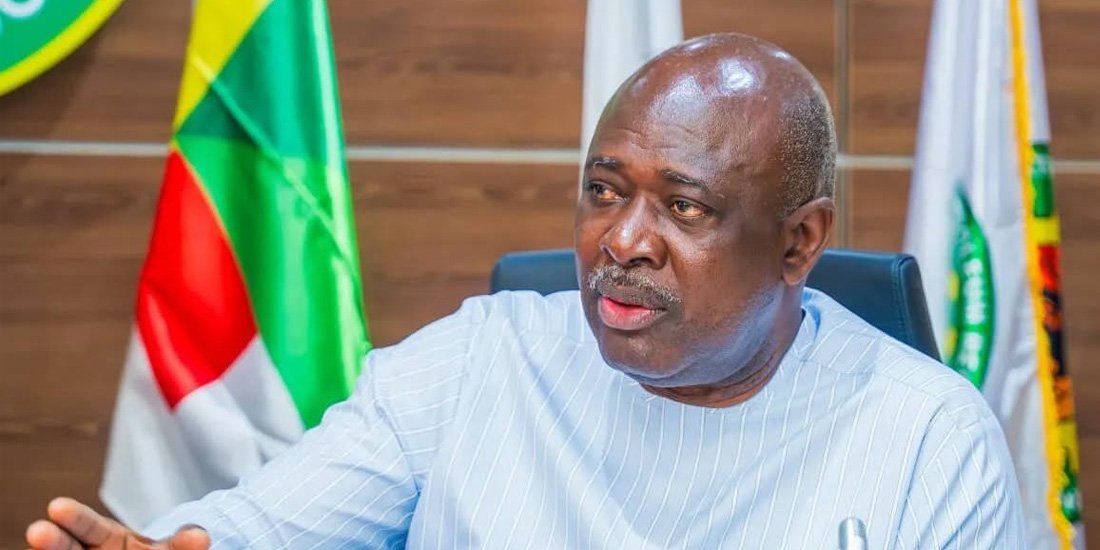
Minister of State for Petroleum Resources (Oil), Senator Heineken Lokpobiri, has defended the removal of petrol subsidy, arguing that Nigeria could now be spending about N21 trillion annually if the old regime had been retained.
Speaking during an interview on Channels Television, Lokpobiri said the estimate was based on a 2023 disclosure by former Minister of Finance Zainab Ahmed that the country was spending about N18.4 billion daily on petrol subsidy.
He said the daily figure, at the then exchange rate of about N448 to the dollar, translated to roughly $41 million a day and about $15 billion annually.
According to the minister, converting that annual dollar cost at an exchange rate of about N1,400 to the dollar would produce an annual subsidy burden of approximately N21 trillion.
“That’s for the purpose of argument, to say that today’s exchange rate is perhaps N1,400 to a dollar. If you change $15 billion at N1,400 to a dollar, it will be about N21 trillion. That’s what Nigeria would have spent, subsidised,” he said.
Lokpobiri argued that President Bola Tinubu’s decision to remove petrol subsidy was consistent with the Petroleum Industry Act 2021, which provides for market-based pricing of petroleum products at wholesale and retail levels.
He described the policy as painful but necessary, saying continued subsidy spending could have severely weakened the economy.
The minister also rejected former Vice President Atiku Abubakar’s proposal for a production subsidy on locally refined petrol, arguing that such a plan lacked legal, fiscal and financial grounding under the current deregulated framework.
Lokpobiri described Atiku’s proposal as political and maintained that petrol pricing was now governed by market forces under the PIA.
Atiku had argued that Nigeria’s position as a crude-producing country, combined with increased domestic refining capacity, should allow government to support lower petrol prices through a targeted production subsidy.
Lokpobiri disagreed, insisting that government could not simply restore a subsidy regime after dismantling it.
Asked how the savings from subsidy removal had been deployed, the minister said they were reflected partly in higher monthly allocations distributed through the Federation Account Allocation Committee.
He pointed to recent FAAC disbursements in excess of N2 trillion and argued that state governments now had greater fiscal space than in previous years.
He also denied that the federal government was still paying or reimbursing petrol subsidy through the Nigerian National Petroleum Company Limited or any other mechanism.
Lokpobiri said deregulation had opened the petroleum sector to greater private investment and cited the Dangote Refinery as an example of the type of project made more commercially viable under market-based pricing.
He also addressed rising pump prices, acknowledging the strain on households but arguing that government no longer directly determines the retail price of petrol.
According to him, crude oil remains a globally traded commodity and movements in international crude prices inevitably affect the cost of refined petroleum products.
The minister also rejected the argument that domestic refining should automatically translate into sharply lower petrol prices, saying refiners still purchase crude within a globally influenced pricing framework.
On production, Lokpobiri said Nigeria was currently producing an average of about 1.8 million barrels per day, including condensates, compared with less than one million barrels per day when the Tinubu administration took office.
He said production could rise above two million barrels per day but identified aging evacuation infrastructure as a major constraint.
“Most of our pipelines have been there for 50 years,” he said, noting that gains from re-entry into old wells could be limited where additional crude could not be efficiently evacuated.
Lokpobiri said relevant agencies were working on gradual pipeline replacement to improve output over the coming years.
He also disclosed that more than 500 shut-in wells were associated with the Shell-to-Renaissance divestment and another set of over 500 wells followed the ExxonMobil-Seplat transaction.
According to him, operators are undertaking re-entry programmes aimed at restoring production from those assets.
The minister also cited a number of upstream projects which he said were advancing, including Bonga, Bonga Southwest, Zaba Zaba, Obeta, Project Panther and Usan.
He added that gas production had risen to more than 7.5 billion cubic feet per day.
On Nigeria’s four state-owned refineries, Lokpobiri acknowledged that the facilities were not currently producing.
He said the Port Harcourt, Warri and Kaduna refineries remained inactive and that new partnerships, including discussions with Chinese companies, were being explored to rehabilitate them.
Regarding the approximately $1.5 billion Port Harcourt refinery rehabilitation programme, he said about $1.4 billion had already been spent before he assumed office, stressing that the expenditure was undertaken by NNPC rather than his ministry.