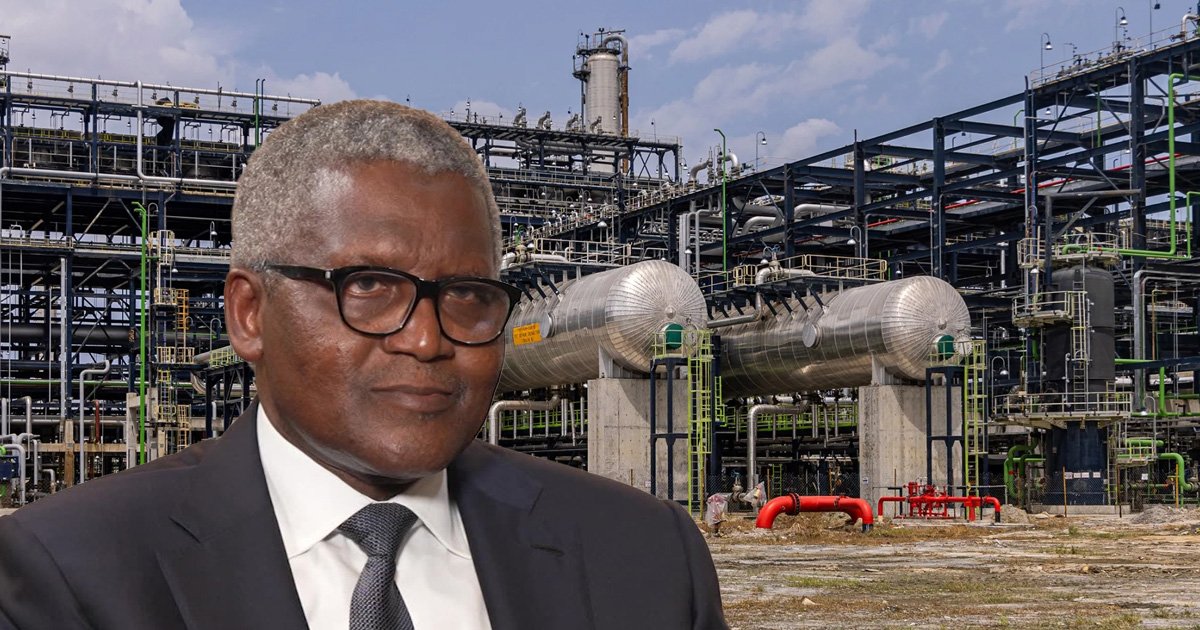
Africa’s leading industrialist, Aliko Dangote, has described the construction of his refinery and fertiliser businesses as the biggest financial gamble of his career, saying he committed virtually all his assets to the projects despite significant uncertainty over their prospects.
Dangote disclosed that his group secured a $3.7 billion loan backed by asset collateral and a personal guarantee to finance the massive investments.
According to him, the scale of the financial commitment reflected his confidence that the refinery would eventually succeed despite widespread doubts over whether such a privately funded industrial project could be completed in Nigeria.
The billionaire said the Dangote Group had maintained a clean borrowing record throughout its 47-year history, stressing that the company had never defaulted on a loan.
He contrasted the refinery project with his textile business, which he described as his biggest commercial mistake.
According to Dangote, the textile business was overwhelmed by competition from imported products, resulting in the loss of thousands of jobs.
Dangote Rejects Family-Only Succession
The industrialist also spoke about succession within the Dangote Group, saying he wants the conglomerate to remain professionally managed rather than become dependent solely on family members.
Dangote said one or more of his daughters could eventually assume leadership positions within the group, stressing that competence, rather than gender, would determine who takes up leadership responsibilities.
He also rejected the notion that having a male child was necessary to preserve a family-owned business, arguing that professional structures and effective governance were more important for ensuring continuity.
Dangote said his objective was to establish governance systems strong enough to prevent any family member from undermining the businesses after his death.
He said the group should operate like major global corporations where leadership can change without destabilising the organisation.
The industrialist also reiterated his plan to commit one-third of his wealth to the Dangote Foundation.
He said his broader legacy ambition was to contribute to industrialisation across Africa and build institutions capable of surviving beyond his lifetime.
Refinery Cannot Subsidise Petrol Amid Rising Costs
Dangote also defended the refinery’s pricing decisions, saying the facility could not sell petrol below prevailing market conditions when crude oil and transportation costs were rising.
He said the refinery had purchased crude at prices as high as $124 per barrel in May, while shipping costs had also increased because of conflicts and disruptions in the Middle East.
According to him, such increases in input and logistics costs inevitably affect the price of refined petroleum products.
Dangote said the refinery would reduce petrol prices when crude oil and international product costs decline, noting that the company had previously reduced its prices without waiting for government directives.
N1trn Invested in Fuel Distribution
The industrialist disclosed that the refinery had invested about N1 trillion in 4,000 new tankers, each with a capacity of 50,000 litres, as part of efforts to reduce transportation costs and improve fuel distribution nationwide.
He said the investment was aimed at strengthening the company’s logistics network and limiting the impact of rising transportation costs on consumers.
Dangote added that the refinery was delivering fuel to some parts of the country without imposing separate transportation charges in an effort to cushion the impact of higher logistics costs.
He also assured Nigerians that the refinery would continue to maintain domestic fuel supply even during periods of international market disruption.
According to him, the facility would not deliberately create shortages or queues through its operations.
Dangote’s comments come amid continued debate over petrol pricing and the role of government intervention following the removal of the broad petrol subsidy.
The Dangote Refinery has also advocated stronger protection for domestic refining against imported petroleum products, while marketers and other industry stakeholders have emphasised the importance of competition and supply diversity.
Dangote said the refinery’s priority remained ensuring a steady domestic fuel supply while operating on a commercially sustainable basis.