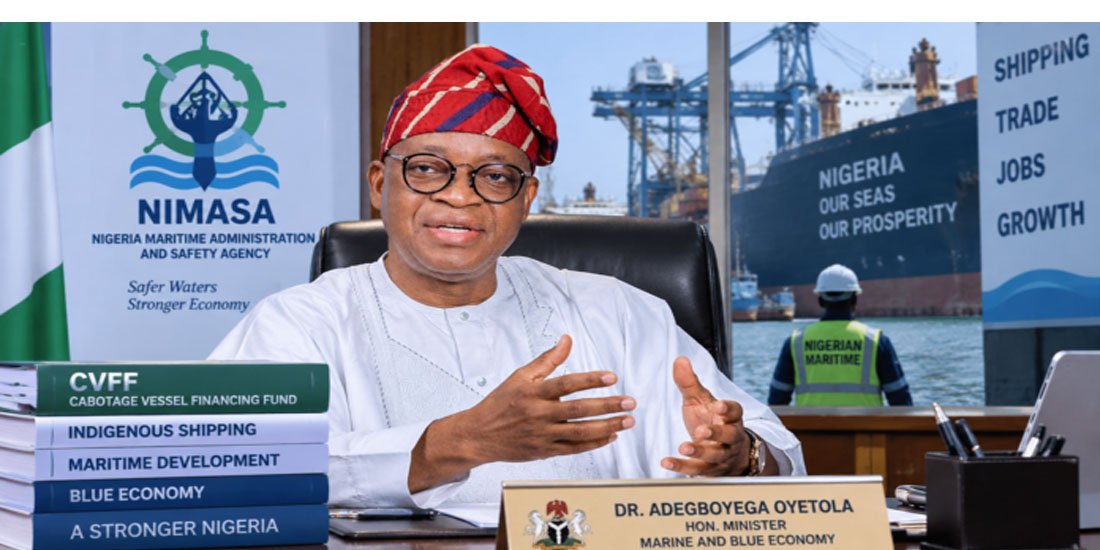
Minister of Marine and Blue Economy Adegboyega Oyetola has directed the Nigerian Maritime Administration and Safety Agency and participating banks to accelerate the long-delayed disbursement of the Cabotage Vessel Financing Fund to qualified Nigerian shipowners.
Oyetola said 92 applications had been received under the funding framework, with 20 already forwarded to approved Primary Lending Institutions and one reviewed and sent onward for approval.
The minister said the government wanted to end more than two decades of delays surrounding the fund and use it to expand indigenous participation in coastal and offshore shipping.
In April 2025, Oyetola directed NIMASA to begin preparations for disbursement after years in which the fund accumulated without being accessed by Nigerian operators.
The government later launched the CVFF application portal in Lagos on January 22, 2026, creating a central process for eligible shipowners seeking financing.
Oyetola has also expanded the number of approved Primary Lending Institutions from five to 12 in an effort to speed up processing and broaden access.
The fund is expected to provide long-term, relatively low-cost financing for vessel acquisition and fleet expansion.
Government says improved access to maritime finance could help Nigerian operators compete for coastal and offshore contracts, reduce dependence on foreign vessels and retain more shipping revenue within the domestic economy.
Oyetola said the initiative could generate more than 30,000 direct and indirect jobs across shipyards, marine engineering, logistics and related services.
He linked the disbursement effort to President Bola Tinubu’s wider blue-economy agenda and the objective of strengthening local capacity in maritime trade.
The minister also highlighted investments in seafarer training and certification.
He said 222 seafarers had received free basic and advanced professional training, while 333 cadets had completed academic programs and earned degrees.
Under the Nigerian Seafarers Development Program, 135 cadets had obtained Certificates of Competency, while 7,059 Nigerian seafarers had been placed onboard vessels to gain sea-time experience.
Oyetola said faster CVFF disbursement, together with workforce development, was intended to build a more competitive indigenous shipping industry.