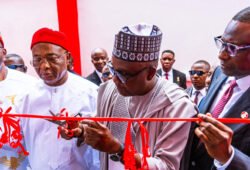
Nigeria now has a central digital repository for education records, the newly launched Digitalized Nigeria Education Management Information System (DNEMIS), though getting the full picture will depend on how many schools actually submit their data.
So far the numbers are partial. Of the country’s 213,235 schools, 124,548, about 58.4 percent, have reported in, capturing more than 40 million learners, nearly 1.2 million teachers, over 730,000 classrooms and more than 600,000 toilets nationwide. Public schools are close to fully represented, at around ninety percent, but private schools lag at roughly fifty percent, a gap Education Minister Dr Tunji Alausa is trying to close by reassuring private proprietors the exercise has nothing to do with taxation. Their inclusion matters statistically too, since nearly three quarters of Nigeria’s junior secondary schools are privately owned.
Alausa described the platform as providing real time information on schools, classrooms, teachers, learners and infrastructure such as water, sanitation and electricity, calling reliable data the backbone of any successful reform, information government can use to identify gaps, deploy teachers, track enrolment and target funding where it is needed most. He credited development partners, including the World Bank, the European Union, Norway and UNICEF, with helping resolve earlier delays in getting the system running, and said it will support ongoing reforms in literacy, digital learning and technical education. He called on state governments to intensify awareness campaigns to boost school participation.
The push for better data comes against a difficult backdrop: UNICEF estimates Nigeria has about 18.3 million out of school children, and the World Bank reports roughly seventy percent of Nigerian children cannot read and understand a simple age appropriate text by age ten. National Bureau of Statistics Director General Semiu Adeniran said his agency will link its own platform to DNEMIS, using household surveys and small area estimation techniques to map out of school children and cross check what the education database shows, creating what he called a single reliable source of education data for the country.